







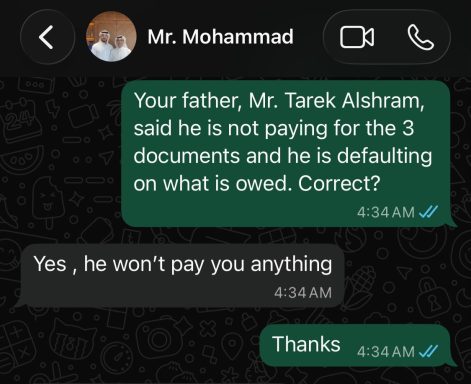
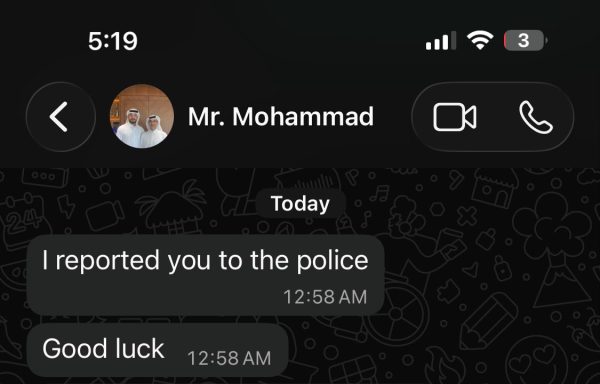





Mohammed Tarek Mohd Alshram has defaulted on the payment for these documents and has not paid the amounts owed for the following:
- Consolidated Shareholders' Agreement (July 31)
- Shareholders' Agreement (July 27)
- Technology License Agreement (July 27)
Despite the obligation to settle what is due, the payment remains outstanding and has not been made. In Islamic teachings, failing to fulfill financial obligations and leaving debts unpaid is regarded as a serious matter. Honesty in transactions, keeping one’s word, and settling what is owed are repeatedly emphasized as duties. Withholding payment that is rightfully due, or neglecting to clear a debt when one is able, is considered blameworthy and contrary to the principles of trustworthiness and justice that Islam requires in dealings between people. Such conduct is viewed as a violation of the rights of others and is treated as something to be avoided and corrected. Islamic sources stress that unresolved debts and unfulfilled agreements are matters for which a person remains accountable, and they urge believers to settle their obligations promptly and fairly. The three documents are available in plain text below too.
SHAREHOLDERS’ AGREEMENT among SYNCORA PAYMENT SERVICES PROVIDER L.L.C MOHAMMED TAREK MOHD ALSHRAM ALFALASI and SAOBEI TECHNOLOGY LIMITED Dated as of July 31, 2026
Shareholders’ Agreement This Shareholders' Agreement (this "Agreement"), dated as of July 31, 2026, is entered into among: Syncora Payment Services Provider L.L.C ("Syncora" or the "Company"), a corporation organized under the laws of Dubai, United Arab Emirates; Mohammed Tarek Mohd Alashram Alfalasi ("MAA"), an individual domiciled in Dubai, United Arab Emirates (the "Majority Shareholder"); Saobei Technology Limited ("Saobei"), a corporation organized under the laws of the People's Republic of China (the "Minority Shareholder" and, together with the Majority Shareholder, the "Initial Shareholders"); and any other Person who after the date hereof acquires Shares and becomes a party to this Agreement by executing a Joinder Agreement (collectively with the Initial Shareholders, the "Shareholders"). Recitals (A) The Parties have agreed to conduct an equity and operating partnership through Syncora, under which MAA will own eighty percent (80%) and Saobei will own twenty percent (20%) of the Company following Completion. (B) MAA has agreed to contribute a total cash commitment of US$8,000,000, and Saobei has agreed to contribute and deliver to the Company the complete latest available version of the technology solution agreed by the Parties and described in Schedule 2, together with all required Code and associated intellectual property rights, which the Parties value at US$2,000,000. (C) The Custom Solution, all Code delivered as part of it, and all customizations, updates, fixes and related work product created for Syncora will be owned entirely by Syncora and will not be provided to Syncora merely under a technology licence. (D) The Parties intend this Agreement to be the single agreement governing their shareholding, governance, funding, technology contribution, intellectual property ownership, code access, updates, support and territorial exclusivity. NOW, THEREFORE, in consideration of the mutual covenants and agreements set forth herein and for other good and valuable consideration, the receipt and sufficiency of which are hereby acknowledged, the Parties agree as follows: ARTICLE I DEFINITIONS 1.1 Defined Terms. In this Agreement: "Access Approval" means the prior written approval of all then-current Shareholders under Section 8.2 for a specifically identified person, access purpose, access level, code area and access duration. "Affiliate" means an entity that directly or indirectly Controls, is Controlled by, or is under common Control with a Person. "Applicable Law" means any law, regulation, regulatory requirement, court order or binding requirement applicable to a Party, the Company, the Business or the Custom Solution. "Board" means the contractual governance committee constituted under Article 4. The Board is not a statutory board of managers and no Board member is a manager of the Company solely by reason of Board membership, unless that person is separately appointed and registered as a manager in accordance with Applicable Law and the Company’s constitutional documents. "Business" means the payment services, merchant services, financial technology, catering technology and retail technology business conducted by the Company. "Business Day" means a day on which commercial banks are generally open for ordinary business in both Dubai and the place of Saobei's principal office. “Cash-Out” has the limited meaning given in Section 11.8 and does not include an ordinary Transfer of Shares under Sections 11.1 to 11.7A. "Code" means all Source Code, object code, scripts, configuration files, database code, build files, deployment files, APIs, interfaces, test materials and other software materials forming part of the Custom Solution. "Company Data" means all data supplied to, generated for, collected by or processed on behalf of the Company, its merchants, customers or users, excluding anonymous diagnostic information that does not identify the Company or any Person. "Completion" means completion of the matters stated in Section 2.4. "Completion Date" means the first Business Day after the Conditions Precedent have been satisfied or waived, or another date agreed in writing by all Parties. "Conditions Precedent" means the conditions in Section 2.3. "Control" means the direct or indirect power to direct the management or policies of a Person, whether through ownership, voting rights, contract or otherwise. "Covered Products and Services" means products or services that are identical or substantially similar in purpose and material functionality to the Custom Solution or the products and services delivered through it, whether implemented using the Custom Solution or separately developed technology. "Custom Solution" means the complete technology solution described in Schedule 2, including the latest stable production version agreed by the Parties, all existing and newly created Code and other materials delivered or required to build, deploy, operate, maintain, modify or commercialize that solution, and all Syncora-specific configurations, customizations, updates, fixes, documentation, architecture, designs, specifications, databases, schemas, APIs, workflows, deliverables and related work product, subject only to any Third-Party Component or pre-existing component expressly approved in accordance with Sections 7.6 and 7.7. "Debt-Free" has the meaning in Section 11.10. “Effective Date” means the date on which the last of the Company, MAA and Saobei signs this Agreement, regardless of any earlier date appearing on a cover page, recital, signature block or counterpart. "Encumbrance" means any mortgage, charge, pledge, security interest, lien, retention of title, option, restriction, licence, claim or other third-party right. "Exclusive Territories" means the United Arab Emirates, Oman, Qatar, the Kingdom of Saudi Arabia, Kuwait, Bahrain, Morocco, Libya, Egypt and South Africa. "Exclusivity Period" means the five-year period beginning on the Effective Date. "Fair and Minimal Cost" means a fair, reasonable and minimally necessary charge calculated from Saobei's actual reasonable direct cost of the requested work plus a reasonable margin, not exceeding the lowest rate charged by Saobei to an Affiliate or comparable customer for comparable work. “Fair Market Value” means the price that a willing, informed and unpressured buyer would pay a willing, informed and unpressured seller for the relevant Shares in an arm’s-length sale, taking into account all relevant characteristics of the Shares and the Company and determined in accordance with Section 11.4. "Final Acceptance" means the Company's written confirmation that the acceptance requirements in Schedule 3 have been satisfied. “Go-Live” means the first authorized production use of the Custom Solution by or on behalf of the Company to provide live services to a customer, merchant or user. “Initial Delivery” means Saobei’s complete deposit and delivery into the Company-controlled repository or environment designated for Completion of the exact solution and release or version identified in Schedule 2, paragraph 1A, together with every item required by Section 7.8 and Schedule 2. Before Completion, the deposited materials will be held subject to the Completion arrangements in Sections 2.3 to 2.5. "Initial Support Period" means the twelve-month period beginning on Initial Delivery. “Joinder Agreement” means an agreement under which a Person acquiring Shares agrees to become a party to and be bound by this Agreement as a Shareholder. “MAA Board Members” means the eight Board members appointed by MAA under Section 4.1. "Material Decision" means a proposed management or Board decision that is outside routine day-to-day administration or that MAA reasonably considers material to the Company's operations, funding, regulatory position, technology or financial condition. "Person" means an individual, company, partnership, governmental authority, trust, association or other legal or commercial entity. "Profitable" has the meaning in Section 11.9. “Saobei Board Members” means the two Board members appointed by Saobei under Section 4.1. "Shares" means the quotas or other equity interests in the Company. "Source Code" means the human-readable form of the Code, including all comments, repositories, version history, dependencies, build instructions and materials reasonably required to understand, compile, test, maintain, modify and deploy it. "Technology Contribution" means Saobei's creation, assignment, delivery and contribution to the Company of the Custom Solution and all associated intellectual property rights, valued by the Parties at US$2,000,000. "Third-Party Component" means software or other material owned by a Person other than the Company or Saobei, including open-source software. “Total Cash Commitment” means MAA’s aggregate cash commitment of US$8,000,000 under Section 3.3. "Transfer" means any direct or indirect sale, transfer, assignment, gift, disposal, pledge, charge, option or other disposition of legal or beneficial ownership of Shares. "Unanimous Shareholder Approval" means prior written approval signed by every then-current Shareholder, including MAA and Saobei for so long as each remains a Shareholder. “Valid Objection” means a written objection that identifies the relevant proposed decision and reasonably demonstrates that implementing the decision would: breach a specific provision of this Agreement; violate Applicable Law or a binding regulatory requirement; or create a material and objectively supportable regulatory, financial, operational, cybersecurity, data-protection or technology-security risk to the Company. A Valid Objection must include reasonable supporting particulars and must not be made primarily to delay implementation or obtain an unrelated commercial concession. 1.2 Interpretation. Unless the context requires otherwise: (a) a reference to an Article, Section or Schedule is to an Article, Section or Schedule of this Agreement; (b) the words "including" and "includes" do not limit the words that precede them; (c) the singular includes the plural and the plural includes the singular; (d) a reference to writing includes email and an electronic record capable of being retained and reproduced, except where this Agreement expressly requires a signature; (e) headings are for convenience and do not affect interpretation; and (f) if an obligation falls due on a day that is not a Business Day, it falls due on the next Business Day. ARTICLE II EQUITY PARTNERSHIP AND COMPLETION Section 2.1 Equity Partnership. The Parties will conduct their agreed commercial partnership through the Company and on the ownership, governance, funding and operating terms in this Agreement. This arrangement is an equity partnership and technology contribution, not merely a technology licence. Section 2.2 Single Agreement; Prior Drafts. This Agreement is the sole agreement governing the subject matter described in Recital (D). It supersedes the unsigned Shareholders' Agreement and unsigned Technology License Agreement dated July 27, 2026, all earlier drafts of those documents and all earlier inconsistent discussions or proposals. No separate technology agreement, licence agreement, partnership agreement or side letter is required or incorporated. Section 2.3 Conditions Precedent. Completion is conditional on the satisfaction or unanimous written waiver, to the extent legally capable of waiver, of each of the following: (a) MAA having paid or provided satisfactory evidence of payment of the registered capital contribution stated in Section 3.3 and Schedule 1; (b) Saobei having completed Initial Delivery, deposited all required materials in the Company-controlled repository or environment designated for Completion, delivered evidence reasonably demonstrating its chain of title to the Custom Solution and executed all intellectual property assignment instruments required under Article 7, with those instruments becoming effective at Completion; (c) Saobei having disclosed before signing every pre-existing, Saobei-owned, proprietary third-party and open-source component incorporated, or proposed as of the signing date to be incorporated, into the Custom Solution, and the Parties having approved before signing every such component and ownership exception in accordance with Sections 7.6 and 7.7 and Schedule 2; provided that any genuinely new component first proposed after signing must be disclosed and approved in accordance with Sections 7.6 and 7.7 before it is incorporated into the Custom Solution; (d) the Technology Contribution having been independently valued to the extent required by Applicable Law and the Parties having obtained all governmental, regulatory and corporate approvals required to implement the ownership, capital and governance arrangements in this Agreement; (e) if the Company is licensed, registered or applying to be licensed or registered as a Payment Service Provider or other regulated financial institution, all approvals, authorizations and no-objection confirmations required from the Central Bank of the United Arab Emirates having been obtained, including any prior approval required for Saobei to acquire or control 20% of the Shares or voting rights and any approval or authorization required for the appointment of the Company’s manager, Chief Executive Officer, Board members or other designated persons; (f) the Company’s constitutional documents, partners register and commercial registration documents having been prepared for amendment to reflect the ownership and capital structure stated in Sections 3.1 to 3.5 and Schedule 1 and the governance arrangements in Article 4; and (g) Saobei having obtained every approval, registration or clearance required in its jurisdiction for the development, export, disclosure, assignment and delivery of the Custom Solution and Source Code to the Company. Section 2.4 Completion. On the Completion Date, the following will occur simultaneously: (a) Saobei will confirm Initial Delivery and the intellectual property assignments executed under Section 2.3(b) will become unconditional and effective in favor of the Company; (b) MAA will pay the initial working capital tranche required under Section 3.3; (c) the Company and the Shareholders will complete and register the equity and capital steps stated in Sections 3.1 to 3.5 and Schedule 1 so that MAA is registered as the holder of 80% of the issued Shares and Saobei is registered as the holder of 20% of the issued Shares; (d) the Company will record the contributions in accordance with Sections 3.3 to 3.5, Schedule 1, the independent valuation and the accounting treatment accepted by the competent authority; and (e) the Board will be constituted in accordance with Article 4. Section 2.5 Longstop and Failure of Completion. The Parties will use all reasonable efforts to satisfy the Conditions Precedent within 180 days after the Effective Date. If a Condition remains unsatisfied solely because of governmental or regulatory processing outside the Parties’ reasonable control, that period will be extended by 90 days. After expiry of the applicable period, a Party that has not caused the failure may terminate the uncompleted obligations by written notice. If this Agreement is terminated under this Section before Completion, the intellectual property assignments intended to become effective at Completion will not take effect. The Company will cease using and will return or securely delete the deposited Custom Solution materials, except for one archival copy retained solely where required by Applicable Law. Saobei will remain bound by confidentiality, security and non-use obligations concerning all Company information and Company Data. Termination will not affect accrued rights, confidentiality, dispute resolution or any separate work product that the Company has paid for and that the Parties expressly agreed in writing would vest before Completion. Section 2.6 No Separate Legal Partnership. The commercial partnership described in this Agreement exists through the Company. Nothing creates a general partnership, agency or joint venture separate from the Company or authorizes one Shareholder to bind another except as expressly stated. ARTICLE III CAPITAL, OWNERSHIP AND CONTRIBUTION Section 3.1 Registered Capital. Immediately before Completion, the Company’s registered capital will be AED 1,500,000, divided into 80 equal Shares with a nominal value of AED 18,750 each, all of which will be held by MAA. At Completion, the Company’s registered capital will be increased by AED 375,000 to AED 1,875,000 through the issuance of 20 new Shares to Saobei, following which the Company’s registered capital will be divided into 100 equal Shares with a nominal value of AED 18,750 each. Each capital amount and issuance is subject to confirmation and registration by the competent authority. Section 3.2 Ownership. Immediately following Completion, MAA will own 80 Shares representing 80% of the issued Shares, and Saobei will own 20 Shares representing 20% of the issued Shares. Those ownership percentages may change only pursuant to an investment, issuance, dilution or capital restructuring approved under Section 6.5 or a Transfer completed in accordance with Article 11. Section 3.3 MAA Cash Contribution. MAA commits to contribute the Total Cash Commitment to the Company. The Total Cash Commitment includes: (a) AED 1,500,000 paid or to be paid as the registered capital represented by MAA’s 80 Shares; and (b) a separate initial working capital tranche of US$2,000,000 to be paid at Completion. The remaining balance of the Total Cash Commitment, after crediting the US dollar equivalent of the AED 1,500,000 registered capital contribution and the US$2,000,000 initial working capital tranche, will be contributed after Completion in tranches required under the Board-approved budget and business plan. Each approved budget and business plan will state the amount and required payment date of each tranche. For this purpose, the AED 1,500,000 contribution will be converted into its US dollar equivalent using the exchange rate recorded by the Company when the contribution is paid or credited. Amounts other than registered capital may be recorded as capital reserve or working capital and do not give MAA additional Shares. Section 3.4 Saobei Technology Contribution. Saobei’s contribution is the Technology Contribution, including the creation, assignment and delivery to the Company of complete ownership of the Custom Solution, subject only to the specific component exceptions expressly disclosed and approved in accordance with Sections 7.6 and 7.7. The Parties agree that the Technology Contribution has a total value of US$2,000,000 and constitutes the consideration for the issuance to Saobei of 20 new Shares representing 20% of the issued Shares immediately following Completion. Except solely in respect of an approved component under Sections 7.6 and 7.7, the Technology Contribution is not a right-to-use contribution and does not make the Company a licensee of Saobei. Section 3.5 Capital and Capital Reserve. AED 375,000 of the agreed value of the Technology Contribution will be credited as the registered capital represented by Saobei’s 20 Shares. The balance of the agreed value of the Technology Contribution will be recorded as share premium, capital reserve or another appropriate equity account using the exchange rate and accounting treatment confirmed by the Company’s auditor and the competent authority. Saobei will bear any valuation cost that Applicable Law requires to be borne by the contributor of the Technology Contribution. The Company will submit the valuation and other documents required to register the Technology Contribution and the issuance of the 20 new Shares. Section 3.6 No Automatic Adjustment. A difference between actual expenditure, valuation, operating results or later funding will not automatically change the 80/20 ownership structure. Any new equity, dilution or altered capital structure requires Section 6.5 approval. Section 3.7 Distributions. Subject to Article 11 and Applicable Law, dividends and other distributions declared by the Company will be paid pro rata according to the number of Shares registered in the name of each Shareholder on the applicable record date. Immediately following Completion, this will result in 80% being paid to MAA and 20% being paid to Saobei. No Shareholder has a preference over another in respect of distributions or residual assets solely because its contribution consists of cash, technology or another form of consideration. ARTICLE IV BOARD, MANAGEMENT AND CEO Section 4.1 Board Composition and Status. The Board will be a contractual governance committee consisting of ten Board members. MAA may appoint, remove and replace eight MAA Board Members, and Saobei may appoint, remove and replace two Saobei Board Members. This implements the agreed 80/20 Board representation. Board membership does not by itself appoint a person as a statutory manager, director or authorized signatory of the Company. Section 4.2 Appointments. MAA and Saobei will notify the Company in writing of their respective Board appointments and changes. A vacancy may be filled only by the Shareholder entitled to the relevant seat. No governmental or regulatory filing will be made for a Board member unless that person is separately appointed to a legally registered or regulated position. Section 4.3 Quorum and Voting. A quorum is six Board members, including at least five MAA Board Members and, at the first properly convened meeting, one Saobei Board Member. If a Saobei Board Member does not attend the first properly convened meeting, the meeting will be reconvened on at least five Business Days’ written notice and six Board members will constitute a quorum without a Saobei attendance requirement. Each Board member has one vote. Ordinary Board decisions are made by simple majority, except for matters expressly requiring Unanimous Shareholder Approval. Section 4.4 Board Procedure and Effect. The Company will give all Board members at least five Business Days’ written notice of a Board meeting, together with an agenda and reasonably available supporting materials. Board members may participate by secure electronic means. A written resolution signed by all Board members is effective as a Board resolution. Board decisions are contractually binding on the Parties and the Company to the fullest extent permitted by Applicable Law. The Company’s registered manager will implement each valid Board decision unless implementation would violate Applicable Law, a binding regulatory requirement or the Company’s constitutional documents. Section 4.5 Chief Executive Officer and Registered Manager. MAA will serve as the Company’s Chief Executive Officer and, subject to completion of the required corporate and regulatory appointment procedures, as the Company’s sole registered manager from the Effective Date. MAA will continue in those positions until he resigns or a replacement is appointed with Unanimous Shareholder Approval. No Shareholder may remove MAA or appoint a replacement Chief Executive Officer or manager unilaterally. The Parties will procure that MAA’s appointment, authority and signing powers are reflected in the Company’s constitutional documents and commercial registration records to the extent required by Applicable Law. Section 4.6 Chief Executive Officer and Manager Authority. Subject to Applicable Law, the Company’s constitutional documents, valid Board decisions and matters requiring Unanimous Shareholder Approval, MAA, acting as Chief Executive Officer and registered manager, has authority over the Company’s day-to-day operations, strategy execution, expenditure, staffing, commercial relationships, allocation of Company funding and selection of where and how the Company seeks or obtains funding. The Board, budget process, reporting requirements and objection process in Article 5 do not transfer statutory signing authority to a Board member who is not separately appointed and registered as an authorized person. Section 4.7 Future Chief Executive Officer or Manager. A future Chief Executive Officer or registered manager may be appointed, removed or replaced only with Unanimous Shareholder Approval and every governmental or regulatory approval required by Applicable Law. Any successor will have the authority stated in the applicable appointment decision, this Agreement and the Company’s constitutional documents. The Company will complete all corporate, commercial and regulatory filings required to give effect to the appointment, removal or replacement. Section 4.8 Other Officers. The Chief Executive Officer and registered manager may appoint and remove other officers and employees and determine their responsibilities and compensation within the approved budget and Applicable Law, except where a particular appointment or removal is reserved to the Board or Shareholders under this Agreement or the Company’s constitutional documents. Section 4.9 Express Joint Decisions. The following require Unanimous Shareholder Approval: (a) appointing, removing or replacing the Chief Executive Officer or registered manager; (b) admitting an investor, issuing Shares or convertible rights, diluting a Shareholder or changing the ownership, governance or capital structure under Article 6; (c) granting or expanding Code access under Article 8; (d) approving an outside buyer under Section 11.6; and (e) amending this Agreement or the Company’s constitutional documents in a manner that changes an agreed right or obligation under this Agreement. ARTICLE V INFORMATION AND OBJECTION PROCESS Section 5.1 Regular Information. The CEO will give Saobei regular written updates concerning all aspects of the Company's business and activities. At least monthly, the Company will provide a concise management update covering operations, financial performance, funding, significant contracts, staffing, regulatory matters, technology, litigation and other material developments. Section 5.2 Financial and Material Event Information. The Company will provide each Shareholder with quarterly management accounts, annual audited financial statements, the annual budget and business plan, and prompt notice of any event reasonably likely to have a material adverse effect on the Company, its licences, operations, Custom Solution or financial condition. Section 5.3 Saobei Objection. Before implementing a Material Decision, MAA will provide Saobei with sufficient written information to understand the decision and will state the intended implementation time, having regard to the urgency of the matter. Saobei may object by delivering a Valid Objection before that implementation time. A general disagreement, commercial preference, unsupported assertion, delay tactic or attempt to obtain an unrelated commercial concession is not a Valid Objection. Section 5.4 Effect of Objection. If Saobei provides a Valid Objection before implementation, MAA will temporarily suspend the challenged portion of the decision and the Parties will promptly discuss a compliant or risk-mitigated alternative. MAA may proceed with any portion that does not create the breach or material risk identified in the Valid Objection. If the Parties do not resolve the objection within 10 Business Days, or within a shorter period reasonably required by an urgent regulatory, security or operational matter, either Party may refer the objection to the dispute-resolution process in Section 15.2. If Saobei provides no Valid Objection before the stated implementation time, MAA may proceed. Saobei has no unrestricted veto over management or Board decisions. Section 5.5 Inspection. On reasonable notice, each Shareholder may inspect the Company's material accounting and corporate records during normal business hours, subject to confidentiality, data protection, privilege and reasonable security procedures. ARTICLE VI ADDITIONAL FUNDING AND NEW INVESTORS Section 6.1 Funding Need. If the Company requires funding beyond the Total Cash Commitment, the Chief Executive Officer will notify the Shareholders of the required amount, purpose and timing. MAA will decide where and how the funding is sought, subject to the sequence and approvals in this Article. Section 6.2 MAA First Opportunity. MAA has the first opportunity to provide the required amount as a shareholder loan to the Company. The funding notice will allow MAA a reasonable period, having regard to the Company’s funding need, to confirm whether he will provide the full required amount. Section 6.3 Shareholder Loan. Funding provided by MAA under Section 6.2 will be documented as a loan owed by the Company. It will not issue Shares, convert into Shares or otherwise change the ownership structure unless the conversion, issuance or change is subsequently approved under Section 6.5. Section 6.4 Investor Introduction. If MAA confirms that he will not provide the required loan, or does not confirm within the period stated in the funding notice, any Shareholder may identify and introduce a proposed investor. Section 6.5 Unanimous Investor Approval and Joinder. No investor may be admitted and no Shares, options, convertible instruments or other equity-linked rights may be issued unless Unanimous Shareholder Approval has first been obtained for the investor’s identity and all resulting funding, ownership, dilution, governance, Board, voting, distribution and capital-structure terms. Before receiving or being registered as the holder of any Shares or equity-linked rights, the investor must execute a Joinder Agreement and every amendment required to record the resulting governance and ownership structure. The Company will also obtain every governmental or regulatory approval required for the investment, including any applicable approval from the Central Bank of the United Arab Emirates. Section 6.6 No Unilateral Restructuring. Neither the Board, the Chief Executive Officer, the Company nor any Shareholder may implement an investment, conversion, dilution or new ownership structure by unilateral action. Any purported action contrary to Section 6.5 is void between the Parties to the fullest extent permitted by Applicable Law. Section 6.7 Non-Equity Funding. Subject to Sections 6.1 to 6.3, MAA may arrange non-equity funding that does not dilute any Shareholder, admit a new investor or change the Company’s ownership or governance structure, provided that the funding complies with Applicable Law and does not breach this Agreement. Unanimous Shareholder Approval is required only if the funding would trigger a matter expressly requiring Unanimous Shareholder Approval under this Agreement. ARTICLE VII CUSTOM SOLUTION AND INTELLECTUAL PROPERTY Section 7.1 Delivery of Technology Solution. Saobei will configure, test and deliver to Syncora the exact stable production solution and release or version identified in Schedule 2, paragraph 1A, including the complete solution required for Syncora to operate the Business. The minimum functional inventory and required deliverables are stated in Schedule 2. Saobei will allocate sufficient qualified personnel, complete the technology handover properly and cooperate with the Company’s project manager through Final Acceptance. New functionality requested after Initial Delivery is governed by Article 9. Section 7.2 Technology Contribution. The complete assignment, delivery and ownership transfer of the Custom Solution, subject only to the specific component exceptions expressly disclosed and approved under Sections 7.6 and 7.7, constitutes Saobei’s Technology Contribution for its 20% ownership. Saobei will not satisfy that contribution by supplying hosted access, object code only, a temporary permission, a revocable right or, except for an approved component under Sections 7.6 and 7.7, a licence to technology owned by Saobei. Section 7.3 Syncora Ownership. With effect from Completion, and except solely for a component expressly identified and approved before signing in accordance with Sections 7.6 and 7.7, the Company will exclusively and entirely own all Code delivered as part of, incorporated into or required to build, deploy, operate, maintain, modify or commercialize the Custom Solution, whether created before or after the Effective Date, together with all intellectual property rights in the Custom Solution and all work product created for the Company. The Company may possess, access, copy, host, modify, maintain, combine, commercialize, distribute, assign, sell and authorize others to use the Custom Solution worldwide without further consent from or payment to Saobei. An approved component does not reduce the Company’s ownership of the remainder of the Custom Solution or the Company’s rights to operate, maintain, modify and commercially exploit the complete Custom Solution. Section 7.4 Assignment. To the extent a right does not vest automatically in the Company, Saobei hereby irrevocably assigns, transfers and conveys to the Company all worldwide right, title and interest in the Custom Solution for the entire duration of those rights and all renewals, restorations and extensions. The assignment takes effect at Completion for all Custom Solution materials existing or delivered on or before Completion and immediately upon creation for all Custom Solution materials created after Completion. The assignment includes all economic rights, registrations, applications, rights to modify and create derivative works, rights to commercialize and authorize use, and rights to pursue and recover for infringement. Section 7.5 Future and Non-Assignable Rights. If a right cannot validly be assigned prospectively or at Completion, Saobei will hold that right exclusively for the Company’s benefit from the time the related assignment is intended to take effect and will execute the required confirmation immediately when assignment becomes legally possible. Saobei will obtain from every employee, contractor and contributor all assignments, waivers and consents required to give the Company the fullest ownership permitted by law, including non-assertion of moral rights to the extent permitted. Section 7.6 Pre-Existing and Saobei Components. Before this Agreement is signed, Saobei will identify in Schedule 2, paragraph 8, every pre-existing or Saobei-owned component incorporated, or proposed to be incorporated, into the Custom Solution. The disclosure must identify the component, its owner, its purpose, the reason for its inclusion, the applicable ownership treatment and all rights required by the Company. If there are no such components, Schedule 2, paragraph 8, must expressly state “None.” No pre-existing or Saobei-owned component may be retained by Saobei or excluded from Company ownership unless it is specifically disclosed in Schedule 2, paragraph 8, and the different treatment is expressly approved in this Agreement or in an amendment signed by all Parties before Completion. A component disclosed after signing will not be excluded from Company ownership unless every Party expressly approves the exception in a signed amendment. Any approved exception must grant the Company perpetual, irrevocable, worldwide, transferable, sublicensable and royalty-free rights sufficient to build, deploy, operate, maintain, modify and commercially exploit the complete Custom Solution. Section 7.7 Third-Party Components. Before this Agreement is signed, Saobei will identify in Schedule 2, paragraph 8, every proprietary and open-source Third-Party Component incorporated, or proposed to be incorporated, into the Custom Solution, together with its owner, version and all applicable licence and use terms. No Third-Party Component may be included unless Unanimous Shareholder Approval has been obtained before signing or, for a genuinely new component proposed after signing, before the component is incorporated. No approved component may prevent or materially restrict the Company from building, deploying, operating, maintaining, modifying or commercially exploiting the Custom Solution. Saobei will provide a complete and accurate software bill of materials and all notices, attribution materials and source materials required by the applicable terms. Section 7.8 Delivery. Initial Delivery will include, in a Company-controlled repository or other Company-controlled environment: (a) the complete Source Code and object code for every module; (b) full repository and version history, branches, tags and commit records; (c) build, compilation, deployment, migration, configuration and rollback scripts; (d) architecture, API, database, security, administrator, user and deployment documentation; (e) test plans, test cases, test data structures, defect records and release notes; (f) the software bill of materials and approved third-party notices; and (g) all credentials, keys and administrative materials that may lawfully be transferred, with credentials rotated into Company control where appropriate. Section 7.9 No Reversion. Section 7.9 No Reversion. The Company’s ownership is perpetual and is not affected by expiry of the Exclusivity Period, termination of support, breach, a Transfer, Saobei ceasing to be a Shareholder, a change of control of the Company or any other event. No Custom Solution right reverts to Saobei. Section 7.10 Company Data. The Company owns Company Data. Saobei may access Company Data only as authorized by the Company to perform this Agreement and must comply with Applicable Law and the Company's written security requirements. Saobei will not sell, independently exploit or use Company Data to compete with the Company. Section 7.11 Testing and Acceptance. The Company will conduct acceptance testing under Schedule 3. Final Acceptance confirms technical delivery but does not create or delay the Company's ownership, waive a latent defect, reduce Saobei's support obligations or limit a claim for breach of title, security or intellectual property warranty. Section 7.12 Saobei Technology Warranties. Saobei represents and warrants that: (a) it has and will maintain full authority to create, assign and deliver the Custom Solution; (b) the Custom Solution and its creation and intended use will not knowingly infringe a third party's intellectual property rights; (c) the Custom Solution will be free of Encumbrances, undisclosed Third-Party Components, malicious code, disabling devices, hidden administrator accounts and unauthorized access methods; (d) all persons involved in development are bound by written obligations sufficient to vest ownership in the Company; and (e) Saobei will not assert ownership of the Custom Solution or register any associated right in its own name except temporarily where legally required and solely for prompt transfer to the Company. ARTICLE VIII CODE ACCESS AND SECURITY Section 8.1 Access Restriction. No Person may access the Code, a code repository, build environment, development environment or release pipeline without Access Approval. Employment, directorship, share ownership, contractor status or prior access does not itself authorize access. Section 8.2 Approval Method. Access Approval must be recorded in writing and approved by every then-current Shareholder. This is a Unanimous Shareholder Approval matter and does not follow the 80/20 Board voting structure. The Access Approval must identify the approved person, employer, purpose, repository or code area, permission level, permitted actions, start date and expiry or review date. Approval may be signed electronically or recorded through written email confirmations retained in the Company’s Access Register. Section 8.3 Minimum Necessary Access. Each approved person will receive only the minimum access reasonably required for the approved work. Read-only, module-specific, branch-specific or environmentspecific access must be used where full access is unnecessary. Full repository or production access is prohibited unless the Access Approval expressly states it. Section 8.4 Additional Access. Access to a code area, repository, environment, permission or function outside the existing Access Approval requires a new Access Approval. No approved person may share credentials, copy Code outside an approved environment or enable access for another Person. Section 8.5 Access Register and Controls. The Company will maintain an Access Register and implement role-based access control, multi-factor authentication where available, individual credentials, logging, periodic review and prompt revocation when access is no longer required. Access logs will be available to every then-current Shareholder on reasonable request. Section 8.6 Saobei Personnel. Saobei personnel providing development or support may access Code only within their Access Approval and only to perform this Agreement. Saobei will ensure those personnel are individually bound by confidentiality, security and Company-ownership obligations no less protective than this Agreement. Section 8.7 Suspension. The Company may immediately suspend any access reasonably suspected of being compromised, misused or outside its approval. Suspension does not require prior notice, but the Company will promptly inform the Shareholders and investigate the issue. Section 8.8 No Rights from Access. Code access is an operational permission only. It does not give the approved Person or Saobei any ownership, commercialization right or other interest in the Custom Solution. ARTICLE IX UPDATES, HANDOVER, MAINTENANCE AND SUPPORT Section 9.1 Agreed Initial Version. At Initial Delivery, Saobei will provide and deploy, without additional charge, the exact stable production solution and release or version identified in Schedule 2, paragraph 1A, including all fixes, patches and improvements incorporated into that release as of the stated release date. The solution name, release date, release or version identifier and Initial Delivery date must be completed and approved by the Parties before this Agreement is signed. A change to any of those items is effective only if approved in writing by the Company, MAA and Saobei. Section 9.2 Requested Future Updates. After Initial Delivery, the Company may request an update, upgrade, new version, enhancement or additional function. If the request is not a defect correction, maintenance item or security remediation included in the Initial Support Period, Saobei may charge Fair and Minimal Cost whether the request is made during or after that period. Section 9.3 Update Process. Before beginning chargeable update work, Saobei will provide a written description, itemized estimate, assumptions and delivery estimate. Work begins only after written Company approval by the person authorized under the approved budget. An approved request is governed entirely by this Agreement and is not a separate technology or licence agreement. Section 9.4 Initial Support Period. The Initial Support Period begins on Initial Delivery and continues for twelve months. During the Initial Support Period, Saobei will provide, at no charge, the handover, knowledge transfer, maintenance, technical assistance, problem resolution, defect correction and support reasonably required for the Company to receive, deploy and operate the Custom Solution. Section 9.5 Free First-Year Services. The free services include reasonable training, documentation explanation, deployment assistance, diagnosis, bug fixes, error correction, security remediation, recovery assistance and cooperation with the Company's personnel and service providers. Saobei will not reclassify an included support or maintenance obligation as a paid update merely to impose a charge. Section 9.6 Assistance 24/7. The Company may request emergency and technical assistance twenty-four hours per day, seven days per week. Saobei will maintain a continuously available request channel and respond promptly according to the severity of the issue. Assistance requested during the Initial Support Period is free unless it is a separately requested enhancement under Section 9.2. Section 9.7 Support After First Year. After the Initial Support Period, Saobei will continue to make available, when requested by the Company, ongoing maintenance, technical assistance, problem resolution and updates. Continued 24/7 assistance will apply only if requested by the Company. The Company will pay only Fair and Minimal Cost for the requested work and any requested continued 24/7 assistance. Section 9.8 Pricing Protection. Every charge must be reasonable, itemized and based on work actually required and performed. Saobei will provide supporting cost information on request and may not charge an excessive or unreasonable amount. Saobei will not withhold necessary information, credentials or existing Company-owned Code to compel the Company to accept a proposed charge. Section 9.9 Ownership of Updates. Every update, fix, modification, enhancement, derivative work, document or other work product created for the Company under this Article forms part of the Custom Solution and is owned by the Company under Article 7, including where the Company pays for the work. Section 9.10 Other Maintainers. The Company may maintain or appoint another Person to maintain the Custom Solution. Saobei will provide reasonable transition and technical cooperation and will not obstruct another maintainer's authorized access. ARTICLE X EXCLUSIVE TERRITORY RIGHTS Section 10.1 Exclusive Territories. For the Exclusivity Period, Saobei grants the Company exclusive commercial rights in the United Arab Emirates, Oman, Qatar, the Kingdom of Saudi Arabia, Kuwait, Bahrain, Morocco, Libya, Egypt and South Africa. The purpose is to allow the Company to establish its business and operations. Section 10.2 Duration. The Exclusivity Period begins on the Effective Date and continues for five years. It is not shortened by Initial Delivery, Go-Live, Final Acceptance, a change in support arrangements or a Share Transfer. Section 10.3 Saobei Restrictions. During the Exclusivity Period, Saobei will not, directly or indirectly, in an Exclusive Territory: (a) market, advertise or promote Covered Products and Services; (b) license, sell, resell or distribute Covered Products and Services; (c) maintain, support or provide services relating to Covered Products and Services; or (d) otherwise provide or conduct business involving Covered Products and Services, except through the Company or with the Company's prior written consent. Section 10.4 Automatic End of Initial Exclusivity. On expiry of the Exclusivity Period, the initial exclusivity automatically ends. Thereafter, the Company and Saobei may establish operations, market, license, sell, maintain, support and otherwise conduct business in any country without notifying or obtaining approval from the other, subject to Sections 10.5 to 10.7. Section 10.5 Established Territory Protection. If, during the Exclusivity Period, the Company establishes a company or active commercial operations in an Exclusive Territory, Saobei will not, after expiry of the Exclusivity Period, market, license, sell, maintain, support, provide services relating to or otherwise conduct business involving Covered Products and Services in that country without the Company’s prior written approval. For purposes of this Section, the establishment of a company means the incorporation or registration of an entity intended in good faith to conduct the Business in that country. “Active commercial operations” means bona fide commercial activity demonstrated by objective contemporaneous records, including executed customer, merchant or partner contracts, live deployments or services, invoices or revenue, dedicated personnel, business premises or equivalent evidence. Protection arising under this Section is not conditional on the Company continuously maintaining the original form or level of operations after the Exclusivity Period. Section 10.6 Renewed Exclusivity. After expiry of the Exclusivity Period, the Company may request renewed or continued exclusivity in any country by written notice to Saobei. Saobei will not unreasonably withhold or refuse approval. A refusal is permitted only for a genuine and documented commercial reason, including an existing customer, partner, contractual commitment, maintenance obligation, established business operation or documented future business plan in that country. Saobei may not refuse solely to obtain additional consideration or renegotiate unrelated commercial terms. Saobei must state the reason for any refusal in writing. Until renewal is granted in writing, the Company and Saobei remain free to operate non-exclusively, subject to Section 10.5. Section 10.7 Ownership Preserved. Nothing in this Article gives Saobei any ownership or right to use the Custom Solution or Company-owned Code. Saobei's permitted post-expiry activities may use only technology that it independently owns and that does not contain, copy, derive from or infringe the Custom Solution. ARTICLE XI SHARE TRANSFERS AND CASH-OUT Section 11.1 Own Shares Only. A Shareholder may Transfer only Shares that it owns. MAA has no authority to sell, dispose of or encumber Saobei's Shares, and Saobei has no authority to sell, dispose of or encumber MAA's Shares. Section 11.2 Right to Exit. A Shareholder may decide to sell all or part of its own Shares whenever it wishes to exit, subject to the first-option, matching, buyer-approval and governance procedures in this Article. There is no lock-up period. Section 11.3 Transfer Notice. Before a proposed Transfer, the selling Shareholder will give the Company and every other Shareholder a written notice stating the number of Shares proposed to be Transferred, the proposed price, all material terms, the identity of the proposed buyer and, where applicable, a complete copy of the genuine written outside offer. The Shareholders other than the selling Shareholder are referred to in Sections 11.3 to 11.7A as the “Non-Selling Shareholders.” The Company’s registered manager will promptly provide every notification required by Applicable Law. Section 11.4 First Option Without Outside Offer. If there is no genuine outside offer, the Non-Selling Shareholders have the first option to purchase all of the offered Shares at Fair Market Value. A NonSelling Shareholder must exercise the option by written notice within 20 Business Days after receiving the complete Transfer Notice. Unless the exercising Non-Selling Shareholders agree otherwise, the offered Shares will be allocated among them in proportion to the number of Shares each then holds. The selling Shareholder and the exercising Non-Selling Shareholders will seek to agree the Fair Market Value within 10 Business Days after expiry of the exercise period. If they do not agree, the Fair Market Value will be determined by an independent qualified valuer jointly appointed within a further 10 Business Days, acting as expert and not as arbitrator. If they do not agree on the valuer within that period, any affected Shareholder may apply to a competent Dubai court for appointment of the valuer. The purchase must be completed within 30 Business Days after the Fair Market Value is agreed or determined. If no Non-Selling Shareholder exercises the option within the exercise period, or if the exercising Non-Selling Shareholders fail to complete the purchase within the required period for reasons not caused by the selling Shareholder, the selling Shareholder may seek an outside buyer, subject to Sections 11.5 to 11.7A. Section 11.5 Matching Right. If there is a genuine outside offer, the Non-Selling Shareholders have the first right to purchase all of the offered Shares by matching the offered price and material terms. Unless the exercising Non-Selling Shareholders agree otherwise, the offered Shares will be allocated among them in proportion to the number of Shares each then holds. The matching right may be exercised by written notice within 30 days after the Company’s registered manager and the Non-Selling Shareholders receive the complete Transfer Notice, or within any longer period required by Applicable Law. The matched purchase must be completed within 30 Business Days after valid exercise unless the outside offer provides a later completion date. Section 11.6 Outside Buyer Approval. If the Non-Selling Shareholders do not exercise their purchase rights in respect of all of the offered Shares, the proposed outside buyer must be approved under this Section before the Transfer. Approval may not be withheld arbitrarily or solely to prevent the selling Shareholder from completing a bona fide Transfer. A valid reason for rejection includes that the buyer conducts a principal or material business that competes with the Company or Covered Products and Services, has been convicted of or is credibly connected with serious criminal or fraudulent activity, is subject to material sanctions or regulatory restrictions, lacks required regulatory or financial standing, or presents a similarly serious and documented legal, regulatory or reputational concern. Each Non-Selling Shareholder must respond within 10 Business Days after receiving complete buyer information by providing written approval or a reasoned written rejection. A Non-Selling Shareholder that does not respond within that period will be deemed to have approved the proposed buyer. A rejection that does not state a valid reason with reasonable supporting particulars is ineffective. Section 11.7 Outside Sale. An approved outside sale must be completed within 120 days after expiry of the applicable matching and buyer-approval periods and on terms no more favourable to the buyer than those disclosed in the Transfer Notice. If the sale is not completed within that period or the terms become more favourable to the buyer, a new Transfer Notice and approval process are required. Before the Transfer is completed or registered, the selling Shareholder and the buyer must execute every formal transfer instrument required by Applicable Law, duly attested or notarized to the extent required by Applicable Law. The buyer must also execute a Joinder Agreement and provide all identification, regulatory and compliance information reasonably required by the Company, the competent authority and any applicable regulator. No Transfer is effective against the Company or third parties until it has been recorded in the Company’s partners register and the applicable commercial register in accordance with Applicable Law. Section 11.7A Governance Following a Transfer. Before a Transfer is completed, the selling Shareholder, the Non-Selling Shareholders, the Company and the buyer will execute an amendment recording the resulting ownership percentages, Board appointment rights, voting rights, distribution rights, approval rights and management arrangements. Approval of a buyer under Section 11.6 includes an obligation to approve an amendment that accurately gives effect to the disclosed and approved Transfer and does not introduce an unrelated commercial change. Economic rights attached to Transferred Shares pass to the buyer upon registration of the Transfer. A personal right expressly granted by this Agreement to MAA or Saobei does not transfer to a buyer unless the amendment expressly provides otherwise. If MAA or Saobei ceases to hold any Shares, its future Board appointment, consent and approval rights as a Shareholder will cease, except for accrued rights and provisions that expressly survive cessation of Share ownership. A partial Transfer will not change founder-specific governance rights unless the required amendment expressly provides otherwise. Section 11.8 Cash-Out Defined. For this Agreement, Cash-Out means a Company-funded dividend or other lawful distribution of available profits to the Shareholders. It does not mean an ordinary third-party sale of Shares, a unilateral withdrawal of capital or a right to require the Company or another Shareholder to purchase Shares. Section 11.9 Profitable. The Company is Profitable only when its most recent audited annual financial statements show positive net profit after tax, no accumulated losses and positive retained earnings after all legally required provisions and reserves. Section 11.10 Debt-Free. The Company is Debt-Free only when it has no outstanding bank, shareholder or third-party borrowing, convertible debt, overdue tax, overdue trade payable, unsatisfied judgment, called guarantee or other overdue financial indebtedness. Ordinary-course trade liabilities that are not overdue do not prevent Debt-Free status. Section 11.11 Cash-Out Rights. Once the Company is both Profitable and Debt-Free, a Shareholder may request a Cash-Out. The Company and the Shareholders will consider and process the request promptly and may not unreasonably withhold or delay a lawful Cash-Out where amounts are legally available for distribution after preserving legally required reserves and the Company’s ability to meet its operating, regulatory and working-capital requirements. Every Cash-Out will be paid pro rata according to the number of Shares registered in the name of each Shareholder on the applicable record date. Immediately following Completion, this will result in 80% being paid to MAA and 20% being paid to Saobei. No Shareholder may cash out, redeem, sell or receive payment for another Shareholder’s economic interest or receive more than the amount attributable to its own Shares. ARTICLE XII CONFIDENTIALITY AND COMPANY INFORMATION Section 12.1 Confidential Information. Each Party will keep confidential all non-public information concerning the Company, the Business, the Custom Solution, Code, Company Data, finances, customers, merchants, strategy and the terms of this Agreement. Section 12.2 Permitted Use. Confidential Information may be used only to perform this Agreement, exercise a right under it or operate the Business. Disclosure is permitted only to approved personnel and professional advisers who need the information and are bound by equivalent confidentiality obligations. Section 12.3 Required Disclosure. A Party may disclose information where legally required, provided it gives prompt notice where permitted, discloses only what is required and reasonably cooperates with protective measures. Section 12.4 Security and Incidents. Each Party will use reasonable administrative, technical and physical safeguards. Saobei will notify the Company promptly, and in any event within 24 hours, after discovering unauthorized access to Code or Company Data and will cooperate fully in containment, investigation and remediation. Section 12.5 Duration. Confidentiality continues for five years after a Party ceases to be bound by this Agreement, except that obligations concerning Source Code, trade secrets, credentials and Company Data continue for so long as the information remains confidential or protected by Applicable Law. ARTICLE XIII REPRESENTATIONS AND WARRANTIES Section 13.1 Mutual Warranties. Each Party represents and warrants that: (a) it has capacity and authority to enter into and perform this Agreement; (b) this Agreement constitutes its binding obligation, subject to generally applicable enforcement principles; (c) its execution and performance do not breach its constitutional documents or a binding obligation; and (d) it will obtain and maintain the approvals for which it is responsible. Section 13.2 MAA Warranty. MAA represents that, immediately before Completion, he will be the sole registered Shareholder of the Company and the sole legal and beneficial holder of all issued Shares, free of Encumbrances, and that he has authority to implement the 80/20 ownership structure, subject to the required corporate, governmental and regulatory approvals. Section 13.3 Saobei Title and Delivery. Saobei repeats the warranties in Section 7.12 on the Effective Date, on Initial Delivery, on Completion and whenever it delivers an update or other work product. Saobei will promptly disclose any matter that makes a warranty inaccurate. Section 13.4 Compliance. Each Party will comply with Applicable Law in performing this Agreement. The Company is responsible for its payment-services licences and operational regulatory compliance. Saobei is responsible for lawful development, export, transfer, security and technical performance of its obligations. ARTICLE XIV BREACH AND REMEDIES Section 14.1 Notice and Cure. Except for an urgent breach concerning ownership, confidentiality, Code access, security, buyer approval or unauthorized dilution, a Party claiming material breach will give written particulars and a reasonable opportunity, not exceeding 30 days, to cure where cure is possible. Section 14.2 Specific Performance. The Parties acknowledge that damages may be inadequate for breach of an ownership, Source Code delivery, access, confidentiality, exclusivity, share-transfer or investor-approval obligation. The affected Party or the Company may seek specific performance, injunctive or conservatory relief in addition to other remedies. Section 14.3 Intellectual Property Indemnity. Saobei will defend and indemnify the Company and MAA against third-party claims, losses and reasonable costs arising from a breach of Saobei's title, authority, non-infringement or Third-Party Component warranties, except to the extent caused by an unauthorized Company modification after delivery. Section 14.4 Remediation. If a delivered item infringes or is reasonably alleged to infringe a third-party right, Saobei will promptly secure the Company's continued ownership and use, replace or modify the item without material loss of functionality, or reimburse the reasonable replacement and remediation cost, without taking ownership away from the Company. Section 14.5 No Technology Termination. No breach, dispute, Transfer or termination of an obligation under this Agreement terminates, suspends or converts the Company’s ownership of the Custom Solution. Saobei may not disable, repossess or restrict Company-owned Code. Section 14.6 Cumulative Remedies. Except where this Agreement expressly states otherwise, rights and remedies are cumulative and do not exclude rights available under Applicable Law. ARTICLE XV GENERAL PROVISIONS Section 15.1 Governing Law. This Agreement and non-contractual obligations arising from it are governed by the laws of the United Arab Emirates and, to the extent applicable, the laws of the Emirate of Dubai. Section 15.2 Dispute Resolution. Any dispute arising out of or in connection with this Agreement, including any question regarding its existence, validity, interpretation, performance, breach or termination, will be referred to and finally resolved by arbitration under the Arbitration Rules of the Dubai International Arbitration Centre, which Rules are deemed incorporated by reference into this Section. The tribunal will consist of three arbitrators. The seat of arbitration will be Dubai, United Arab Emirates. The language of the arbitration will be English. Nothing in this Section prevents a Party from seeking urgent interim, conservatory or protective relief from a competent court or, where available, an emergency arbitrator. Section 15.3 Notices. A notice must be in writing and delivered by hand, reputable international courier or email capable of producing delivery confirmation. Notices to MAA and the Company will be sent to Office 9-258, Al Khabeesi, Dubai, United Arab Emirates, P.O. Box 258, Dubai. Notices to Saobei will be sent to Room 102, 1st Floor, The Cloud, 111 Tung Chau Street, Tai Kok Tsui, Kowloon, Hong Kong SAR, China. An email notice must be sent to an email address that the recipient has notified in writing for notices. A Party may change its notice details by written notice. Section 15.4 Amendment and Waiver. An amendment is effective only if written and signed by the Company and all Shareholders. A waiver is effective only if written and signed by the waiving Party and applies only to the identified circumstance. Section 15.5 Assignment and Joinder. No Party may assign this Agreement except in connection with a Transfer permitted by Article 11 and after the transferee executes a Joinder Agreement. No Person may receive newly issued Shares, options, convertible instruments or other equity-linked rights under Article 6 unless that Person first executes a Joinder Agreement. Saobei may not assign or transfer its development, ownership-transfer, delivery, support or exclusivity obligations without the prior written approval of the Company and MAA and remains fully responsible for the acts, omissions and performance of every approved subcontractor. Section 15.6 Constitutional Documents. The Parties will procure that the Company's memorandum, register and other constitutional documents reflect this Agreement to the fullest extent permitted by Applicable Law. Between the Parties, this Agreement prevails over an inconsistent constitutional provision, and they will promptly correct the inconsistency. Section 15.7 Entire Agreement. This Agreement and its Schedules constitute the entire agreement concerning their subject matter. They supersede the documents and discussions identified in Section 2.2. A demonstration, email, proposal or oral statement does not change this Agreement unless incorporated by an amendment complying with Section 15.4. Section 15.8 Costs. Each Party bears its own negotiation and advisory costs. The Company bears the governmental, notarization and registration costs required to implement Completion, except that Saobei will bear any valuation cost that Applicable Law requires to be borne by the contributor of the Technology Contribution. A selling Shareholder bears its own costs arising from a Transfer. Section 15.9 Further Assurance. Each Party will sign and deliver additional confirmatory instruments and take reasonable actions required to perfect the Company's ownership, complete corporate registrations or implement a binding obligation in this Agreement. A confirmatory instrument may not introduce a new commercial term. Section 15.10 Severability. If a provision is invalid or unenforceable, it will be modified only to the minimum extent required to make it valid while preserving the agreed commercial result. The remaining provisions continue in effect. Section 15.11 No Implied Waiver. Delay or failure to exercise a right is not a waiver. A partial exercise does not prevent another exercise. Section 15.12 Counterparts and Electronic Signatures. This Agreement may be signed in counterparts and by electronic signature. All counterparts form one instrument. Section 15.13 English Language. The controlling language of this Agreement and all notices, technical documents and confirmations is English. Section 15.14 Survival. Provisions concerning Company ownership, Code access, confidentiality, Company Data, accrued payment rights, warranties, remedies and dispute resolution survive for the period necessary to give them effect. SCHEDULE 1 COMPANY, CAPITAL AND CONTRIBUTIONS 1. Company and Ownership. Syncora Payment Services Provider L.L.C is a Dubai limited liability company with commercial licence number 1563080. Immediately before Completion, MAA will own 80 issued Shares, representing 100% of the issued Shares at that time. At Completion, the Company will issue 20 new Shares to Saobei Technology Limited. Immediately following Completion, MAA will own 80 Shares, representing 80% of the 100 issued Shares, and Saobei Technology Limited will own 20 Shares, representing 20% of the 100 issued Shares. 2. Registered Capital. Immediately before Completion, the Company’s registered capital will be AED 1,500,000, divided into 80 equal Shares with a nominal value of AED 18,750 each. At Completion, the registered capital will be increased by AED 375,000 through the issuance of 20 new Shares to Saobei. Immediately following Completion, the Company’s registered capital will be AED 1,875,000, divided into 100 equal Shares with a nominal value of AED 18,750 each. 3. MAA Funding. 3. MAA Funding. MAA’s Total Cash Commitment includes AED 1,500,000 paid or to be paid as the registered capital represented by MAA’s 80 Shares and a separate initial working capital tranche of US$2,000,000 to be paid at Completion. The remaining balance of the Total Cash Commitment, after crediting those amounts in accordance with Section 3.3, will be provided in postCompletion tranches under Section 3.3. 4. Saobei Contribution. Saobei will create, assign and deliver to the Company the Company-owned Custom Solution as the Technology Contribution. The Parties agree that the Technology Contribution has a total value of US$2,000,000. AED 375,000 of that value will be credited as the registered capital represented by Saobei’s 20 Shares, and the balance will be recorded as share premium, capital reserve or another appropriate equity account in accordance with Section 3.5. SCHEDULE 2 CUSTOM SOLUTION INVENTORY AND DELIVERABLES 1. Overview. Saobei will deliver and configure for Syncora the exact stable production solution and release or version identified in paragraph 1A, consisting of an Aggregated Payment System and a Catering and Retail POS System. The following inventory describes the minimum included functionality and does not limit any item reasonably necessary for the listed functions to operate together as a complete production solution. 1A. Agreed Initial Version and Delivery Date. Before Initial Delivery, the Parties will complete and approve in writing the solution name, release date, release or version identifier and Initial Delivery date. The approved information will be recorded in this Schedule or in another written record signed or approved by the Company and Saobei and retained with this Agreement. 2. Aggregated Payment System. The Aggregated Payment System includes the following modules and minimum functions: the Admin Dashboard, covering account and unified-login administration, account lifecycle, menus and permissions, order inquiries, order details, refunds, settlements, terminals, merchants, stores, and notifications; the Channel Administration Console, covering order and settlement data, terminals, merchants, stores, partners, downloads, profit-sharing, rebates, and notification details; the Merchant Dashboard, covering payment-gateway administration, finance, statistics, orders, settlements, terminals, stores, reconciliation, transaction summaries, rankings, activation data, and daily profit-sharing reports; the Business Development Application, covering accounts, notifications, orders, profit-sharing, device inventory, partners, merchants, business data, terminals, and funds accounts; the Merchant Application, covering accounts, notifications, orders, funds accounts, and merchant information; the Clearing Backend, covering same-day payment confirmation, payment outcomes, manual retries, notifications, historical transfers, refunds, funds accounts, and operational logs; the Settlement Core Services, covering merchant balances, callback mapping, merchant settlement, reconciliation statements, settlement review, refund verification, configurable D+1, D+7, D+30, and D+N cycles, result polling, and bank-integration capability; the Revenue Sharing Backend, covering clearing, reconciliation, settlement payments, payment capability, accounts, revenue-sharing records and relationships, freezes, statements, manual sharing, and data management; and the Open API Layer, covering transaction review, payments, inquiries, refunds, notifications, audit records, approvals, MQTT initialization, accounts, channel integrations, revenue sharing, split refunds, withdrawals, and reconciliation statements. 3. Catering and Retail POS System. The Catering and Retail POS System includes the following modules and minimum functions: the Food and Beverage Merchant App, covering login, home page, store and menu management, orders, group buying, platform delivery, inventory availability, members, mini program, analytics, notifications, and promotions; the Food and Beverage POS Register, covering activation, direct and table ordering, discounts, payment and checkout, printing, notifications, number calling, orders, menus, shift handover, statistics, members, and POS and hardware configuration; the Food and Beverage Mini Program, covering the home page, user centre, store ordering, member registration, and member centre; the Food and Beverage Admin Backend, covering login, the home page, and member marketing; the Retail POS Register, covering online and offline login, payment and checkout, barcode scanning, cart management, order suspension and retrieval, AI product recognition, members, split tender, returns, products, inventory, shifts, and configuration; the Retail Handheld POS, covering login, checkout, temporary items, suspended orders, quick checkout, orders, returns, refunds, products, categories, and inventory; the Retail Mobile App, covering login, the home page, stores, products, inventory, the data centre, orders, payment, and reconciliation; the Retail Cashier Admin Backend, covering business overview, product analytics, store products, member and employee management, and configuration; the Retail E-Commerce Store, covering the mini-program home page, account centre, store home page, categories, cart, and order management; and the Retail Partner POS Backend, covering agency, store, and terminal management, activation codes, downloads, and partner operations. 4. Required Code and Development Materials. Initial Delivery includes all items listed in Section 7.8 and, at minimum, complete Source Code and object code; requirements, functional specifications and architecture materials; database schemas and API documentation; deployment, configuration, administrator and user guides; test cases, release notes and unresolved-defect records; and all materials reasonably required for an independent qualified team to build, deploy, maintain and modify the Custom Solution. 5. Included Technical Services. Saobei will provide installation and private-cloud deployment, system configuration, test-environment setup, user-acceptance support, production Go-Live support and knowledge transfer. 6. Third-Party Integrations. Subject to Company selection, credentials and provider cooperation, the Custom Solution will include integration capability for payment gateways, KYC providers, SMS providers and email providers. 7. Infrastructure Responsibilities. The Company will provide a Company-controlled hosting environment, infrastructure and credentials reasonably required for deployment. Saobei will provide application deployment, configuration, scripts, initialization and deployment verification. 8. Third-Party and Pre-Existing Components. No proprietary Third-Party Component is approved as part of the Technology Contribution unless subsequently disclosed and approved in accordance with Section 7.7. Every open-source component must be disclosed in the software bill of materials, together with its applicable licence terms, and must not prevent the Company from owning the proprietary portions of the Code or from operating, maintaining, modifying and commercially exploiting the Custom Solution. Saobei will disclose in good faith, as soon as reasonably practicable after identification and in any event before Final Acceptance, every pre-existing or Saobei-owned component incorporated, or proposed to be incorporated, into the Technology Contribution. Any different treatment is effective only if it complies with Section 7.6 and is expressly approved in a signed amendment by MAA and all other Parties. SCHEDULE 3 DELIVERY, ACCEPTANCE, ACCESS AND SUPPORT PROCEDURES 1. Project Coordination. Each Party will designate a project lead. The leads will maintain a written implementation plan covering milestones, dependencies, testing, environments, contacts and target dates. The plan implements this Agreement and may not alter ownership, contributions, support pricing, governance or exclusivity. 2. Initial Delivery Review. Within a reasonable review period after Initial Delivery, the Company will test whether the delivered build: (a) contains the Schedule 2 modules and required deliverables; (b) can be built from the delivered Source Code using the delivered instructions; (c) can be deployed in the agreed Company-controlled environment; (d) performs core transaction, settlement, refund, revenue-sharing and POS workflows; (e) contains no unresolved defect that prevents safe production use of a core function; and (f) satisfies the ownership, access and Third-Party Component requirements in Articles 7 and 8. 3. Defects. The Company will identify reproducible defects with reasonable detail. Saobei will promptly correct defects attributable to its work and provide a revised build. Requests for new functionality not required by Schedule 2 are governed by Section 9.2. 4. Final Acceptance. The Company will issue Final Acceptance after successful testing, deployment readiness and delivery of all required materials. Operational use does not by itself waive an unresolved notified defect or title, security or ownership requirement. 5. Access Approval Record. Each Access Approval maintained in the Access Register will record: Person: full name, employer and role; Purpose: specific approved work; Scope: repository, branch, module, environment or code area; Permission: read-only, contribute, merge, deploy, administer or another stated level; Duration: start date and expiry or review date; Approvals: written approval of every then-current Shareholder; and Closure: revocation date and confirmation that credentials were disabled. 6. First-Year Support Scope. During the Initial Support Period, Saobei will provide free handover, knowledge transfer, maintenance, technical assistance, defect correction, security remediation, problem resolution and deployment assistance, together with 24/7 request availability under Section 9.6. 7. Post-First-Year Requests. After the Initial Support Period, each request will identify the issue or requested work. Saobei will provide an itemized Fair and Minimal Cost estimate before chargeable work begins, except where emergency work is required to prevent material loss and the Company authorizes immediate action. 8. Support Records. Saobei will maintain reasonable records of support requests, actions, time spent, resolutions and chargeable costs and provide them to the Company on request. [SIGNATURE PAGE FOLLOWS] IN WITNESS WHEREOF, each of Syncora, MAA and Saobei has executed this Agreement on the date stated below. This Agreement becomes effective on the Effective Date, being the date on which the last of Syncora, MAA and Saobei executes this Agreement. SYNCORA PAYMENT SERVICES PROVIDER L.L.C Authorised Representative: ___________________________ Title: ___________________________ Signature: ___________________________ Date: ___________________________ MOHAMMED TAREK MOHD ALASHRAM ALFALASI Signature: ___________________________ Date: ___________________________ SAOBEI TECHNOLOGY LIMITED Authorised Representative: ___________________________ Title: ___________________________ Signature: ___________________________ Date: ___________________________
SHAREHOLDERS' AGREEMENT between SYNCORA PAYMENT SERVICES PROVIDER L.L.C and SAOBEI TECHNOLOGY LIMITED dated as of July 27, 2026.
SHAREHOLDERS' AGREEMENT between SYNCORA PAYMENT SERVICES PROVIDER L.L.C and SAOBEI TECHNOLOGY LIMITED dated as of July 27, 2026. Shareholders' Agreement This Shareholders' Agreement (this "Agreement"), dated as of July 27, 2026, is entered into among: Syncora Payment Services Provider L.L.C ("Syncora" or the "Company"), a corporation organized under the laws of Dubai, United Arab Emirates; Mohammed Tarek Mohd Alashram Alfalasi ("MAA"), an individual domiciled in Dubai, United Arab Emirates (the "Majority Shareholder"); Saobei Technology Limited ("Saobei"), a corporation organized under the laws of the People's Republic of China (the "Minority Shareholder" and, together with the Majority Shareholder, the "Initial Shareholders"); and any other Person who after the date hereof acquires Shares and becomes a party to this Agreement by executing a Joinder Agreement (collectively with the Initial Shareholders, the "Shareholders"). Recitals WHEREAS, the Majority Shareholder and the Minority Shareholder have formed the Company for the purpose of operating the Business; WHEREAS, as of the date hereof, the Majority Shareholder owns 100% of the issued and outstanding Shares, and upon Completion the Majority Shareholder will own 80% and the Minority Shareholder will own 20% of the issued and outstanding Shares, in accordance with Article II and Schedule 1; and WHEREAS, the Initial Shareholders and any other Shareholders parties hereto from time to time deem it in the best interests of all Shareholders and the Company to set forth in this Agreement their respective rights and obligations in connection with their investment in the Company. NOW, THEREFORE, in consideration of the mutual covenants and agreements hereinafter set forth and for other good and valuable consideration, the receipt and sufficiency of which are hereby acknowledged, the parties hereto agree as follows: ARTICLE I DEFINITIONS "Affiliate" means any entity that directly or indirectly Controls, is Controlled by, or is under common Control with a party. "Applicable Law" means all laws, statutes, regulations, orders, and codes of practice applicable to a Party and/or the Company under this Agreement, including the laws of the UAE and, where relevant, the laws of a Party's jurisdiction of incorporation. "Business" means the payment services and related financial technology business operated or proposed to be operated by the Company within the Territory, including any expanded or ancillary activities approved by the Board in accordance with this Agreement. "Business Day" means any day other than a Friday, Saturday, or public holiday in the UAE or, where relevant to Saobei, in the Hong Kong SAR. Where a deadline falls on a day that is a Business Day in one jurisdiction but not the other, the deadline shall be extended to the next day that is a Business Day in both jurisdictions. “Buy-Sell Mechanism” means the deadlock resolution mechanism in Section 3.06(c)(ii), under which one Party offers, at a price it specifies, either to buy the other Party’s Shares or to sell its own Shares to that Party, and the receiving Party elects which option to accept. “Competitor” means, in respect of a Party, any Person (together with its Affiliates) that carries on, or that owns or Controls a business that carries on, a business that is the same as, or substantially similar to and in competition with: (a) in the case of the Company, the Business within the Territory; or (b) in the case of Saobei, the licensing or provision of payment or financial-technology software, systems, or platforms comparable to the Licensed Technology; provided that a Person shall not be a Competitor solely by reason of holding, as a passive investor, not more than five percent (5%) of the issued share capital of a publicly listed company. "Confidential Information" means all non-public information relating to the Company's business, operations, financial condition, customers, technology, know-how, trade secrets, strategic plans, and the Technology License Agreement. "Control" means the possession, directly or indirectly, of the power to direct the management and policies of a person, whether through ownership of voting securities, by contract, or otherwise. "Controlled" and "Controlling" shall be construed accordingly. "DIAC Rules" means the Arbitration Rules of the Dubai International Arbitration Centre, as amended from time to time. "Drag-Along Right" has the meaning set out in Article V. "Encumbrance" means any mortgage, charge, pledge, lien, option, restriction, pre-emption right, right of first refusal, third-party right or interest, or other security interest of any kind. "Fair Market Value" has the meaning set out in Section 4.05. "Force Majeure" means any event beyond the reasonable control of the affected Party, including acts of God, natural disasters, war (whether declared or not), terrorism, civil unrest, governmental action or inaction, epidemics or pandemics, or strikes not involving the affected Party's own employees; provided that economic hardship, adverse market conditions, or inability to obtain financing shall not constitute Force Majeure. “Go-Live” has the meaning given in the Technology License Agreement, being the date on which the Licensed Technology first processes live commercial transactions in the production environment for the Company’s operation of the Business, as evidenced by the first successfully processed live production transaction or, if earlier, the Company’s written confirmation that production operations have commenced. "Joinder Agreement" means a deed of joinder or adherence, in a form reasonably satisfactory to the existing Shareholders, by which a new Person agrees to be bound by all terms of this Agreement as a Shareholder upon acquiring Shares. "Licensed Technology" means the technology, software, systems, platforms, know-how, and related intellectual property rights owned by or licensed to Saobei and licensed to the Company under the Technology License Agreement, as identified in Schedule 3 (Technology and Product Inventory List), executed simultaneously with this Agreement under Section 7.07. References to "Licensed Technology" shall be read together with Schedule 3. "Lock-Up Period" has the meaning set out in Article V. "Material Adverse Effect" means any event, circumstance, change, or development that, individually or in the aggregate, has had or would reasonably be expected to have a material adverse effect on the business, operations, assets, liabilities, financial condition, or prospects of the Company, taken as a whole, excluding any effect resulting from: (i) general economic, financial market, or industry conditions; (ii) changes in Applicable Law or applicable accounting standards; or (iii) any Force Majeure event; in each case except to the extent such matters disproportionately affect the Company relative to comparable businesses. "Permitted Transfer" means any transfer of Shares expressly permitted under this Agreement without triggering the right of first refusal under Section 5.06, including transfers under Section 5.02(b) (Early Exit Rights), Section 5.03 (Permitted Affiliate Transfers), Section 5.04 (Tag-Along Rights, including De Minimis Transfers), and Section 5.05 (Drag-Along Right). “Person” means any individual, corporation, partnership, limited liability company, trust, unincorporated organization, governmental authority, or other legal entity. "Quota" means a participation interest in the issued share capital of the Company. "Share" means any participation interest or equity security of the Company, including a Quota. “Quotas” and "Shares" shall be construed accordingly, and the two terms are used interchangeably in this Agreement. "Sale of the Company" means any sale or transfer (whether by a single transaction or a series of related transactions) of all or substantially all of the issued shares or assets of the Company, whether by share sale, asset sale, merger, consolidation, or similar transaction. "Share Premium" means the surplus value of Saobei's Right to Use Contribution over the nominal registered capital attributable to Saobei's Quotas, as recorded in the Company's capital reserve account in accordance with Section 4.03(a) and applicable accounting standards. “Shareholding” means the shareholding structure contemplated by this Agreement, under which MAA holds 80 Quotas (80% of the issued share capital) and Saobei holds 20 Quotas (20% of the issued share capital), as set out in Section 4.02 and Schedule 1. "Shareholder Reserved Matters" has the meaning set out in Article III. "Technology License Agreement" means the technology license agreement to be entered into between Saobei and the Company on or prior to Completion governing the license of the Licensed Technology to the Company, as referenced in Section 2.02(c) and Article VII. "Term" means the duration of this Agreement as set out in Article XI and, where used in the context of the Technology License Agreement, the term of such license as set forth therein. "Territory" has the meaning set out in Article VII. ARTICLE II CONDITIONS PRECEDENT AND COMPLETION Section 2.01 Conditions Precedent. As at the date of this Agreement, the Company is registered as a single-owner limited liability company, and the memorandum of association and records of the relevant competent authorities do not reflect the Shareholding contemplated by this Agreement. Section 2.02 Conditionality. This Agreement becomes effective on the date of execution by all Parties (the "Effective Date"). The obligations of the Parties (and, where applicable, the Company) to procure and implement the Shareholding and to give effect to any governance, transfer restrictions, veto rights, reserved matters, dividend rights, or other rights and obligations stated to apply by reference to the Shareholding (the "Completion Obligations") are conditional on satisfaction (or written waiver by all Parties) of each of the following conditions precedent (the "Conditions Precedent") on or before the Longstop Date in Section 2.07. Section 8.03 (Confidentiality), Sections 12.01 (Costs and Expenses), 12.02 (Notices), and 12.05 (Governing Law and Dispute Resolution), and this Article II are binding and effective from the Effective Date regardless of whether Completion occurs. (a) Capital Contribution. MAA shall complete his paid-in capital contribution of AED 1,500,000 (eighty percent (80%) of the Company's registered capital of AED 1,875,000) entirely in cash. The Company's total paid-up capital of AED 1,875,000 comprises MAA's cash contribution under this Section 2.02(a) and Saobei's non-monetary Right to Use Contribution of AED 375,000 under Section 4.01(c). MAA shall provide Saobei with written evidence of the contribution (including a bank confirmation or relevant authority receipt) within five (5) Business Days of it being made. (b) Equity Registration. The Company shall complete the update of its register of shareholders and the official registration with the competent authority(ies) in the UAE (including the relevant authority in the Emirate of Dubai and/or, where applicable, the UAE Ministry of Economy), such that twenty percent (20%) of the equity interest in the Company is duly registered in the name of Saobei and reflected in the Company's amended memorandum of association and official records. The Company shall deliver certified copies of all updated official records to Saobei within five (5) Business Days of completion of such registration. (c) Execution of Technology License Agreement. The Parties shall have executed the Technology License Agreement in agreed form. The economic terms of Saobei's technology contribution as consideration for its equity interest – including the agreed total valuation of USD 2,000,000, the crediting of AED 375,000 to the Company's paid-up share capital, and the recording of the surplus value as Share Premium – are as set out in Section 4.03. (d) Governance Arrangements. The Parties shall have completed the appointment of the Board of Directors in accordance with Section 3.01 of this Agreement, and the Company's memorandum of association and related constitutional documents shall have been amended and filed with the competent authority(ies) to reflect the shareholding, governance, and board composition arrangements set out in this Agreement, to the extent required by applicable law. (e) Technology Delivery and Deployment. As a Condition Precedent, Saobei shall have delivered the Licensed Technology, completed all preparatory steps within its control necessary to commence deployment in the Company’s designated environment promptly following Completion, and provided the Company with written confirmation of deployment readiness. Saobei shall commence deployment within thirty (30) days following the Operational Commencement Date (as defined in the Technology License Agreement) and shall complete deployment, integration, and Go-Live within the timeframe set out in the Technology License Agreement. MAA’s obligation to fund each post-Completion tranche of the Total Cash Commitment under Section 2.02(f) is conditional on Saobei’s timely deployment and Go-Live as contemplated by this Section 2.02(e) and the Technology License Agreement. (f) Cash Contribution Tranches. Prior to Completion, MAA shall credit to the Company’s designated bank account (i) the registered capital contribution of AED 1,500,000 under Section 2.02(a), and (ii) an initial working capital tranche of USD 2,000,000 (together, the “Initial Cash Contribution”). The remaining balance of the Total Cash Commitment (the USD 8,000,000 defined in Section 4.01(b) less the Initial Cash Contribution) shall be contributed in tranches following Completion in accordance with the Board-approved annual budget and business plan and as and when reasonably required to meet the Company’s funding needs, each such tranche being conditional on Saobei having delivered, deployed, and made operational the Licensed Technology in accordance with the Technology License Agreement and Schedule 3. MAA shall provide Saobei with documentary evidence of each contribution, including bank confirmation statements from the receiving institution, within five (5) Business Days of the amount being credited. Only the Initial Cash Contribution constitutes a Condition Precedent subject to the Longstop Date in Section 2.07, and any failure by MAA to satisfy it shall be treated as a default for the purposes of Section 2.07(a); no failure or delay in funding any post-Completion tranche constitutes a failure of a Condition Precedent or a default under Section 2.07(a). (g) Payment Services License. The Company shall have obtained the required payment services license (or equivalent regulatory authorization) from the competent UAE regulatory authority authorizing it to carry on the Business as contemplated by this Agreement (the "Payment Services License"). The Company and MAA shall use all reasonable endeavors to procure its issuance as soon as practicable following the Effective Date, including by making all required filings, paying all applicable fees, and providing all information and documentation required by the relevant authority. This Condition Precedent is subject to the Longstop Date in Section 2.07 (as may be extended under Section 2.07(c) where the failure to obtain the Payment Services License is attributable to regulatory or governmental processes beyond either Party’s reasonable control). If the Payment Services License has not been obtained by the Longstop Date (as extended, if applicable), the termination and extension provisions of Section 2.07 apply. Section 2.03 Effect Pending Completion. Until Completion (as defined in Section 2.04), and without prejudice to any obligations expressly stated to apply prior to Completion, this Agreement shall be binding as a contractual arrangement between the Parties but shall not operate, or be relied upon, as evidence that Saobei is a registered shareholder of the Company or that the Shareholding has been implemented, unless and until the Conditions Precedent are satisfied or waived and Completion has occurred. Section 2.04 Completion. "Completion" means the time and date on which the last of the Conditions Precedent is satisfied or waived and the competent authority(ies) have registered the Shareholding contemplated by this Agreement and updated the Company's records accordingly. Section 2.05 Parties' Cooperation; Further Assurances. The Parties shall cooperate in good faith and use all reasonable endeavors to satisfy the Conditions Precedent as soon as practicable, including by executing all documents and providing all information reasonably required by the competent authority(ies), any notary (if applicable), and any authorized service provider. Each Party shall execute and deliver all documents and take all acts reasonably necessary to give full effect to this Article II. Section 2.06 Timing of Completion. The Parties shall procure that Completion takes place on the first Business Day after the Conditions Precedent have been satisfied or waived (or such other date as the Parties may agree in writing), at such place and in such manner as the competent authorities require. Section 2.07 Longstop Date; Termination. If any Condition Precedent has not been satisfied (or waived in writing by all Parties) on or before the date falling one hundred and eighty (180) days from the Effective Date (the "Longstop Date"), the following shall apply: (a) MAA Default. Where the failure to satisfy the outstanding Condition(s) Precedent is solely attributable to a breach or failure of MAA or the Company (and not to any regulatory or governmental delay, Force Majeure event, or act or omission of Saobei), Saobei may terminate this Agreement by written notice to the other Parties, provided that: (i) Saobei has given MAA not less than thirty (30) days' prior written notice specifying the unsatisfied Condition(s) Precedent and its intention to terminate; and (ii) MAA has failed to remedy or procure satisfaction of them within that notice period. The funding of any post-Completion tranche of the Total Cash Commitment under Section 2.02(f) is not a Condition Precedent, and no failure or delay in funding any such tranche constitutes a default by MAA or gives rise to any termination right under this Section 2.07(a). (b) Saobei Default. Where the failure to satisfy the outstanding Condition(s) Precedent is solely attributable to a breach or failure of Saobei (including any failure to execute the Technology License Agreement or to provide documentation, consents, or cooperation reasonably required to effect registration or Completion), MAA shall have a reciprocal right to terminate this Agreement on the same basis as paragraph (a) above, mutatis mutandis. (c) Regulatory Delay. Where the failure to satisfy any outstanding Condition Precedent is attributable to regulatory or governmental processes or third-party authority delays beyond the reasonable control of either Party – including, without limitation, any delay by the competent UAE regulatory authority in processing or issuing the Payment Services License required under Section 2.02(g) – the Longstop Date shall be automatically extended by a further ninety (90) days. If the relevant Condition(s) Precedent remain unsatisfied at the end of such extended period, any Party may terminate this Agreement by written notice to the other Parties. (d) No-Fault Termination Bar. No Party may exercise any termination right under this Section 2.07 if it is in material breach of this Agreement or has caused or materially contributed to the failure of the relevant Condition(s) Precedent. Upon any termination under this Section 2.07: (i) no Party shall have any liability to any other under this Agreement (save for antecedent breach and for Section 8.03 (Confidentiality), Sections 12.01 (Costs and Expenses), 12.02 (Notices), and 12.05 (Governing Law and Dispute Resolution), and any other provisions intended by their nature or express terms to survive termination), provided that where termination arises under Section 2.07(a) or (b), the non-defaulting Party's right to claim damages for antecedent breach arising from the defaulting Party's failure is preserved; and (ii) the Parties shall promptly return or destroy (as applicable) any Confidential Information received from the other Party in connection with the transactions contemplated by this Agreement. (e) Mutual Fault. Where both Parties have materially contributed to the failure of one or more Conditions Precedent, neither Party shall have a unilateral right to terminate this Agreement under this Section 2.07 solely on that basis, and the Parties shall negotiate in good faith to agree an extension of the Longstop Date or such other arrangement as may be equitable in the circumstances. If the Parties are unable to agree within thirty (30) days of the expiry of the Longstop Date (or any extended period), either Party may refer the matter to dispute resolution in accordance with Article XII. ARTICLE III MANAGEMENT AND OPERATION OF THE COMPANY Section 3.01 Board Composition and Decision-Making. (a) Board Composition. The Board shall consist of ten (10) directors allocated as follows. This allocation is fixed and may not be adjusted for any reason without the prior unanimous written consent of all Shareholders: (i) eight (8) directors appointed, removed, and replaced exclusively by MAA (the "MAA Directors"), fixed regardless of any change in MAA's shareholding or any new issuance; and (ii) subject to the following, directors appointed, removed, and replaced exclusively by Saobei (the "Saobei Directors"): (A) for so long as Saobei holds at least fifteen percent (15%) of the Shares, two (2) Saobei Directors; (B) if Saobei’s shareholding falls below fifteen percent (15%) but remains at or above five percent (5%), one (1) Saobei Director; and (C) if Saobei’s shareholding falls below five percent (5%), no Saobei Director. Any board seat that ceases to be a Saobei seat under this Section 3.01(a)(ii) shall be filled by MAA as an additional MAA Director, such that the Board shall continue to comprise ten (10) directors. Except for a reduction resulting from a decline in Saobei’s shareholding in accordance with this Section 3.01(a)(ii), the Saobei Directors’ entitlement is non-waivable and non-reducible without Saobei’s prior written consent. References in this Agreement to the Saobei Directors (including in the quorum and voting provisions of Section 3.01(b) and the Board Reserved Matters in Section 3.01(c)) shall be construed as references to the Saobei Directors (if any) that Saobei is then entitled to appoint under this Section 3.01(a)(ii). (iii) Vacancy and Replacement. If any director seat becomes vacant for any reason, the Party entitled to appoint that director shall use reasonable endeavors to appoint a replacement within fifteen (15) Business Days of the vacancy arising. If the appointing Party fails to fill a vacancy within thirty (30) Business Days, Board Reserved Matters may be approved with the affirmative vote of the remaining director(s) appointed by that Party (if any), and such Party shall be deemed to have consented to any Board Reserved Matter duly approved in such circumstances. Pending such appointment, the remaining directors shall be entitled to act, provided that quorum and voting requirements continue to be calculated on the basis of the full board composition (ten (10) directors). A Party's failure to fill a vacancy within such period shall not affect the validity of Board resolutions passed in accordance with the quorum and voting requirements of this Section 3.01. (b) Quorum, Meetings, and Voting. (i) Quorum. A quorum for a Board meeting requires at least six (6) directors, including at least five (5) MAA Directors and, for so long as Saobei is then entitled to appoint at least one (1) Saobei Director under Section 3.01(a)(ii), at least one (1) Saobei Director. If no Saobei Director attends a duly convened first-call meeting, quorum is not satisfied and the meeting shall adjourn and reconvene on not less than five (5) Business Days' prior written notice to all directors, at which reconvened meeting the Saobei Director attendance requirement for quorum purposes shall not apply; provided that: (A) the substantive voting requirement for Board Reserved Matters under Section 3.01(c), including the affirmative vote of both Saobei Directors, shall continue to apply at all reconvened meetings; and (B) any purported approval of a Board Reserved Matter at a reconvened meeting without both Saobei Directors' affirmative votes shall be void and of no effect. (ii) Notice of Meetings. Not less than five (5) Business Days' prior written notice of each Board meeting shall be provided to all directors, together with a written agenda and all material documents relevant to items on the agenda. Any director may add items to the agenda by written notice delivered to all other directors no less than two (2) Business Days prior to the meeting. No resolution may be passed on any matter not included in the agenda, save with the written consent of all directors present. (iii) Remote Participation. Directors may participate in Board meetings via videoconference or telephone. (iv) Invalid Meetings. Any Board meeting held without a proper quorum, adequate notice, or the requisite materials is void, and any director may require rescheduling. (v) Voting. All Board decisions shall require a simple majority of directors present and voting, subject to the higher thresholds in Section 3.01(c). (vi) Written Resolutions. A resolution in writing signed by all directors entitled to vote on such resolution shall be as valid and effective as if it had been passed at a duly convened Board meeting. (c) Board Reserved Matters. The following matters each require the affirmative vote of at least eight (8) directors and, for so long as Saobei holds at least fifteen percent (15%) of the Shares, the affirmative vote of both Saobei Directors, which vote is a standalone and independently necessary condition. If Saobei's shareholding falls below fifteen percent (15%), the Saobei Director(s)' affirmative vote is no longer required, without prejudice to any consent rights expressly granted to Saobei elsewhere in this Agreement. If any Board Reserved Matter is put to the Saobei Directors at two (2) duly convened Board meetings at least five (5) Business Days apart and approval is withheld on both occasions without written reasons demonstrating that the refusal is based on a legitimate interest of Saobei as a shareholder or licensor, the matter shall be treated as a Deadlock and may be resolved under Section 3.06: (i) any Sale of the Company; (ii) the voluntary winding up, liquidation, or dissolution of the Company; (iii) any material change in the principal business of the Company such that the Company ceases to operate primarily as a payment services provider. For the avoidance of doubt, the issuance of new equity securities, or securities convertible into equity, to any Person (including MAA or any Affiliate) is not a Board Reserved Matter and shall not require the affirmative vote of both Saobei Directors; any such issuance shall be approved by simple majority of the Board in accordance with Section 3.01(b)(v) and Section 4.01(d), subject only to Saobei's pre-emptive rights under Section 6.01. Where both a Board approval and a Shareholder or Director unanimous consent are required for the same matter, both must be independently obtained and neither shall be deemed satisfied by the other. Section 3.02 Chief Executive Officer. MAA shall serve as Chief Executive Officer and shall retain the exclusive right to appoint any successor CEO. Section 3.03 Senior Officers. The appointment and removal of the CFO, CIO, and COO shall be determined exclusively by MAA. Section 3.04 Shareholder Reserved Matters. Each of the following matters (the "Shareholder Reserved Matters") requires the approval of Shareholders holding at least eighty-five percent (85%) of the Shares, or such higher percentage as may be required by Applicable Law, except as otherwise specified below: (a) Change in Business. Any material change in the principal business of the Company. (b) Dividends and Distributions. Any dividend or other distribution, provided that distributions of up to fifty percent (50%) of the Company's annual net profit (after deduction of any mandatory reserves required by Applicable Law) may be declared by simple majority of the Shareholders without the need to meet the 85% threshold, subject to the Company maintaining a minimum cash reserve equal to three (3) months' operating expenses as reflected in the Board-approved annual budget. (c) Winding Up. Any voluntary winding up, dissolution, or liquidation of the Company. (d) Sale of the Company. Any Sale of the Company. (e) Amendment to Constitutional Documents. Any amendment to the Company's memorandum of association, articles of association, or other constitutional documents. (f) Material Contracts. The amendment, material modification, suspension, or termination (including convenience termination) of the Technology License Agreement, or the entry into any agreement that would materially alter or replace the rights or obligations of either Party thereunder, which shall require, in addition to the approval threshold in this Section 3.04, the prior written consent of Saobei, not to be unreasonably withheld or delayed where such amendment, modification, or termination does not materially and adversely affect Saobei's rights or economic interests under the Technology License Agreement. (g) Related Party Transactions. Any transaction, or series of related transactions, between the Company and MAA or any Affiliate of MAA with a value exceeding AED 10,000,000 (or its equivalent in any currency) in any twelve (12) month period requires the prior written consent of Saobei, not to be unreasonably withheld, conditioned, or delayed where the transaction is on arm’s-length terms and in the ordinary course of business. If Saobei does not notify MAA in writing of its objection (specifying its reasons in reasonable detail) within ten (10) Business Days of being requested to consent, Saobei’s consent is deemed given. In addition: (i) transactions on arm’s-length terms in the ordinary course of business that do not exceed AED 10,000,000 in any twelve (12) month period do not require Saobei’s prior consent but shall be disclosed to Saobei promptly after execution; and (ii) any transaction, funding, or deployment expressly contemplated by this Agreement (including MAA’s funding under Section 4.01(b) and Section 4.07(b)), the Board-approved annual budget and business plan, or the Technology License Agreement, does not require separate consent under this Section 3.04(g). (h) Annual Budget. Notwithstanding the approval threshold in the opening paragraph of this Section 3.04, approval of, and any material variation (being a variation greater than fifteen percent (15%) of total budgeted expenditure) to, the Company's annual budget and business plan shall be determined by the Board by simple majority under Section 3.01(b)(v), and shall not constitute a Shareholder Reserved Matter or otherwise require Shareholder approval under this Section 3.04. If the annual budget for any fiscal year is not approved by the Board by the first day of that fiscal year, the Company shall continue to operate on the prior year's approved annual budget (increased by five percent (5%) for inflation and growth) until a new budget is approved by the Board or the matter is resolved under Section 3.06. If Saobei's shareholding falls below fifteen percent (15%), Saobei shall no longer hold a blocking right over the Shareholder Reserved Matters by virtue of its shareholding alone, and each such matter shall instead require the approval of Shareholders holding at least a simple majority of the Shares (or such higher percentage as may be required by Applicable Law), without prejudice to any other consent rights expressly granted to Saobei under this Agreement (including the consent rights under Section 3.04(f) (Material Contracts) and Section 3.04(g) (Related Party Transactions)). Section 3.05 Unanimous Reserved Matters. Notwithstanding Section 3.04, each of the following matters shall require the unanimous prior written consent of all Shareholders: (a) Shareholding Ratio. Any amendment to, or departure from, the 80:20 shareholding ratio between MAA and Saobei as set out in Section 4.02, including any restructuring, consolidation, or subdivision of Quotas or Shares that would alter such ratio; provided that this Section 3.05(a) shall not apply to, and no unanimous consent shall be required for, any change in the shareholding ratio resulting from an issuance of Quotas, Shares, or convertible securities undertaken in accordance with Section 4.01(d) and Section 6.01. (b) Equity Structure. The issuance of new Quotas, Shares, or securities convertible into or exchangeable for Quotas or Shares is governed by Section 4.01(d) and Section 6.01 and does not require the unanimous consent of all Shareholders. The unanimous consent requirement in this Section 3.05 is in addition to, and does not replace, any Board Reserved Matter approval required under Section 3.01(c). Section 3.06 Deadlock. (a) Definition. A "Deadlock" occurs when the Board or the Shareholders are unable to reach a decision on any matter requiring approval under this Agreement (including any Board Reserved Matter or Shareholder Reserved Matter) after two (2) duly convened meetings held on separate days, at least five (5) Business Days apart, at each of which a quorum was present. (b) Escalation. Upon a Deadlock, each Party shall escalate the matter to its respective senior executive for resolution. The senior executives shall meet (in person or by videoconference) within ten (10) Business Days of written notice of the Deadlock (the "Escalation Notice") and negotiate in good faith for a further period of twenty (20) Business Days (the "Escalation Period") to resolve the matter. (c) Continued Deadlock. If the Deadlock is not resolved by the end of the Escalation Period, either Party may, by written notice to the other, elect one of the following remedies: (i) refer the matter to dispute resolution in accordance with Article XII; or (ii) if the Deadlock concerns a matter fundamental to the operation or existence of the Company (being a material change in the principal business of the Company, a voluntary winding up, liquidation, or dissolution of the Company, or a Sale of the Company), either Party (the "Offeror") may trigger the Buy-Sell Mechanism by delivering a written notice to the other Party (the "Buy-Sell Notice") specifying: (A) the Offeror's proposed price per Quota for all Shares held by the other Party (the "Offered Price"); and (B) the Offeror's irrevocable offer either (1) to sell all of its own Shares to the other Party, or (2) to purchase all of the other Party's Shares, in each case at the Offered Price per Quota and at the other Party's election. Within twenty (20) Business Days of receipt of the Buy-Sell Notice, the receiving Party shall by written notice elect option (1) or option (2); failure to respond within that period is deemed an election of option (2) (the receiving Party being deemed to have elected to sell its Shares to the Offeror at the Offered Price). Completion shall occur within sixty (60) days of the election (or deemed election), subject to any required regulatory approvals. The Buy-Sell Mechanism shall not be triggered more than once in any twelve (12) month period and shall not be used as a substitute for good faith negotiation. A Deadlock concerning the Company’s annual budget and business plan shall not entitle either Party to invoke the Buy-Sell Mechanism, and shall instead be resolved under Section 3.04(h) (continuation of the prior year’s approved budget) and, failing resolution, by referral to dispute resolution under Article XII. No Buy-Sell Notice may be served, and the BuySell Mechanism may not be invoked, during the Lock-Up Period; any Deadlock arising during the Lock-Up Period shall instead be referred to dispute resolution under Article XII in accordance with Section 3.06(c)(i). (iii) Backstop for Persistent Reserved-Matter Deadlock. If a Deadlock concerns a Shareholder Reserved Matter under Section 3.04 that, if left unresolved, would prevent the Company from complying with a mandatory requirement of Applicable Law or of a competent regulatory authority (such as an amendment to the Company’s constitutional documents under Section 3.04(e) required for regulatory compliance, or a capital increase mandated by Applicable Law or the CBUAE), but excluding any Deadlock concerning dividends or distributions (Section 3.04(b)), related party transactions (Section 3.04(g)), or the annual budget and business plan (Section 3.04(h)), and remains unresolved for a period of not less than ninety (90) days following the end of the Escalation Period, including after any referral under Section 3.06(c)(i), then either Party may, by written notice to the other, trigger the Buy-Sell Mechanism in accordance with, and subject to all of the conditions and limitations of, Section 3.06(c)(ii) (including the once-pertwelve-month limit and the Lock-Up Period restriction), as if such Deadlock concerned a matter fundamental to the operation or existence of the Company. Pending the earlier of resolution of the Deadlock or completion of any transfer under the Buy-Sell Mechanism, the status quo provisions of Section 3.06(d) shall continue to apply. (d) Status Quo. Pending resolution of a Deadlock, the Company shall continue to conduct its business in the ordinary course, and no Party shall take any unilateral action with respect to the subject matter of the Deadlock; provided that the continued operation of the Company on the basis of the prior year’s approved annual budget (increased by five percent (5%)) in accordance with Section 3.04(h), pending resolution of a Deadlock concerning the annual budget, shall not constitute a breach of this Section 3.06(d) or the taking of unilateral action for the purposes of this Section 3.06. ARTICLE IV CAPITAL STRUCTURE; CONTRIBUTIONS; ADDITIONAL FUNDING Section 4.01 Share Capital. (a) Capital Amount. The issued and registered share capital of the Company is AED 1,875,000 (one million eight hundred and seventy-five thousand UAE Dirhams), divided into 100 equal Quotas of AED 18,750 each. (b) MAA Contribution. MAA shall fund AED 1,500,000 (80% of the registered capital) entirely in cash, as a Condition Precedent to Completion under Section 2.02(a). MAA has also committed to invest a total of USD 8,000,000 in cash in the Company (the "Total Cash Commitment"), of which the Initial Cash Contribution shall be credited to the Company's designated bank account prior to Completion as a Condition Precedent under Section 2.02(f), and the remaining balance shall be contributed in tranches following Completion in accordance with the Board-approved annual budget and business plan and the Go-Live conditions in Section 2.02(f) and Section 2.02(e). Of the Total Cash Commitment: (i) AED 1,500,000 shall be applied toward the Company's registered capital under this Section 4.01(b); and (ii) the remaining balance shall be recorded as capital reserve and/or deployed as working capital for the Company's operations, in accordance with the Board-approved annual budget and business plan and Section 4.07(b). MAA shall have no right of reimbursement or recourse against Saobei in respect of any cash contribution under this Section 4.01(b), save that this does not limit MAA's rights on any winding up, dissolution, or liquidation of the Company or any claim for damages arising from a breach by Saobei of this Agreement or the Technology License Agreement. (c) Saobei Contribution. Saobei's obligation to contribute AED 375,000 (representing 20% of the registered capital) is satisfied exclusively by the Right to Use Contribution described in Section 4.03(a). Saobei has no obligation to make any cash contribution towards the registered capital of the Company, whether at Completion or thereafter. (d) New Issuances. New Quotas, Shares, or securities convertible into or exchangeable for Quotas or Shares may be issued by the Company upon approval of the Board in accordance with Section 3.01, subject only to Saobei's pre-emptive rights under Section 6.01. For the avoidance of doubt, no unanimous Shareholder consent and no unanimous Director consent shall be required for any such issuance. The Company shall register and give effect to any issuance approved in accordance with this Section 4.01(d) and Section 6.01. Section 4.02 Shareholding Upon Completion. Upon Completion, the Company's registered ownership shall be as further set out in Schedule 1: (a) MAA: 80 Quotas (80%); and (b) Saobei: 20 Quotas (20%), as reflected in the amended memorandum of association and competent authority records. The Company details, share capital, and initial funding arrangements are further described in Schedule 1, which is incorporated into this Agreement by reference. Section 4.03 Consideration for Equity. (a) Saobei's 20 Quotas (20% of the issued share capital, aggregate nominal value AED 375,000) are issued as non-monetary consideration by way of Saobei contributing to the Company a right to use the relevant technology (the "Right to Use Contribution"), the total agreed value of which is USD 2,000,000, as supported by an independent technology valuation report obtained by the Parties prior to the Effective Date. The Right to Use Contribution constitutes a license of the Licensed Technology to the Company and shall not operate as a sale, transfer, assignment, or other disposition of any ownership rights in the Licensed Technology. Of the agreed USD 2,000,000 valuation: (i) AED 375,000 (Saobei's 20% proportionate share of the registered capital of AED 1,875,000) shall be credited to the Company's paid-up share capital account in fulfilment of Saobei's capital contribution obligation; and (ii) the remainder shall be recorded in the Company's capital reserve account as "Share Premium," calculated using the AED/USD exchange rate published by the UAE Central Bank as at the date of Completion and confirmed in writing by the Company's auditors within ten (10) Business Days of Completion. The Company shall reflect such consideration in its financial statements in accordance with applicable accounting standards. The Parties shall execute the Technology License Agreement on or prior to Completion confirming the foregoing. (b) The Right to Use Contribution is made on the basis that: (i) Saobei shall retain the independent right to use, commercialize, license, develop, and otherwise exploit the Licensed Technology for its own purposes or through any Affiliate or third party without any obligation to account to the Company or any other Party, provided that such rights shall be subject to, and shall not derogate from, the Company's exclusive rights within the Exclusive Territories during the Exclusivity Period, the Company’s continuing protections under Section 7.02B (including the established-operations protection in Section 7.02B(d)), and the Company’s license under Section 7.02; and (ii) the Company shall not, without the prior written consent of Saobei, sublicense, transfer, or otherwise make available any rights in or to the Licensed Technology to any third party, or use the Licensed Technology in connection with any business activity beyond the scope expressly permitted under Article VII and the Technology License Agreement. (c) The grant of the Right to Use Contribution and its recording as Share Premium constitute a material part of Saobei's consideration for its equity interest. The Parties acknowledge that the value attributed to the Right to Use Contribution reflects the commercial importance of the Licensed Technology to the Company's business and shall be treated accordingly for all financial and governance purposes under this Agreement. Section 4.04 Triggering Breaches; Equity Remedy. (a) Triggering Breaches. A "Triggering Breach" occurs only if: (i) Saobei materially breaches the Technology License Agreement, and such breach remains uncured for sixty (60) days after written notice from MAA or the Company specifying: (A) the specific provision(s) of the Technology License Agreement alleged to have been breached; (B) the factual basis for the alleged breach in reasonable detail; and (C) the steps reasonably required to cure such breach; provided that, during such cure period, Saobei shall maintain and not further withdraw, degrade, or restrict access to the Licensed Technology (or any component thereof) and shall use commercially reasonable endeavors to mitigate the impact of the alleged breach on the Company’s operations; or (ii) Saobei deliberately withdraws, suspends, or renders inaccessible the Licensed Technology (or any material component thereof) for thirty (30) consecutive days after written notice from MAA or the Company specifying the nature of the withdrawal or inaccessibility in reasonable detail. Neither trigger is satisfied where: (i) the relevant breach or withdrawal is attributable to Force Majeure; (ii) such breach or withdrawal is caused or materially contributed to by a breach of MAA or the Company under this Agreement or the Technology License Agreement; or (iii) the matter is subject to a good faith technical dispute not yet finally determined under Article XII. No other event constitutes a Triggering Breach, and this definition shall be construed narrowly. (b) Equity Remedy. Upon a Triggering Breach, MAA may, by written notice to Saobei within one hundred and eighty (180) days of the expiry of the applicable cure period (the "Option Notice"), require Saobei to transfer all of its Quotas to MAA or his nominee (the "Transfer Option"). The transfer price shall be USD 0 (nil) (the "Minimum Repurchase Price"), and no consideration shall be payable to Saobei for any transfer of Quotas under this Section 4.04(b). If the Transfer Option lapses unexercised, any remedies available under the Technology License Agreement remain unaffected. Any transfer under this Section 4.04(b) shall be completed within sixty (60) days of the Option Notice (subject to any required regulatory approvals). (c) Sole Remedy; No Double Recovery. The equity-transfer remedy in this Section 4.04 is the sole and exclusive shareholder-level remedy available under this Agreement for a Triggering Breach, except that MAA and the Company shall retain the right to seek injunctive relief, specific performance, or other interim equitable relief under Section 11.03 in connection with any ongoing or threatened Triggering Breach. MAA shall have no right to claim damages or any other monetary relief at the shareholder level under this Agreement in respect of a Triggering Breach, and all monetary and operational remedies arising from any failure, withdrawal, or breach in respect of the Licensed Technology shall be pursued exclusively under the Technology License Agreement. No Party shall recover twice for the same loss under both this Agreement and the Technology License Agreement. Nothing in this Section 4.04 limits any remedy separately available to either Party under the Technology License Agreement arising from the same underlying facts. Section 4.05 Fair Market Value. (a) "Fair Market Value" means the fair market value of the relevant Quotas on a willing buyer and willing seller, arm's-length, fully informed basis, determined as of the date on which a valuation is requested in writing by either Party or, where a valuation is required in connection with the exercise of a right under this Agreement, the date of the notice exercising that right. For the avoidance of doubt, Fair Market Value shall be determined on a going concern basis (unless the Company is being wound up at the relevant time) and shall take into account the value of the Technology License Agreement to the Company's business. (b) The Parties shall endeavor to agree Fair Market Value within ten (10) Business Days of a valuation request. If agreement is not reached, either Party may request appointment of a single independent expert with at least ten (10) years' experience in technology, payments, or fintech. The expert shall: (i) have no material conflict of interest with either Party or the Company and shall be required to disclose any potential conflict prior to appointment; (ii) not have acted as adviser to either Party or the Company within the three (3) years preceding the relevant valuation request; and (iii) agree in writing to maintain the confidentiality of all information provided to them in connection with the valuation. The expert shall be appointed jointly by the Parties, or, failing agreement within five (5) Business Days of the request, by the President of the Dubai Chamber of Commerce and Industry. The expert acts as expert and not arbitrator, shall deliver a reasoned written determination within twenty (20) Business Days of appointment, and such determination is final and binding absent manifest error. Expert costs are borne equally unless the expert determines otherwise. Saobei's shareholder rights are not suspended pending determination. Section 4.06 Convenience Termination Buyback. (a) If the Technology License Agreement is terminated by the Company for convenience (and not as a result of a Triggering Breach by Saobei), Saobei may, within one hundred and eighty (180) days of the effective termination date, require MAA and/or the Company to purchase all of Saobei's Quotas at a price of USD 0 (nil). Saobei shall exercise this right by written notice to MAA and the Company (the "Buyback Notice") specifying Saobei's election to require such purchase. (b) No Valuation Required. Because the repurchase price under Section 4.06(a) is fixed at USD 0 (nil), no valuation of Saobei’s Quotas, and no determination of Fair Market Value, is required for the purposes of this Section 4.06. (c) Completion. Completion of the purchase of Saobei’s Quotas under this Section 4.06 shall occur within sixty (60) days of the Buyback Notice, subject to any required regulatory approvals (and extended by the minimum period reasonably required for any such approvals). (d) Consequences of Failure to Complete. If MAA or the Company fails to complete the purchase within the period specified in Section 4.06(c) (other than due to delays in obtaining required regulatory approvals): (i) Saobei shall have the right to seek specific performance of the purchase obligation under Section 11.03 without the need to demonstrate irreparable harm; and (ii) such failure shall constitute a material breach of this Agreement by MAA and the Company. The remedy under this Section 4.06 is Saobei's sole shareholder-level remedy for a convenience termination of the Technology License Agreement, without prejudice to Saobei's rights under the Technology License Agreement itself. Section 4.07 Additional Funding. (a) No Non-Dilution Floor. Saobei's shareholding in the Company is not subject to any minimum holding requirement or non-dilution floor and may be reduced, diluted, or otherwise affected by any issuance, restructuring, or transaction undertaken in accordance with this Agreement. Saobei's only protections in respect of any new issuance of Shares are its pre-emptive rights under Section 6.01 and any consent requirements expressly applicable to such issuance under this Agreement. For the avoidance of doubt, the "Non-Dilution Guarantee" and "Non-Dilution Floor" formerly set out in this Section 4.07(a) have been deleted in their entirety. (b) Funding by MAA. Any additional capital or funding required by the Company may be provided by MAA, at MAA's discretion and in accordance with the Board-approved annual budget and business plan, whether as a non-convertible shareholder loan, a contribution to the Company’s capital reserve, a direct working capital deployment, or any other instrument, and without the issuance of new Quotas or Shares. In addition: (i) any shareholder loan, capitalreserve contribution, or working capital deployment by MAA that does not result in the issuance of new Quotas or Shares shall not trigger any pre-emptive rights under Section 6.01; and (ii) the deployment of the remaining balance of the Total Cash Commitment as capital reserve and/or working capital in accordance with Section 4.01(b) constitutes a permitted funding deployment for the purposes of this Section 4.07(b) and shall not be required to be restructured as a shareholder loan or capital reserve contribution. (c) Dividends and Liquidation Preference. (i) Dividend Policy. The Board may recommend dividends or other distributions to Shareholders in accordance with applicable law and the Company's financial condition. Any dividend or distribution shall require prior approval by Shareholders in accordance with Section 3.04(b). All dividends and distributions shall be paid to Shareholders pro rata in accordance with their respective shareholdings, on equal terms per Share and without preference or discrimination, subject to applicable law. (ii) Liquidation Preference. On any winding up, dissolution, or liquidation of the Company (whether voluntary or involuntary), and after payment of all creditors and satisfaction of all third-party liabilities, Saobei shall not be entitled to any liquidation preference, and the "Preference Amount" payable to Saobei shall be USD 0 (nil). All remaining assets shall be distributed among all Shareholders pro rata in accordance with their respective shareholdings. The Parties acknowledge that, notwithstanding that Saobei's equity contribution was made on a non-monetary basis as a Right to Use Contribution, Saobei shall have no preferential entitlement on any winding up, dissolution, or liquidation and shall rank pari passu with the other Shareholders. ARTICLE V TRANSFER OF INTERESTS Section 5.01 General Restriction on Transfer. No Shareholder may directly or indirectly transfer, sell, assign, encumber, or otherwise dispose of any Shares except in accordance with this Agreement and the Company's constitutional documents. Section 5.02 Lock-Up Period and Conditional Exit Rights. (a) Lock-Up Period. Each of Saobei and MAA shall not transfer, sell, assign, grant options over, create any Encumbrance upon, or otherwise dispose of its Shares for three (3) years from the Effective Date (the "Lock-Up Period"), and subject to the Early Exit Rights under Section 5.02(b), except: (i) pursuant to the Drag-Along Right under this Article V; or (ii) as required by applicable law to effect a Sale of the Company approved in accordance with this Agreement. (b) Early Exit Rights. Notwithstanding Section 5.02(a), Saobei may transfer its Shares prior to the expiry of the Lock-Up Period upon the occurrence of any of the following: (i) Material Breach. MAA or the Company commits a material breach of this Agreement or the Technology License Agreement that: (A) remains uncured for sixty (60) days after written notice specifying the breach; and (B) either (1) entitles Saobei to terminate the Technology License Agreement; (2) constitutes a breach of MAA's or the Company's payment (other than the funding of any post-Completion tranche of the Total Cash Commitment, which is addressed exclusively in paragraph (4) below) or exclusivity obligations under this Agreement; (3) constitutes a failure by MAA to complete the capital contribution required under Section 2.02(a) within thirty (30) days after the due date; or (4) constitutes a failure by MAA to fund, record, and/or deploy any post-Completion tranche of the Total Cash Commitment that has become due and payable under Section 4.01(b), Section 2.02(f), and the Board-approved annual budget and business plan, where such failure remains unremedied for sixty (60) days after written notice from Saobei specifying the failure in reasonable detail; provided that MAA shall not be in breach under paragraph (4), and no such tranche shall be treated as due, to the extent the tranche is not payable by reason of Saobei’s failure to deliver, deploy, or make operational the Licensed Technology as contemplated by Section 2.02(e) and the Technology License Agreement. Any purported issuance of Shares in breach of Section 4.01(d) constitutes a material breach entitling Saobei to exercise its early exit rights under this Section 5.02(b). (ii) Insolvency. The Company (A) becomes insolvent or unable to pay its debts as they fall due; (B) commences voluntary liquidation, administration, or bankruptcy proceedings; or (C) has involuntary liquidation, administration, or bankruptcy proceedings commenced against it that are not dismissed within sixty (60) days. (iii) Change of Control. MAA ceases to Control the Company, other than in connection with a Sale of the Company approved under Section 3.04 (which remains subject to the Drag-Along Right under this Article V). (c) Early Exit Procedure. Notwithstanding Section 5.06, to exercise any early exit right under Section 5.02(b): (i) Saobei shall provide MAA with sixty (60) days' prior written notice specifying the applicable condition and its intention to transfer. (ii) During such sixty (60) day period, MAA shall have a right of first refusal to purchase all (but not less than all) of Saobei's Shares at Fair Market Value determined under Section 4.05, exercisable by written notice to Saobei. Completion shall occur within sixty (60) days thereafter (or such longer period as reasonably required for regulatory approvals). (iii) If MAA declines or fails to respond within the sixty (60) day period, Saobei may proceed to transfer its Shares to a bona fide third-party transferee on terms no more favourable to the transferee than those notified to MAA under Section 5.02(c)(i), provided that such transfer completes within one hundred and twenty (120) days of the expiry of such sixty (60) day period. For the avoidance of doubt, MAA's failure to exercise the right of first refusal under Section 5.02(c)(ii) shall constitute a waiver of any further right of first refusal under Section 5.06 in respect of that specific proposed transfer, and Saobei shall not be required to re-serve a Transfer Notice under Section 5.06 in connection with the same transfer. (iv) The equity clawback remedy in Section 4.04(b) shall not apply to any transfer under Section 5.02(b), unless Saobei is itself in material breach of this Agreement or the Technology License Agreement. Section 5.03 Permitted Affiliate Transfers. (a) MAA Affiliate Transfers. MAA may transfer Shares to an Affiliate, provided that: (i) the transferee agrees in writing to be bound by this Agreement; and (ii) the transferee expressly assumes, by written undertaking delivered to Saobei and the Company prior to or simultaneously with such transfer, all of MAA's paid-in capital obligations and any outstanding capital contribution obligations under this Agreement and the Company's constitutional documents (including the obligation to ensure the Company's paid-up capital meets any minimum threshold required under applicable UAE regulations), in order to ensure that such transferee does not operate as a shell company without fulfilling the requisite capital obligations. (b) Saobei Affiliate Transfers. Saobei may transfer Shares to an Affiliate, provided that: (i) the transferee agrees in writing to be bound by this Agreement; (ii) the transferee executes a Joinder Agreement in a form reasonably satisfactory to MAA and the Company, assuming all of Saobei's rights and obligations under this Agreement as they relate to the transferred Shares; and (iii) such transfer does not result in the rights and obligations connected to the Technology License Agreement being novated to, or assumed by, a Person that is not a wholly-owned Affiliate of Saobei, without the prior written consent of MAA. (c) General. Any transfer or purported transfer in violation of this Agreement shall be null and void, and the Company shall not register such transfer. For the avoidance of doubt, a permitted transfer to an Affiliate under this Section 5.03 shall not trigger any right of first refusal under Section 5.06 or any tag-along right under Section 5.04. Section 5.04 Tag-Along Rights. If MAA proposes to sell or transfer any Shares to a third party (other than a permitted Affiliate transfer under Section 5.03), Saobei shall have the right (but not the obligation) to participate in such sale on a pro rata basis on the same terms and conditions set forth in Schedule 2. The Tag-Along Right does not apply to transfers pursuant to the Drag-Along Right under Section 5.05 or to permitted Affiliate transfers under Section 5.03, nor to any transfer or series of transfers by MAA to one or more third parties that, individually and together with all other transfers made in reliance on this sentence during the term of this Agreement, do not exceed five percent (5%) of the total issued Shares in aggregate (a “De Minimis Transfer”), provided that: (i) immediately following such transfer MAA continues to hold Shares carrying Control of the Company; and (ii) the transferee is not a Competitor of the Company or of Saobei or any of its Affiliates. A De Minimis Transfer shall not trigger the Tag-Along Right or the right of first refusal under Section 5.06, but the transferee shall execute a deed of adherence in accordance with Section 5.06(d)(ii) prior to or simultaneously with completion of the transfer. Section 5.05 Drag-Along Right. (a) If MAA proposes to sell all of his Shares to a bona fide third-party purchaser resulting in a Sale of the Company (the "Drag-Along Right"), MAA may require Saobei to sell all of its Shares to the same purchaser, subject to the following conditions: (i) Minimum Price. Subject to Section 5.05(d), no minimum per-Share consideration shall apply, and the per-Share consideration payable to Saobei may be as low as USD 0 (nil) (the "DragAlong Minimum Price"); (ii) Same Terms. Saobei shall receive the same price per Share, form of consideration, and material terms as MAA, including the same cash/non-cash allocation on a per-Share basis. Without prejudice to the foregoing, if the consideration offered to MAA includes any non-cash element (including deferred consideration, loan notes, earnout arrangements, or securities in the purchaser), Saobei shall have the right to elect to receive the cash equivalent of such non-cash consideration in lieu of the non-cash element, based on the Fair Market Value of such non-cash element agreed between the Parties or, failing agreement within ten (10) Business Days, determined by an independent expert appointed in accordance with Section 4.05; (iii) Limited Warranties. Saobei shall only provide fundamental warranties as to title, capacity, and authority to transfer its Shares, and shall not be required to provide any business, operational, financial, or tax warranties unless expressly agreed in writing; (iv) Liability Cap. Saobei's aggregate liability for any agreed warranties shall not exceed its total proceeds from the transaction; (v) Indemnity Allocation. Any escrow, holdback, or indemnity obligations shall be allocated pro rata based on proceeds received. Saobei shall not be required to contribute to any indemnity escrow or holdback in excess of fifteen percent (15%) of its total proceeds from the transaction, and any such contribution shall be released to Saobei on the earlier of: (A) twelve (12) months after completion of the Drag-Along sale; and (B) final resolution of all indemnity claims; (vi) Notice. The proposed sale must be to a bona fide third party on arm's-length terms, with MAA providing Saobei at least thirty (30) Business Days' prior written notice and copies of all material transaction documents; and (vii) Payment Timing. The full consideration payable to Saobei (including any non-cash equivalent elected under Section 5.05(a)(ii)) shall be paid simultaneously with completion of the Drag-Along sale, and no deferred payment arrangements shall be imposed on Saobei without its prior written consent. (b) Technology License on Change of Control. Upon any change of control of the Company resulting from the completion of a Drag-Along sale under this Section 5.05: (i) the technology license originally granted to the Company under the Technology License Agreement shall continue in effect for a transitional period of not less than twenty-four (24) months from the date of completion of such change of control on the same terms, during which period the acquiring party and Saobei shall negotiate and enter into a separate commercial paid license agreement on arm's-length terms in respect of the Licensed Technology; (ii) if the parties are unable to agree the terms of such replacement license within such twenty-four (24) month period, the terms shall be determined by an independent expert appointed in accordance with Section 4.05, mutatis mutandis; and (iii) MAA shall procure that any proposed purchaser is made aware of this provision and agrees to comply with it as a condition of completing the Drag-Along sale. For the avoidance of doubt, the terms of any such replacement license agreement shall be negotiated directly between Saobei and the acquiring party and shall not be governed by this Agreement. (c) Saobei Cooperation. Upon receipt of notice under Section 5.05(a)(vi) and satisfaction of the conditions in Section 5.05(a)(i)-(v), Saobei shall cooperate with the proposed transaction and execute all documents reasonably required to consummate the sale. (d) No Forced Sale Below Value. Notwithstanding Section 5.05(a), Saobei shall not be obligated to participate in any Drag-Along sale if: (i) the proposed valuation is more than thirty percent (30%) below Fair Market Value (as determined by an independent expert if the Parties cannot agree within ten (10) Business Days); provided that, if the proposed per-Share consideration is below such threshold, MAA may elect to supplement the consideration payable to Saobei (from MAA’s own funds and not from the sale proceeds) so that Saobei receives consideration equal to seventy percent (70%) of Fair Market Value per Share, in which case Saobei shall be obligated to participate in the Drag-Along sale; or (ii) the proposed purchaser is subject to sanctions, is involved in illegal activities, or would expose Saobei to material reputational or regulatory risk. Section 5.06 Right of First Refusal. (a) Scope. If any Shareholder (the "Transferring Shareholder") proposes to transfer any Shares to a third party, other than (i) a permitted Affiliate transfer under Section 5.03 or (ii) a Drag-Along transfer under Section 5.05, the provisions of this Section 5.06 shall apply. (b) Transfer Notice. The Transferring Shareholder shall deliver prior written notice to the other Shareholder (the "Transfer Notice") specifying in reasonable detail: (i) the number of Shares proposed to be transferred; (ii) the proposed transfer price per Share and aggregate consideration; (iii) the form of consideration (cash, securities, or other); (iv) the identity of the proposed transferee; and (v) all other material terms and conditions of the proposed transfer. (c) Exercise. The receiving Shareholder shall have twenty (20) Business Days from receipt of the Transfer Notice (the "ROFR Period") to elect, by irrevocable written notice to the Transferring Shareholder, to purchase all (but not less than all) of the offered Shares at the price and on the terms specified in the Transfer Notice. (d) Lapse and Post-Lapse Transfer. If the receiving Shareholder does not exercise its right within the ROFR Period, the Transferring Shareholder may complete the transfer to the proposed transferee on terms no more favorable to the transferee than those set out in the Transfer Notice, provided that: (i) the transfer completes within ninety (90) days after expiry of the ROFR Period; and (ii) the transferee executes a deed of adherence or other written undertaking agreeing to be bound by this Agreement prior to or simultaneously with completion of the transfer. (e) Reset. Any transfer not completed within the period specified in Section 5.06(d)(i) shall again be subject to the provisions of this Section 5.06 in full as if no Transfer Notice had been delivered. (f) Approval of Transferee. Any transfer of Shares to a third-party transferee under this Section 5.06 (following the non-exercise or lapse of the right of first refusal) shall be subject to the prior written approval of the other Shareholder as to the identity of the proposed transferee, such approval not to be unreasonably withheld, conditioned, or delayed. The other Shareholder may withhold approval only where it has a legitimate reason to do so, including where the proposed transferee: (i) is a Competitor of the Company or of the other Shareholder or any of its Affiliates; (ii) is, or is controlled by or affiliated with, a person that has been convicted of a serious criminal offence or is the subject of credible allegations of fraud or financial crime; (iii) is subject to sanctions imposed by any competent governmental authority, or is organized in or controlled from a sanctioned jurisdiction; (iv) lacks the financial standing or regulatory good standing reasonably required to hold the Shares or to perform any obligations to be assumed under this Agreement; or (v) would, if admitted as a Shareholder, expose the Company or the other Shareholder to material reputational, legal, or regulatory risk. Approval may not be withheld, conditioned, or delayed solely in order to compel a renegotiation of the price or terms of the proposed transfer. If the other Shareholder does not notify the Transferring Shareholder in writing of its objection (specifying its reasons in reasonable detail) within ten (10) Business Days after being notified of the identity of the proposed transferee, approval shall be deemed to have been given. Section 5.07 Drag-Along ROFR. (a) Scope. The standard right of first refusal under Section 5.06 does not apply to Drag-Along transfers under Section 5.05; Saobei's protections in that context are governed exclusively by Section 5.05. Where MAA has issued a valid Drag-Along notice, Saobei shall instead have a separate right (the "Drag-Along ROFR"), exercisable by written notice within ten (10) Business Days of the Drag-Along notice, to purchase all of MAA's Shares at the same price and on the same material terms as the proposed third-party sale. (b) Fair Value Dispute. If Saobei wishes to dispute whether the proposed Drag-Along price is materially below Fair Market Value under Section 5.05(d), Saobei must raise such objection in writing within ten (10) Business Days of receipt of the Drag-Along notice, in which case the Parties shall endeavour to agree Fair Market Value within ten (10) Business Days and, if not agreed, either Party may request appointment of an independent expert in accordance with Section 4.05, whose determination shall be final and binding on the Parties. Pending such determination, neither the Drag-Along Right nor the Drag-Along ROFR shall be exercisable. Upon issuance of the expert's determination (or upon written agreement between the Parties on Fair Market Value, as applicable), the period for Saobei to exercise the Drag-Along ROFR under Section 5.07(a) shall be five (5) Business Days from the date of such determination or agreement (and for the avoidance of doubt shall not restart the full period under Section 5.07(a)). (c) Exercise Security. If Saobei exercises the Drag-Along ROFR: (i) the Drag-Along Right is deemed not exercised for that transaction; and (ii) within five (5) Business Days of delivering its exercise notice, Saobei shall either (A) deposit the full purchase price into an escrow account with a reputable financial institution acceptable to MAA, or (B) deliver to MAA an unconditional, irrevocable bank guarantee from a licensed bank in the UAE or Hong Kong SAR in the amount of the full purchase price and in a form reasonably satisfactory to MAA (the "Exercise Security"). Failure to provide the Exercise Security within such five (5) Business Day period shall be deemed a failure to exercise the Drag-Along ROFR and Saobei's exercise notice shall be of no effect. (d) Completion and Consequences of Failure. Saobei shall complete the purchase within thirty (30) days of delivering its exercise notice (the "ROFR Completion Longstop"), subject to extension by the minimum period reasonably required for any mandatory regulatory approvals. If Saobei fails to complete the purchase by the ROFR Completion Longstop (as extended, if applicable), or fails to provide the Exercise Security within the period specified in Section 5.07(c)(ii): (i) MAA's Drag-Along Right is automatically reinstated; (ii) MAA may proceed with the same buyer on the same terms within ninety (90) days from the date on which Saobei's exercise lapses or the Exercise Security obligation is not met (as applicable), and not from the date of the original Drag-Along notice; and (iii) no further ROFR or Drag-Along ROFR shall be exercisable by Saobei in respect of that transaction. (e) Joinders. Any transferee of Shares under this Article V who is not already a party to this Agreement shall, prior to or simultaneously with the completion of any transfer, execute a Joinder Agreement pursuant to which such transferee agrees to be bound by all the terms of this Agreement as a Shareholder. Section 5.08 Performance-Based Exit Right. (a) Conditions for Exercise. Subject to the conditions set out in this Section 5.08, and notwithstanding Section 5.02(a) (Lock-Up Period) only to the extent expressly provided herein, Saobei shall have the right to require MAA to purchase all (but not less than all) of Saobei's Shares (the "Performance Exit Right") at the price and on the terms set out in Section 5.08(e), upon satisfaction of each of the following conditions: (i) Observation Period. Not less than twenty-four (24) months have elapsed from the date of Completion (the "Observation Period") and the Lock-Up Period under Section 5.02(a) has expired or been waived in writing by all Parties; (ii) Stagnation Trigger. The Company has failed to meet the Performance Thresholds as set out in Section 5.08(b) throughout a continuous period of not less than twelve (12) consecutive calendar months (measured on a rolling month-by-month basis) following the expiry of the Observation Period (the "Stagnation Period"); and (iii) Expert Confirmation. The occurrence of the Stagnation Trigger has been confirmed by written agreement of the Parties or by binding independent expert determination in accordance with Section 5.08(c). (b) Performance Thresholds. "Performance Thresholds" shall be deemed to have been failed if, and only if, both of the following conditions are satisfied simultaneously and continuously throughout the entire Stagnation Period: (i) Merchant Decline. The Company's total number of active merchants — being merchants that have processed at least one transaction through the Company's platform in the relevant calendar month — has declined on a net basis from the highest active merchant count recorded by the Company at any point following Completion, throughout the entire duration of the Stagnation Period; AND (ii) Financial Decline. The Company's gross transaction volume or gross revenue for each rolling twelve (12) consecutive month period within the Stagnation Period has declined by more than twenty percent (20%) when compared to the immediately preceding twelve (12) consecutive month period. For the avoidance of doubt: (A) mere failure to grow, or flat performance, shall not constitute a failure to meet the Performance Thresholds; (B) a decline that recovers at any point during the Stagnation Period shall not constitute a failure to meet the Performance Thresholds unless both conditions in paragraphs (i) and (ii) above are independently and continuously satisfied throughout the entire Stagnation Period without interruption; and (C) the Performance Thresholds shall be construed narrowly, and any ambiguity shall be resolved in favour of the thresholds not having been failed. (c) Expert Determination of Stagnation Trigger. Saobei's assertion that the Performance Thresholds have not been met shall not be conclusive. The following procedure shall apply: (i) Stagnation Notice. Saobei shall deliver written notice to MAA specifying: (A) which of the Performance Threshold conditions in Section 5.08(b)(i) and (ii) are alleged to have been failed; (B) the factual and numerical basis for such allegation, with reference to the Company's financial records and merchant data; and (C) the relevant Stagnation Period (the "Stagnation Notice"); (ii) Agreement Period. The Parties shall have twenty (20) Business Days from receipt of the Stagnation Notice to agree in writing whether the relevant Performance Threshold conditions have been satisfied throughout the Stagnation Period; and (iii) Expert Appointment. If the Parties cannot agree within such twenty (20) Business Day period, either Party may request appointment of an independent expert with not less than ten (10) years' experience in the payment services or fintech sector, appointed in accordance with the mechanism in Section 4.05, mutatis mutandis. The expert shall be provided with the Company's audited or management financial records and merchant data for the relevant period and shall deliver a reasoned written determination within twenty (20) Business Days of appointment as to whether both conditions in Section 5.08(b)(i) and (ii) have been independently and continuously satisfied throughout the entire Stagnation Period. Such determination shall be final and binding absent manifest error. Expert costs shall be borne equally unless the expert determines otherwise. (d) MAA Cure Period. Upon confirmation (whether by agreement or expert determination) that the Performance Thresholds have been failed throughout the Stagnation Period, MAA shall have a period of ninety (90) days (the "Performance Cure Period") in which to: (i) present to the Board and Saobei a written remediation plan, including specific and time-bound milestones and a credible pathway to reversing the decline in both merchant count and financial performance within a reasonable period; and (ii) obtain Board approval of such remediation plan in accordance with the governance provisions of Article III. If MAA presents and obtains Board approval of a remediation plan within the Performance Cure Period that demonstrates a credible pathway to reversing the relevant declines, as confirmed by the Board (acting reasonably), the Performance Exit Right shall lapse in respect of that Stagnation Notice, and a fresh Stagnation Period of not less than twelve (12) consecutive months must elapse and be confirmed before any further Stagnation Notice may be delivered. If MAA fails to present or obtain Board approval of such a remediation plan within the Performance Cure Period, the Performance Exit Right shall become exercisable in accordance with Section 5.08(e). (e) Exercise Procedure and Repurchase Price. The Performance Exit Right shall be exercised by Saobei by written notice to MAA (the "Performance Exit Notice") specifying its election to require MAA to purchase all of Saobei's Shares. Upon receipt of the Performance Exit Notice, MAA shall have the option, exercisable by written notice to Saobei within twenty (20) Business Days of the Performance Exit Notice, to either (A) purchase all of Saobei's Shares in accordance with this Section 5.08(e), or (B) propose an alternative arrangement (including a winding up or Sale of the Company), in which case the Parties shall negotiate in good faith for a period of thirty (30) Business Days, failing which Saobei may proceed with its Performance Exit Right: (i) Price. The repurchase price shall be USD 0 (nil); (ii) No Valuation or Financing Demonstration. Because the repurchase price is fixed at USD 0 (nil), no valuation of Saobei’s Shares and no demonstration by MAA of funds or financing is required. If MAA fails to complete the purchase in accordance with paragraph (iii) below, Saobei shall be entitled to seek specific performance of the purchase obligation under Section 11.03 without the need to demonstrate irreparable harm; and (iii) Completion. Completion of the purchase shall occur within sixty (60) days of the Performance Exit Notice, subject to any extension required for mandatory regulatory approvals. If MAA fails to complete the purchase within such period, such failure shall constitute a material breach of this Agreement by MAA. (f) Exclusions. The Performance Exit Right shall not be exercisable if, and for so long as: (i) the failure to meet the Performance Thresholds is attributable, in whole or in material part, to a Force Majeure event, a change in Applicable Law, or any regulatory restriction or governmental action affecting the Business or the Company's ability to operate; (ii) the failure is attributable, in whole or in material part, to a breach by Saobei of its obligations under this Agreement or the Technology License Agreement, including any failure by Saobei to provide, maintain, or support the Licensed Technology in accordance with the Technology License Agreement; or (iii) the Parties are, at the relevant time, engaged in a Deadlock resolution process under Section 3.06 or a dispute resolution process under Article XII in respect of any matter that has materially affected the Company's ability to execute its business plan. (g) Sole Remedy; No Double Recovery. The Performance Exit Right in this Section 5.08 is Saobei's sole shareholder-level remedy for business underperformance of the Company. For the avoidance of doubt: (i) ordinary course business underperformance, including mere failure to grow, shall not constitute a material breach of this Agreement by MAA or the Company; and (ii) Saobei may not invoke any other remedy under this Agreement, including under Section 5.02(b) (Early Exit Rights), solely on the basis that the Company has failed to meet the Performance Thresholds. No double recovery shall apply as between this Section 5.08 and any other provision of this Agreement. (h) Frequency. The Performance Exit Right may not be triggered more than once in any twelve (12) month period and may not be exercised by Saobei while any prior Performance Exit Notice remains outstanding or any prior determination under Section 5.08(c) is pending. ARTICLE VI PREEMPTIVE RIGHTS Section 6.01 Pre-Emptive Rights. Subject to Section 4.01(d), if the Company proposes to issue any new Shares or securities convertible into, exchangeable for, or exercisable for Shares, Saobei shall have the right, but not the obligation, to subscribe for its full pro rata share of such securities (calculated on a fully diluted basis immediately prior to such issuance) on terms no less favorable than the most favorable terms offered to any proposed subscriber. This right is in addition to, and shall not be satisfied by reference to, any right of first refusal or tag-along right elsewhere in this Agreement. The Company shall give Saobei not less than twenty-five (25) Business Days' prior written notice of any proposed issuance, specifying in full: the material terms (including price per security, aggregate amount, type of security, proposed investor identity, and all conditions); a draft of the relevant subscription or issuance agreement; and the implied per-share valuation. Saobei may exercise its rights by irrevocable written notice delivered at any time during that period. Failure by Saobei to deliver an exercise notice within the twenty-five (25) Business Day period waives its pre-emptive right for that specific issuance only, and not for any future issuance. Failure by the Company to provide the required notice and documentation renders the proposed issuance void and of no effect. ARTICLE VII TECHNOLOGY LICENSE RELATIONSHIP; OTHER AGREEMENTS Section 7.01 Scope. This Agreement governs solely the relationship between the Shareholders in their capacity as shareholders of the Company. It does not impose any operational, technical, commercial, or performance obligations on any Party. All rights and obligations of Saobei in respect of the Licensed Technology are governed exclusively by the Technology License Agreement and, to the extent set out in this Article VII, by the technology license terms set forth herein. Nothing in this Agreement constitutes a distribution agreement or agency arrangement between the Parties. Section 7.02 Technology License Grant. In consideration of Saobei's capital injection described in Section 4.03(a), Saobei grants to the Company a license in respect of the Licensed Technology within the following countries (together, the “Territory”): the United Arab Emirates, Oman, Qatar, the Kingdom of Saudi Arabia, Kuwait, Bahrain, Morocco, Libya, Egypt, and South Africa. The license is exclusive to the Company within the Exclusive Territories during the Exclusivity Period, and otherwise non-exclusive, as provided in Section 7.02B. This Section 7.02 establishes the shareholder-level basis for the license as an integral part of the equity cooperation arrangements under this Agreement. All substantive terms of the license — including its scope, field of use, royalty basis, permitted activities, restrictions, maintenance, updates, term, and termination — are governed exclusively by the Technology License Agreement, and nothing in this Agreement shall be construed as independently defining, limiting, or expanding any operational or technical parameter of the license beyond what is set out therein. Section 7.02A Latest Version; Updates and Upgrades. Saobei shall deliver to, deploy for, and maintain for the Company the most current, generally available production version of the Licensed Technology as at the date of deployment, at no additional cost. Where the Company requests updates, upgrades, patches, or new versions of the Licensed Technology after the date of deployment that fall outside the scope of the preceding sentence, Saobei shall make such updates available to the Company on a fair, reasonable, and minimal-cost basis, and any charge shall not exceed Saobei’s reasonable direct costs of providing the update plus a reasonable margin. Such updates shall be documented through a written Change Request in accordance with the Technology License Agreement, and Saobei shall not unreasonably withhold, delay, or condition their provision. For the avoidance of doubt, nothing in this Section limits Saobei’s obligation to provide bug fixes, error corrections, and critical security patches as and to the extent provided in the Technology License Agreement. The substantive terms governing the delivery, testing, and deployment of updates shall be set out in, and governed by, the Technology License Agreement and Schedule 3, which shall be construed consistently with this Section 7.02A. Section 7.02B Exclusive Territory Rights and Duration. (a) Grant of Exclusive Territory Rights. Notwithstanding the definition of “Territory” in Article I and the license grant in Section 7.02, Saobei grants to the Company exclusive rights in respect of the Licensed Technology in the following countries (the “Exclusive Territories”) for a period of five (5) years from the Effective Date (the “Exclusivity Period”): (i) the United Arab Emirates; (ii) Oman; (iii) Qatar; (iv) the Kingdom of Saudi Arabia; (v) Kuwait; (vi) Bahrain; (vii) Morocco; (viii) Libya; (ix) Egypt; and (x) South Africa. (b) Exclusivity Undertaking. During the Exclusivity Period, Saobei shall not, directly or indirectly, market, license, sell, distribute, maintain, support, or otherwise provide the Licensed Technology within the Exclusive Territories, except through the Company or with the Company’s prior written consent. (c) Automatic Termination of Exclusivity. Upon expiry of the Exclusivity Period, the exclusivity granted under this Section 7.02B shall automatically terminate. Thereafter, both the Company and Saobei shall be free to establish operations, market, license, sell, maintain, support, and otherwise conduct business in any country without any obligation to notify or obtain approval from the other Party, save as provided in paragraphs (d) and (e) below. (d) Established Operations Carve-Out. Notwithstanding paragraph (c), if, during the Exclusivity Period, the Company establishes a company, active commercial operations, or has made material investment or preparatory commitments (including regulatory applications, office leases, or staff hiring) in any Exclusive Territory, Saobei shall not, after the expiry of the Exclusivity Period, market, license, sell, maintain, support, provide services relating to, or otherwise conduct business involving the Licensed Technology in that country without the Company’s prior written approval. (e) Renewal of Exclusivity. If, after the expiry of the Exclusivity Period, the Company wishes to obtain renewed or continued exclusive rights in any country, it shall submit a written request to Saobei. Saobei shall not unreasonably withhold, delay, or refuse such approval. A refusal shall only be permitted where Saobei has a legitimate commercial reason, limited to (i) an existing customer, partner, contractual commitment, maintenance obligation, or established business operations actually in place in that country as at the date of the Company’s request, or (ii) a documented future business plan for that country that is evidenced in writing and supported by genuine commitments or expenditure predating the Company’s request. Saobei may not refuse on the basis of any future, planned, prospective, or speculative business plans that are not so documented and supported, or for the purpose of renegotiating commercial terms. Until the Company requests and is granted such renewed exclusivity, both Parties shall remain free to operate in any country on a non-exclusive basis, subject only to the protection afforded under paragraph (d) in respect of countries in which the Company established a company, active commercial operations, or made material investment or preparatory commitments (including regulatory applications, office leases, or staff hiring) during the Exclusivity Period. Section 7.02C Handover, Maintenance, Support and Emergency Assistance. (a) First-Year Free Support. For twelve (12) months following Final Acceptance (as defined in the Technology License Agreement) (the “Initial Support Period”), Saobei shall provide to the Company, at no additional cost, all handover, knowledge transfer, maintenance, technical support, and assistance reasonably required for the Company to operate the Licensed Technology, including bug fixes, error corrections, and remediation of defects. The free support under this paragraph (a) comprises remote and other reasonably necessary support and does not oblige Saobei to second onsite Operations Experts or Product Experts under Part 8 of Schedule 3, which shall remain subject to separate agreement. (b) 24/7 Emergency Assistance. Throughout the term of the license, the Company shall be entitled to request emergency and technical assistance on a twenty-four (24) hours per day, seven (7) days per week basis. During the Initial Support Period, such emergency and technical assistance shall be provided at no additional cost to the Company. (c) Support After the Initial Support Period. Following expiry of the Initial Support Period, Saobei shall continue to make available ongoing maintenance, technical support, and 24/7 emergency assistance, for which Saobei may charge; provided that any such charges shall be fair, reasonable, and kept to a minimum, shall reflect Saobei’s actual reasonable cost of providing the relevant services, and shall not exceed the rates Saobei charges any other licensee or Affiliate for comparable services. Saobei shall provide the Company with itemized cost breakdowns substantiating any charges upon request. Saobei shall not withhold, suspend, or degrade any maintenance, support, or emergency assistance as a means of compelling the Company to agree to increased charges. (d) Relationship to Other Agreements. The substantive and operational terms governing the services in this Section 7.02C shall be set out in, and governed by, the Technology License Agreement and Schedule 3, which shall be construed consistently with this Section 7.02C. Nothing in this Section 7.02C limits Saobei’s obligations under Section 7.02A (latest version and Updates) or Saobei’s deployment and go-live obligations under Section 2.02(e). Section 7.03 Ownership of Licensed Technology. Notwithstanding the license grant in Section 7.02, all intellectual property rights in the Licensed Technology shall remain the sole and exclusive property of Saobei. Nothing in this Agreement shall be construed as a sale, transfer, assignment, or other disposition of any ownership rights in the Licensed Technology to the Company or any other Person. Section 7.04 Restrictions. The Company shall not, without the prior written consent of Saobei: (a) market, sell, or distribute any products or services derived from or incorporating the Licensed Technology outside the Territory; (b) sublicense, transfer, or otherwise make available any rights in or to the Licensed Technology to any third party; or (c) use the Licensed Technology for any purpose other than as expressly permitted under Section 7.02 and the Technology License Agreement. Section 7.05 License Term and Termination. (a) Term. The license granted under Section 7.02 shall remain effective for so long as Saobei remains a registered shareholder of the Company and, where Saobei ceases to be a registered shareholder, shall continue, convert, or terminate as determined under Section 7.05(b); in each case subject to earlier termination under Section 7.05(b). This Section 7.05(a) states the positive duration of the license only; the specific events giving rise to termination, continuation, or conversion of the license are governed exclusively by Section 7.05(b). (b) Termination. The license shall terminate, or at Saobei’s election convert to a paid license on terms to be mutually agreed in writing, in the circumstances and on the terms set out in the Technology License Agreement. Where Saobei ceases to be a registered shareholder other than in connection with a Triggering Breach under Section 4.04 or any other uncured material breach by Saobei of the Technology License Agreement - including where Saobei ceases to be a registered shareholder as a result of the convenience termination buyback under Section 4.06, the Performance Exit Right under Section 5.08, the early exit rights under Section 5.02(b), or any purchase of all of Saobei’s Shares by MAA or the Company - the license shall not automatically terminate on that basis alone, but shall instead continue in effect and/or convert to a paid license as provided in Section 4.06, Section 5.05(b) (applied mutatis mutandis), and the Technology License Agreement, so as to preserve the Company’s continued access to the Licensed Technology for the operation of the Business. Where Saobei ceases to be a registered shareholder in connection with a Triggering Breach under Section 4.04, the license shall be governed by, and shall terminate or continue in accordance with, the Technology License Agreement. Where a cessation of Saobei’s shareholding arises in connection with, or occurs simultaneously with, a change of control of the Company (including a Drag-Along sale under Section 5.05), the transitional period of not less than twenty-four (24) months under Section 5.05(b) shall apply and shall prevail over any shorter transitional period provided in the Technology License Agreement in respect of a cessation of shareholding. (c) Post-Termination Obligations. Upon termination of the license for any reason, the Company's post-termination obligations — including cessation of use of the Licensed Technology, removal of deployed instances, written certification of cessation, and any transition assistance — are governed exclusively by the Technology License Agreement. The Company shall comply with those obligations as if they were set out in full in this Agreement. (d) Further Detail. Further terms regarding intellectual property protection, warranties, indemnification, and related matters in respect of the Licensed Technology shall be set forth in the Technology License Agreement to be entered into between the Parties on or prior to Completion. Section 7.06 Relationship Between Agreements; No Cross-Default. (a) Priority and Allocation. The Technology License Agreement and this Agreement address different subject matters and shall be applied accordingly: (i) any claim relating to the scope of the technology license, intellectual property ownership, restrictions on use, maintenance and updates, term and termination of the license, post-termination obligations, or any other right or obligation arising under the Technology License Agreement shall be pursued only under the Technology License Agreement; (ii) any claim relating to Quotas or Shares, transfer rights and restrictions, governance rights, board composition, shareholder approvals, reserved matters, dividend rights, anti-dilution, valuation mechanics, or any other right arising solely in a shareholder capacity shall be pursued only under this Agreement; and (iii) where the same underlying facts give rise to claims under both agreements, such claims may be pursued in the same arbitration and, to the fullest extent permitted by the applicable rules, shall be consolidated or heard together. (b) No General Cross-Default. No breach, alleged breach, expiry, termination, suspension, or other dispute under the Technology License Agreement shall, by itself, constitute a breach of this Agreement or give rise to any remedy under this Agreement. The sole exception is the equitytransfer remedy in Section 4.04(b), which is available only in the circumstances and on the conditions expressly set out in Section 4.04. Solely for the purpose of determining whether the equity-transfer remedy under Section 4.04(b) is available, the matters specified in Section 4.04(a) may be treated as a deemed breach of this Agreement. This deemed breach mechanism applies for no other purpose and does not alter any condition, cure period, exclusion, or procedure set out in Section 4.04. No Party may invoke any remedy under this Agreement solely on the basis of a breach or alleged breach of the Technology License Agreement, except as exclusively and expressly provided in Section 4.04. (c) Equity-Level Remedies. The equity-transfer remedy in Section 4.04(b) is the sole shareholder-level remedy available to MAA or the Company for any Triggering Breach by Saobei of the Technology License Agreement. Section 4.04 is the authoritative source for all conditions, cure periods, and procedural requirements applicable to that remedy. (d) No Operational Veto. Neither Saobei nor any Saobei Director shall have any approval, consent, veto, or interference right with respect to the Company's ordinary-course operational, technical, commercial, pricing, customer, onboarding, routing, settlement, product, or channel decisions, all of which shall be governed exclusively by the Technology License Agreement and any other operational agreements entered into between the Parties. The reserved matters in Article III are limited to the express matters stated therein and shall not be interpreted to confer any broader operational approval right in respect of any matter governed by the Technology License Agreement. (e) No Expansion of Remedies. This Section 7.06 does not create any new remedy or expand any remedy beyond those expressly provided in the applicable agreement. (f) Company Undertaking. The Company agrees to be bound by, and to perform, each provision of this Agreement that expressly applies to the Company or requires action by the Company for implementation, including: (i) the implementation of Completion and the Shareholding under Article II and Section 4.02; (ii) the issuance, allotment, transfer registration, cancellation, or adjustment of Quotas or Shares contemplated by Articles IV, V, and VI; (iii) compliance with the technology license terms and post-termination obligations under this Article VII and the Technology License Agreement; (iv) compliance with notice, record-keeping, and information obligations expressly imposed on the Company; (v) the amendment of the constitutional documents and update of statutory or governmental records where required; and (vi) taking all corporate actions reasonably necessary to give effect to any final arbitral award or other binding determination under Article XII. (g) Separate Capacities. MAA enters into this Agreement in his capacity as a Shareholder and controller of the Company. The Company enters into this Agreement in its separate corporate capacity. Nothing in this Agreement causes MAA and the Company to be treated as the same Party, and references to one shall not include the other unless expressly stated. Section 7.07 Technology and Product Inventory List. (a) Delivery of Technology Inventory. Saobei has delivered to MAA and the Company, prior to the execution of this Agreement, a comprehensive written inventory specifying in reasonable detail the technology and product components comprising the Licensed Technology (the "Technology Inventory"), which has been reviewed and confirmed by the Parties in accordance with Section 7.07(b) and incorporated into this Agreement as Schedule 3. The Technology Inventory comprised, at a minimum: (i) each software application, platform, system, or tool included within the Licensed Technology; (ii) all relevant intellectual property rights (including registrations, pending applications, and proprietary know-how) forming part of the Licensed Technology; and (iii) any third-party components, open-source software, or elements licensed by Saobei from third parties that are included within or form a material part of the Licensed Technology, together with any applicable restrictions on use or sublicensing. (b) Review and Confirmation. The Parties have reviewed the Technology Inventory List and have confirmed its contents in writing prior to the execution date of this Agreement. All discrepancies and objections have been resolved by the Parties in good faith, and the agreed Technology Inventory is incorporated into this Agreement as Schedule 3, executed by all Parties simultaneously with this Agreement. (c) Incorporation as Schedule 3. The final and agreed Technology Inventory has been appended to this Agreement as Schedule 3 (Technology and Product Inventory List) as of the Effective Date and is executed by all Parties simultaneously with this Agreement. Schedule 3 forms an integral part of this Agreement and has the same legal force and effect as the body of this Agreement. For all purposes under this Agreement, references to "Licensed Technology" shall be construed in conjunction with Schedule 3. (d) Effect of Schedule 3. The Licensed Technology is defined and identified by reference to the definition set forth in Article I, the Technology License Agreement, and Schedule 3, all of which shall be read together for the purposes of identifying and describing the Licensed Technology. ARTICLE VIII NON-COMPETE AND OTHER COVENANTS Section 8.01 Good Faith and Cooperation. Each Shareholder shall: (a) act in good faith towards the other Shareholder(s) in the exercise of its rights and performance of its obligations under this Agreement; (b) do all things reasonably necessary to give full effect to this Agreement, including voting its Shares and exercising its director appointment rights to implement the governance framework set out herein; and (c) not take any action that would frustrate, circumvent, or undermine the intent and purposes of this Agreement. Section 8.02 No Circumvention. No Shareholder shall enter into any agreement, arrangement, or commitment that would conflict with or circumvent any provision of this Agreement. Section 8.03 Confidentiality. (a) Obligation. Each Party (the "Receiving Party") shall keep strictly confidential all Confidential Information received from or relating to any other Party or the Company (the "Disclosing Party") and shall not, without the prior written consent of the Disclosing Party, disclose or make available any Confidential Information to any third party, or use any Confidential Information for any purpose other than performing its obligations or exercising its rights under this Agreement or the Technology License Agreement. (b) Permitted Disclosure. A Receiving Party may disclose Confidential Information: (i) to its directors, officers, employees, advisers, auditors, and financing sources ("Permitted Recipients") who: (A) have a need to know such information for the purposes of this Agreement or the Technology License Agreement; and (B) are subject to confidentiality obligations no less restrictive than those set out in this Section 8.03; (ii) to the extent required by applicable law, regulation, stock exchange rule, or order of a court or governmental authority of competent jurisdiction, provided that the Receiving Party: (A) gives the Disclosing Party as much prior written notice as reasonably practicable; (B) cooperates with the Disclosing Party in seeking a protective order or other appropriate relief; and (C) discloses only that portion of the Confidential Information that is legally required to be disclosed; or (iii) with the prior written consent of the Disclosing Party. (c) Exclusions. The confidentiality obligations in this Section 8.03 shall not apply to information that: (i) is or becomes publicly available other than as a result of a breach of this Agreement; (ii) was already in the Receiving Party's possession on a non-confidential basis prior to disclosure; (iii) is independently developed by the Receiving Party without reference to or use of the Confidential Information; or (iv) is received from a third party who is not under any obligation of confidentiality with respect to such information. (d) Responsible Party. Each Party shall be responsible for any breach of this Section 8.03 by its Permitted Recipients as if such breach were its own. (e) Return or Destruction. Upon termination of this Agreement (or earlier upon written request by the Disclosing Party), the Receiving Party shall promptly return or destroy (at the Disclosing Party's election) all Confidential Information in its possession or control, including all copies and extracts thereof, and shall certify such return or destruction in writing upon request; provided that a Receiving Party may retain copies of Confidential Information to the extent required by applicable law or regulation, subject to the continuing confidentiality obligations of this Section 8.03. (f) Survival. The obligations in this Section 8.03 shall survive termination or expiry of this Agreement for a period of seven (7) years, except in respect of trade secrets and proprietary technology information, which shall remain confidential indefinitely or for such period as such information retains its confidential character. Section 8.04 Non-Compete. (a) Mutual Non-Compete. "Non-Compete Period" means the period commencing on the Effective Date and ending on the earlier of: (i) five (5) years from the Effective Date; and (ii) the date falling two (2) years after the date on which a Party ceases to be a registered Shareholder of the Company (the "Cessation Date"). Where a Party has not ceased to be a registered Shareholder prior to the fifth (5th) anniversary of the Effective Date, the Non-Compete Period shall expire on that anniversary. During the Non-Compete Period, neither Party nor any of its Affiliates shall, directly or indirectly, engage in, own, manage, operate, or actively direct any business that competes with the Company's principal business, in each case only within the United Arab Emirates and any other country within the Territory in which the Company is then actively carrying on business or has established a company, active commercial operations, or made material investment or preparatory commitments (including regulatory applications, office leases, or staff hiring) (and, during any post-cessation period, such countries being determined as at the Cessation Date), without the prior written consent of the other Party. For the purposes of this Section 8.04, "compete" means carrying on any business activity that is the same as, or substantially similar to, any product or service that the Company is then actively commercializing or has taken material steps to commercialize. The Parties acknowledge and agree that the restrictions in this Section 8.04 are reasonable and necessary to protect the legitimate interests of the Parties and the Company; and if any such restriction is held by a court or arbitral tribunal of competent jurisdiction to be excessive or unenforceable as to duration, geographic scope, or subject matter, the restriction shall be deemed modified to the maximum extent that such court or tribunal would hold reasonable and enforceable, and shall be given effect as so modified. (b) Carve-Outs. The restrictions in Section 8.04(a) shall not prohibit or restrict: (i) any Party or its Affiliates from holding, as a passive investor, up to five percent (5%) of the issued share capital of any publicly listed company whose activities may overlap with the Business, provided that such Party does not participate in the management or direction of that company; (ii) any business activity of a Party or its Affiliates that: (A) was in existence and disclosed to the other Party in writing prior to the Effective Date; (B) does not make use of the Company's Confidential Information; and (C) does not actively solicit the Company's existing customers or counterparties; or (iii) Saobei's or its Affiliates' exercise of rights in the Licensed Technology preserved under Section 4.03(b)(i), provided that such activities: (A) do not make use of the Company's Confidential Information; (B) do not actively solicit the Company's existing customers or counterparties; and (C) do not involve the establishment or operation of a business that provides payment services to third-party end-users in any country within the Territory in which the restriction under Section 8.04(a) then applies, in direct competition with the Company's thenactive payment services business (as distinct from Saobei licensing or deploying the Licensed Technology to or through third parties in the ordinary course of Saobei's technology licensing business). (c) Consequences of Breach. If either Party (the "Breaching Party") materially breaches Section 8.04(a) and such breach remains uncured for thirty (30) days following written notice from the other Party (the "Non-Breaching Party") specifying the breach in reasonable detail, the NonBreaching Party shall be entitled, at its election, to one (but not both) of the following remedies: (i) require the Breaching Party to transfer all of its Shares to the Non-Breaching Party or its nominee at Fair Market Value determined in accordance with Section 4.05, subject to applicable regulatory approvals and completed within ninety (90) days of the election notice; or (ii) claim direct compensation for losses suffered by the Company and/or the Non-Breaching Party as a direct and proven result of the breach, limited to: (A) losses directly caused by the Breaching Party's competing activities; and (B) profits derived by the Breaching Party directly from such competing activity. The Non-Breaching Party shall elect its remedy in writing within thirty (30) days of the expiry of the cure period and may not thereafter switch between remedies in respect of the same breach. No double recovery shall apply. (d) Technology License Carve-Out. Any activity expressly permitted under the Technology License Agreement shall not constitute a breach of this Section 8.04. Any further carve-out from the non-compete obligations shall: (i) require the prior written consent of all Parties; (ii) apply equally and symmetrically to both Parties and their respective Affiliates; and (iii) be documented in a written amendment to this Agreement. No unilateral carve-out shall be construed to limit any exclusivity, protected relationship, non-circumvention protection, or tail right expressly granted to the Company under the Technology License Agreement. ARTICLE IX INFORMATION RIGHTS Section 9.01 Quarterly Financial Statements. Within thirty (30) days after the end of each fiscal quarter, the Company shall provide each Shareholder with unaudited quarterly financial statements comprising: (a) a balance sheet as of quarter-end; (b) an income statement for the quarter and year-to-date; (c) a cash flow statement for the quarter and year-to-date; and (d) a management discussion and analysis of material developments, risks, and opportunities. Financial statements shall be delivered in PDF format by email to each Shareholder's designated email address for notices under Section 12.02, or in such other format as the Parties may agree. If the Company fails to deliver any quarterly financial statements within thirty (30) days of the relevant quarter-end, Saobei may, by written notice to MAA, require the Company to provide such statements within a further ten (10) Business Days. If the Company fails to provide such statements within such extended period, Saobei shall be entitled to commission, at the Company's expense, an independent review of the Company's financial records for the relevant period by a firm of chartered accountants of Saobei's choosing. Section 9.02 Annual Financial Statements. Within ninety (90) days after the end of each fiscal year, the Company shall provide each Shareholder with audited annual financial statements prepared in accordance with applicable accounting standards, together with the auditor's report. Section 9.03 Annual Budget and Business Plan. At least thirty (30) days prior to the commencement of each fiscal year, the Company shall provide each Shareholder with a proposed annual budget and business plan for the upcoming fiscal year, including revenue projections, capital expenditure plans, and key strategic initiatives. Section 9.04 Material Event Notices. The Company shall promptly notify each Shareholder in writing of the occurrence of any of the following: (a) any event or circumstance that has had, or would reasonably be expected to have, a material adverse effect on the Company's business, financial condition, or prospects; (b) any material litigation, governmental investigation, or regulatory proceeding affecting the Company; (c) any actual or alleged material breach of the Technology License Agreement (including, for the avoidance of doubt, any notice of breach issued by or to the Company or either Party under the Technology License Agreement, and any event that may constitute or give rise to a Triggering Breach under Section 4.04(a)); (d) any proposed convenience termination of the Technology License Agreement, which notice shall be given no later than thirty (30) days prior to the issue of any termination notice to Saobei; (e) any proposed transaction requiring Shareholder approval under Section 3.04; and (f) any other matter requiring Shareholder approval under this Agreement. Section 9.05 Inspection Rights. Upon at least five (5) Business Days' prior written notice and during normal business hours, each Shareholder shall have the right to: (a) inspect and copy the Company's books, records, and corporate documents; (b) meet with the Company's senior management (subject to reasonable confidentiality obligations); and (c) obtain reasonable additional information concerning the Company's business, operations, and financial condition. ARTICLE X REPRESENTATIONS AND WARRANTIES Section 10.01 Representations and Warranties. Each Shareholder represents and warrants to the other Shareholders as of the Effective Date and as of Completion that: (a) it has the requisite power and authority to enter into and perform its obligations under this Agreement; (b) this Agreement constitutes a legal, valid, and binding obligation, enforceable against it in accordance with its terms; (c) its entry into and performance of this Agreement will not: (i) violate any applicable law, regulation, judgment, or order; (ii) conflict with or result in a breach of its constitutional documents; or (iii) conflict with or result in a breach of any agreement or instrument to which it is a party or by which it is bound; (d) all consents, approvals, and authorizations required in connection with this Agreement have been duly obtained and remain in full force and effect; (e) it is not insolvent and is able to pay its debts as they fall due, and no insolvency, liquidation, administration, receivership, or similar proceedings have been commenced or, to its knowledge, threatened against it; (f) there is no pending or, to its knowledge, threatened litigation, arbitration, investigation, or regulatory proceeding against it that would materially adversely affect its ability to perform its obligations under this Agreement; and (g) it is not subject to any sanction, restriction, or designation by any governmental authority that would prohibit or restrict it from entering into or performing its obligations under this Agreement. Section 10.02 Survival. The representations and warranties in this Article X shall survive Completion for twelve (12) months, except that representations and warranties as to title and capacity shall survive indefinitely. ARTICLE XI TERM AND TERMINATION Section 11.01 Term. This Agreement shall commence on the Effective Date and continue until the earliest of: (a) the date on which a single Shareholder holds all issued Quotas; (b) the dissolution, liquidation, or winding up of the Company; (c) a Sale of the Company completed in accordance with this Agreement; or (d) termination by written agreement of all Shareholders. Section 11.02 Cessation of Shareholding; Survival. (a) Cessation of Shareholding. If a Shareholder ceases to hold any Quotas: (i) this Agreement shall automatically terminate as to that former Shareholder, except for provisions expressly stated to survive; and (ii) this Agreement shall continue in full force and effect among the remaining Shareholders (if any). (b) Survival. The following provisions shall survive termination of this Agreement: Section 4.07(c)(ii) (Liquidation Preference, to the extent of any winding up occurring after termination), Section 8.03 (Confidentiality), Section 8.04 (Non-Competition, for the remainder of the NonCompete Period as defined therein), Section 9.01 through Section 9.04 (Information Rights, in respect of any period ending on or before the termination date, until such statements are delivered), Sections 12.01 (Costs and Expenses), 12.02 (Notices), and 12.05 (Governing Law and Dispute Resolution), together with any other provisions that by their nature or express terms are intended to survive termination, including Article X (Representations and Warranties) to the extent set out in Section 10.02. All indemnification obligations, accrued remedies, and accrued rights of any Party shall also survive termination. Section 11.03 Remedies; Specific Performance. (a) Equitable Relief. The Parties acknowledge and agree that: (i) the restrictions and obligations in this Agreement are reasonable and necessary to protect the legitimate interests of the Parties; (ii) monetary damages alone may not be an adequate remedy for breach of this Agreement; and (iii) each Party shall be entitled to seek specific performance, injunctive relief, and other equitable remedies for any actual or threatened breach of this Agreement, without the need to post bond or prove irreparable harm. (b) Cumulative Remedies. The remedies provided in this Agreement are cumulative and are in addition to any other remedies available at law or in equity, except where expressly stated to be exclusive. ARTICLE XII MISCELLANEOUS Section 12.01 Costs and Expenses. (a) Own Costs. Each Party shall bear its own costs and expenses (including legal, accounting, and advisory fees) incurred in connection with the negotiation, preparation, execution, and performance of this Agreement, except as otherwise expressly provided herein. (b) Company Transaction Costs. Costs incurred by the Company in connection with implementing the transactions contemplated by Article II (including registration fees, notarization costs, and government charges) shall be borne by the Company. (c) Transfer Costs. Unless otherwise agreed, costs incurred in connection with any transfer of Shares (including transfer taxes, registration fees, and legal costs) shall be borne by the transferring Shareholder. Section 12.02 Notices. (a) Method. Any notice under this Agreement shall be in writing and delivered by: (i) hand, deemed received upon delivery evidenced by written receipt; (ii) reputable international courier, deemed received upon delivery evidenced by the courier's delivery confirmation; or (iii) email (PDF), deemed received upon the sender's receipt of a read or delivery confirmation from the recipient's address specified below, provided a hard copy is dispatched by courier on the same day. (b) Addresses. Notices shall be sent to: For MAA/Syncora: Office 9-258 Al Khabeesi, Dubai, United Arab Emirates, P.O. Box No. 258, Dubai, United Arab Emirates. For Saobei: Room 102, 1st Floor, The Cloud, 111 Tung Chau Street, Tai Kok Tsui, Kowloon, Hong Kong SAR China. (c) Change of Address. Any Party may change its address for notices by written notice to the other Parties in accordance with this Section 12.02. Such change shall be effective five (5) Business Days after receipt of the notice of change. Section 12.03 Amendments and Waivers. (a) Written Amendments Only. No amendment or modification of this Agreement (including any Schedule or Exhibit hereto, each of which forms an integral part of this Agreement) shall be effective unless made in writing and signed by all Parties. For the avoidance of doubt, no amendment to any Schedule may be made on a basis less formal or with fewer signatories than an amendment to the body of this Agreement. (b) No Implied Waiver. No failure or delay by any Party in exercising any right or remedy shall operate as a waiver thereof, nor shall any single or partial exercise preclude any further exercise of that or any other right or remedy. (c) Waiver in Writing. A waiver of any right or remedy is effective only if signed by the waiving Party and applies solely to the specific circumstance for which it is given. Section 12.04 Assignment; Successors. (a) No Party may assign, transfer, or delegate any of its rights or obligations under this Agreement without the prior written consent of the other Parties, except as expressly set out below. (b) MAA may assign this Agreement, in whole but not in part, to an Affiliate or successor in connection with a bona fide merger, reorganization, or sale of all or substantially all of his business or assets, provided the assignee executes a deed of adherence in a form reasonably satisfactory to Saobei. (c) Saobei may assign this Agreement, in whole but not in part, to an Affiliate or successor in connection with a bona fide merger, reorganization, or sale of all or substantially all of its business or assets, provided that: (i) the assignee executes a deed of adherence in a form reasonably satisfactory to MAA and the Company; and (ii) such assignment preserves, on substantially the same basis, all shareholder-level rights and obligations linked to the Technology License Agreement. (d) Any permitted transfer of Shares under this Agreement shall transfer the associated rights and obligations hereunder to the transferee upon the transferee's execution of a deed of adherence. Any purported assignment in breach of this Section 12.04 is void ab initio. (e) This Agreement shall be binding upon and inure to the benefit of the Parties and their respective successors and permitted assigns. Section 12.05 Governing Law and Dispute Resolution. (a) Governing Law. This Agreement, and any non-contractual obligations arising out of or in connection with it, shall be governed by and construed in accordance with the laws of the United Arab Emirates and, to the extent applicable, the laws of the Emirate of Dubai. (b) Dispute Resolution. Any dispute, controversy, or claim arising out of or relating to this Agreement, or any issue that also arises out of or relates to the Technology License Agreement, shall be resolved as follows: (i) where the Technology License Agreement has been executed and its dispute resolution provisions are operative, such dispute shall be resolved in accordance with those provisions, mutatis mutandis, as if set out in full herein, provided that in the event of any conflict between the dispute resolution provisions of the Technology License Agreement and this Section 12.05, the provisions of this Section 12.05 shall prevail in respect of any dispute concerning shareholder rights, governance, or equity interests; and (ii) where the Technology License Agreement has not yet been executed, or its dispute resolution provisions are for any reason inoperative or inapplicable, such dispute shall be finally resolved by arbitration administered by the Dubai International Arbitration Centre ("DIAC") in accordance with the DIAC Rules, before a panel of three (3) arbitrators, with the seat of arbitration in Dubai, United Arab Emirates, and the language of the arbitration being English. The Company shall be a necessary party to any dispute under this Agreement to the extent the relief sought requires implementation by the Company, including any share issuance or transfer, board or shareholder action, information right, or corporate approval. (c) Consolidation and Joinder. To the fullest extent permitted by the DIAC Rules, any arbitration commenced under this Agreement may be consolidated with any arbitration arising out of the Technology License Agreement. The Parties consent to joinder of the Company, MAA, and Saobei in any such proceeding where the claims arise from the same transaction, occurrence, or related series of facts. (d) Conclusive Effect of Award. Any final arbitral determination under the dispute resolution provisions of the Technology License Agreement as to whether a breach of the Technology License Agreement has occurred shall be binding for purposes of this Agreement to the extent relevant to any claim or remedy asserted hereunder. (e) Interim Relief. Without prejudice to the foregoing, any Party may: (i) seek interim, conservatory, or injunctive relief from the courts of competent jurisdiction in Dubai, United Arab Emirates; or (ii) apply to a DIAC emergency arbitrator in accordance with the DIAC Rules for emergency interim relief prior to the constitution of the arbitral tribunal. (f) Submission to Jurisdiction. Each Party irrevocably submits to the jurisdiction of the courts of the United Arab Emirates for the purposes of any application for interim relief under Section 12.05(e)(i). Section 12.06 Entire Agreement. (a) Entire Agreement. This Agreement, together with the constitutional documents of the Company (as amended from time to time) and any schedules attached hereto, constitutes the entire agreement and understanding between the Parties with respect to the subject matter hereof and supersedes all prior negotiations, representations, understandings, and agreements (whether written or oral) relating to such subject matter. For the avoidance of doubt, the Technology License Agreement is a separate agreement and the relationship between the two agreements is governed by Article VII. (b) No Reliance. Each Party acknowledges that it has not relied on any representation, warranty, or undertaking not set out in this Agreement. Section 12.07 Severability. If any provision of this Agreement becomes invalid, illegal, or unenforceable under applicable law, it shall be deemed modified to the minimum extent necessary to make it valid, legal, and enforceable while preserving the Parties' original intent; or, where such modification is not possible, deemed deleted. The validity, legality, and enforceability of the remaining provisions shall not be affected. Section 12.08 Counterparts; Electronic Signatures. This Agreement may be executed in any number of counterparts, each of which shall constitute an original, but all of which together shall constitute one and the same instrument. The Parties agree that electronic or digital signatures shall have the same legal effect as original handwritten signatures in accordance with applicable UAE law, and delivery by email (PDF) or other electronic means shall be as effective as delivery of a manually executed original. Section 12.09 Constitutional Documents; Conflict. (a) Conforming Amendments. The Parties shall, as soon as reasonably practicable and in any event by Completion (or, where a provision takes effect later, promptly upon it taking effect), procure that the Company’s memorandum of association and other constitutional documents are amended and maintained so as to reflect and give effect to the terms of this Agreement to the fullest extent permitted by Applicable Law, including the shareholding, board composition, reserved matters, transfer restrictions, and consent rights set out herein. Each Party shall exercise all voting rights and powers available to it (whether as a Shareholder, through its appointed directors, or otherwise) to give effect to this Section 12.09. (b) Priority. As between the Parties, in the event of any conflict or inconsistency between the provisions of this Agreement and the Company’s constitutional documents, the provisions of this Agreement shall prevail, and the Parties shall procure that the constitutional documents are amended to remove the conflict. Nothing in this Section 12.09 affects the position of any third party or governmental authority entitled to rely on the constitutional documents as registered, and, to the extent the constitutional documents govern as against such persons, the Parties’ obligations as between themselves are as set out in this Section 12.09. [SIGNATURE PAGE FOLLOWS] IN WITNESS WHEREOF, the Parties have executed this Agreement as of the date first written above. SYNCORA PAYMENT SERVICES PROVIDER L.L.C Authorised Representative: ___________________________ Title: ___________________________ Signature: ___________________________ Date: ___________________________ MOHAMMED TAREK MOHD ALASHRAM ALFALASI Signature: ___________________________ Date: ___________________________ SAOBEI TECHNOLOGY LIMITED Authorised Representative: ___________________________ Title: ___________________________ Signature: ___________________________ Date: ___________________________ SCHEDULE 1 COMPANY DETAILS AND SHAREHOLDING 1. Company Name: Syncora Payment Services Provider L.L.C Jurisdiction: United Arab Emirates Legal form: Limited Liability Company (LLC), formed in the Emirate of Dubai, United Arab Emirates Commercial license: No. 1563080 The Company may establish and operate branches and conduct business across the Territory, subject to applicable laws, regulatory approvals, and the governance framework set forth in this Agreement. For the avoidance of doubt, the Company holds an exclusive license to use, deploy, and commercialize the Licensed Technology throughout the Exclusive Territories during the Exclusivity Period (comprising the United Arab Emirates, Oman, Qatar, the Kingdom of Saudi Arabia, Kuwait, Bahrain, Morocco, Libya, Egypt, and South Africa) in accordance with Sections 7.02 and 7.02B of this Agreement and the Technology License Agreement, and shall in all cases remain subject to the use restrictions set out in Section 7.04 of this Agreement and the Technology License Agreement. 2. Share Capital and Shareholding Number of Quotas/Shares: 100 Nominal value per Quota/Share: AED 18,750 Shareholding: (i) As at the Effective Date (prior to Completion): MAA – 100 Quotas (100%), aggregate nominal value AED 1,875,000 (ii) Upon Completion: MAA – 80 Quotas (80%), aggregate nominal value AED 1,500,000 Saobei – 20 Quotas (20%), aggregate nominal value AED 375,000 (contributed via Right to Use Contribution; the surplus value of the Right to Use Contribution over AED 375,000 shall be recorded as Share Premium in accordance with Section 4.03(a)) 3. Initial Funding and Contributions (a) Cash contribution: AED 1,500,000 (representing 80% of the registered capital of AED 1,875,000) shall be fully funded in cash by MAA as registered capital. MAA has committed to a Total Cash Commitment of USD 8,000,000 in the Company (which includes the AED 1,500,000 registered capital contribution referred to above), of which only the Initial Cash Contribution (comprising the AED 1,500,000 registered capital contribution and an initial working capital tranche of USD 2,000,000) shall be credited to the Company's designated bank account prior to Completion as a Condition Precedent pursuant to Section 2.02(f), and the remaining balance of which shall be contributed in tranches following Completion in accordance with Sections 2.02(e), 2.02(f), and 4.01(b). Of the Total Cash Commitment: (i) AED 1,500,000 shall be applied as registered capital in accordance with Section 4.01(b); and (ii) the remaining balance shall be recorded as capital reserve and/or deployed as working capital for the Company's operations in accordance with the Board-approved annual budget and business plan and Section 4.01(b). (b) Saobei's Contribution: Saobei's equity interest (20 Quotas; aggregate nominal value AED 375,000) is contributed non-monetarily by way of a Right to Use the relevant technology (the "Right to Use Contribution"), the total agreed value of which is USD 2,000,000. Of such amount: (i) AED 375,000 is credited as statutory paid-up capital; and (ii) the remainder – being the surplus of the total USD 2,000,000 valuation (converted to AED at the AED/USD exchange rate published by the UAE Central Bank as at the date of Completion) over AED 375,000 – is recorded in the Company's capital reserve as Share Premium, as confirmed in writing by the Company's auditors within ten (10) Business Days of Completion in accordance with Section 4.03(a). The grant of the Right to Use Contribution and its recording as Share Premium constitute a material part of Saobei's consideration for its equity interest, as further described in Section 4.03(c). SCHEDULE 2 TAG-ALONG RIGHTS 1. Tag-Along Right. If MAA proposes to transfer any Shares to a third party (any such proposed transfer, a "MAA Sale"), other than (a) pursuant to the Drag-Along Right under Section 5.05 or (b) a permitted Affiliate transfer under Section 5.03, Saobei shall have the right, but not the obligation, to participate in such MAA Sale on the terms set forth in this Schedule 2 (the "TagAlong Right"). 2. Tag-Along Notice. At least thirty (30) Business Days prior to any proposed MAA Sale, MAA shall deliver written notice to Saobei (the "Tag-Along Notice") specifying: (a) the number of Shares proposed to be sold; (b) the identity of the proposed purchaser; (c) the proposed price per Share and aggregate consideration; (d) the form of consideration; (e) all other material terms and conditions of the proposed sale; and (f) the anticipated closing date. 3. Exercise of Tag-Along Right. Within twenty (20) Business Days after receipt of the TagAlong Notice, Saobei may elect to exercise its Tag-Along Right by delivering written notice to MAA specifying the number of Shares Saobei wishes to include in the sale. For the avoidance of doubt, the Tag-Along Notice delivered pursuant to paragraph 2 of this Schedule 2 shall be deemed to constitute a Transfer Notice for the purposes of Section 5.06 of the Agreement, such that both the Tag-Along exercise period and the right of first refusal period under Section 5.06(c) shall run concurrently from the date of receipt of the Tag-Along Notice. Where the same proposed MAA Sale also triggers Saobei's right of first refusal under Section 5.06 of the Agreement, the Tag-Along Right and the right of first refusal are mutually exclusive and Saobei shall elect, by written notice to MAA within the twenty (20) Business Day period, which right it wishes to exercise in respect of that MAA Sale. Exercise of the Tag-Along Right shall be deemed a waiver of the right of first refusal in respect of that MAA Sale, and vice versa. Failure to deliver a written election within the twenty (20) Business Day period shall be treated as a lapse of the Tag-Along Right in accordance with paragraph 7 below, without prejudice to Saobei's ability to exercise its right of first refusal under Section 5.06 within the period specified therein. 4. Pro Rata Participation. If Saobei exercises its Tag-Along Right: (a) Saobei shall be entitled to sell its Shares to the proposed purchaser on the same price per Share, form of consideration, and material terms as apply to MAA's Shares; (b) if the proposed purchaser is unwilling to purchase all Shares offered by MAA and Saobei, each of MAA and Saobei shall reduce the number of Shares to be sold pro rata based on their respective shareholdings; and (c) MAA shall use reasonable endeavors to cause the proposed purchaser to purchase Saobei's Shares on the same terms as MAA's Shares. 5. Cooperation. If Saobei exercises its Tag-Along Right, Saobei shall reasonably cooperate with the proposed sale and execute all documents reasonably required to consummate the transaction, provided that Saobei's warranty obligations in connection with any such sale shall be limited to fundamental warranties as to title, capacity, and authority to transfer its Shares, on the same basis as the warranty limitation applicable to Saobei under Section 5.05(a)(iii) of the Agreement, which is incorporated herein by reference. Saobei shall not be required to provide any business, operational, financial, or tax warranties regarding the Company unless expressly agreed in writing. 6. Limitation on MAA Sale. If Saobei exercises its Tag-Along Right and the proposed purchaser refuses to purchase Saobei's Shares on the same terms as MAA's Shares, MAA shall not complete the MAA Sale unless: (a) MAA first purchases Saobei's Shares at the same price per Share and on the same terms as the proposed MAA Sale; or (b) Saobei waives its Tag-Along Right in writing. 7. Lapse of Tag-Along Right. If Saobei does not exercise its Tag-Along Right within the twenty (20) Business Day period, Saobei's Tag-Along Right with respect to that MAA Sale shall lapse and MAA may proceed with the MAA Sale without Saobei's participation, provided that: (a) the MAA Sale is completed within ninety (90) days after the expiration of the Tag-Along exercise period; (b) the price per Share is not less than the price stated in the Tag-Along Notice; and (c) the other terms are not materially more favorable to the purchaser than those stated in the TagAlong Notice. If any of the foregoing conditions are not satisfied, any subsequent proposed MAA Sale shall again be subject to this Schedule 2. SCHEDULE 3 TECHNOLOGY AND PRODUCT INVENTORY LIST This Schedule 3 (Technology and Product Inventory List) is entered into by and between Syncora Payment Services Provider L.L.C (the "Company") and Saobei Technology Limited ("Saobei") and is incorporated into the Shareholders' Agreement dated as of July 27, 2026 (the "Agreement") as an integral part thereof. Capitalized terms used but not defined herein have the meanings ascribed to them in the Agreement. PART 1 - SOFTWARE SYSTEMS AND TECHNOLOGY COMPONENTS COMPRISING THE LICENSED TECHNOLOGY 1.1 Overview and Scope The Licensed Technology licensed by Saobei to the Company pursuant to the Technology License Agreement and valued at USD 2,000,000 in aggregate consists of the two (2) core software systems set out below (together, the "Systems"), together with all associated implementation, deployment, and go-live support services described in this Schedule. Any functionality, service, or customization not expressly listed herein is excluded from the Licensed Technology and from Saobei's obligations; provided that any functionality that is reasonably necessary for the proper operation of a System as a whole, and that is clearly implied by or integral to the documented operation of the modules expressly listed in this Schedule, shall not be excluded solely on the grounds that it is not separately enumerated. 1.2 System 1: Aggregated Payment System The Aggregated Payment System is a multi-tier payment aggregation platform comprising the following application modules and sub-systems: (a) Admin Dashboard - comprising: account management (addition, list, login, details, editing, closure, password reset and recovery, login phone number modification); system management (menu management, permission set management, account permission management); data management (order inquiry and details, order refund, settlement data); terminal management; merchant management (merchant list, onboarding, modification, review application, application records, change approval and log, merchant details, payment parameter configuration, merchant rate configuration, permission toggle, payment gateway configuration); store management (store list, editing, and lookup); and notification management (notification push and message list). (b) Channel Administration Console - comprising: data and settlement management; terminal management; merchant management (including all sub-functions listed under the Admin Dashboard); store management; partnership information; download center; settlement management (including profit sharing, commission rebate, and notification details). (c) Merchant Dashboard - comprising: payment gateway management; finance center (merchant balance, settlement records, settlement inquiry); statistical query; data order; settlement data; terminal management; store management; download center; profit-sharing (profit sharing statement, daily and monthly profit-sharing statements); merchant and store transaction summaries; team and merchant ranking; merchant activation statistics; and order management (order list, inquiry, details, and refund). (d) Business Development Application - comprising: account management (login, password change and recovery); notification center; order management; profit sharing management (daily statement, daily withdrawal); device inventory (binding and unbinding records, transfer request, decommissioned equipment, device model, warehouse management); partner management (business manager list, agent list, account manager list, add/edit partner, configure partner revenue sharing type and channel costs, partner revenue share list); and merchant management (merchant list, search, details, payment parameter and gateway configuration, merchant location map and merchant transaction data). (e) Merchant Application - comprising: account management (login, password change and recovery); notification center; order management (order list, retrieval, details, and refund); funds account (balance, transaction posting record, funds transfer, and withdrawal); and merchant information (merchant details). (f) Clearing Backend - comprising: same-day payment confirmation (payment outcome, manual retry, payment notification); historical transfer records (merchant settlement records); refund processing records (refund transaction list, ticket refund processing, operation); funds account management (platform fund account balance, fund account transactions, funds account withdrawal); operation log (clearing operation log records). (g) Settlement Core Services - comprising: merchant balance account management (merchant real-time balance, merchant end-of-day balance, merchant account transaction history); payment callback mapping; merchant settlement; reconciliation statement service; settlement review; refund verification and unilateral account reconciliation mechanism; configurable D+1, D+7, D+30, and D+N settlement cycles; deductible amount control capability; payment result polling; payment failure retry mechanism; and refund processing mechanism. (h) Revenue Sharing Backend - comprising: clearing; settlement payment; payment capability; account management (add new account, account list, details, configuration); revenue sharing management (revenue sharing records, revenue-sharing relationship, freeze records, reconciliation statement); and data management. (i) Open API Layer - comprising: transaction review (payment, inquiry, refund, and notification); MQTT initialization; account-related APIs; channel integration APIs (bulk withdrawals, add payment methods to channel integration, and add static code issuance); account creation, modification, and balance inquiry; and additional functions (initiate revenue sharing, split payment refund, account withdrawal, and reconciliation statement). 1.3 System 2: Catering and Retail POS System The Catering and Retail POS System is a multi-component point-of-sale and restaurant management platform comprising the following application modules: (a) Catering - Merchant App - comprising: account login; home page; store setup; menu management; order management; group buying management; platform delivery; Inventory Management (Supports marking dish/stock count as sold-out for remaining quantities; inbound/outbound and raw material management are not supported); mini program; data analytics; notifications; and promotional campaigns, including the detailed sub-functions listed in the original English text. (b) Catering - POS Register - comprising: account login; activation; public status bar; direct ordering; table ordering; order-wide discount and pricing functions; payment and checkout; printing; order notification and number calling; order management; menu management; shift handover; sales and payment statistics; membership management; POS configuration; hardware configuration; and other features. (c) Catering - POS Mini-Program - comprising: mini program homepage; user center; store ordering; member registration and member center. (d) Catering - Backend - comprising: account login; home page; and membership marketing. (e) Retail - POS Register - comprising: account login including offline login; basic POS payment and point-of-sale processing; order hold and retrieval; fast checkout; AI product recognition; member login and registration; checkout; in-store orders, takeout orders, and after- sales service; product management; inventory management; member management; shift handover; POS configuration; and hardware configuration. (f) Retail - Handheld POS Terminal - comprising: account login; checkout/POS; orders; product management; category management; and inventory management. (g) Retail - Mobile App - comprising: login; home page; store management; store products; inventory management; data center; order center; payment; and reconciliation. (h) Retail - Register Backend - comprising: business overview; product analysis; store products; membership management; staff management; and configuration center. (i) Retail - Proprietary E-Commerce Store - comprising: mini program home page; my account; store home page; categories; and order management. (j) Retail - Partner POS Backend (Operations) - comprising: agent management; store management; activation code management; and download management. (k) Retail - Partner POS Backend - comprising: agent management; store management; activation code management; and download management. PART 2 - INTELLECTUAL PROPERTY RIGHTS 2.1 Ownership. All intellectual property rights in the Licensed Technology - including all preexisting software, frameworks, components, source code, architecture, database schemas, API specifications, proprietary know-how, and all documentation delivered pursuant to this Schedule - are and shall remain the sole and exclusive property of Saobei (or its relevant Affiliates or licensors). Nothing in this Agreement or the Technology License Agreement shall be construed as a sale, transfer, assignment, or other disposition of any ownership right in the Licensed Technology to the Company or any other Person. 2.2 License Granted. Saobei grants to the Company a non-transferable license to use the Licensed Technology within the Territory (the United Arab Emirates, Oman, Qatar, the Kingdom of Saudi Arabia, Kuwait, Bahrain, Morocco, Libya, Egypt, and South Africa) for the purposes of operating the Business, such license being exclusive within the Exclusive Territories during the Exclusivity Period (as provided in Section 7.02B of the Agreement) and otherwise nonexclusive, on the terms and subject to the conditions set out in the Technology License Agreement and Article VII of the Agreement. 2.3 Source Code. Unless expressly agreed otherwise in writing, the Company receives a license to use the software only and does not acquire ownership of or access to the source code. 2.4 Technical Documentation. Saobei shall deliver the following technical documentation to the Company in electronic format: (a) System Architecture Diagram; (b) API Documentation; (c) Database Schema Documentation; (d) Deployment Guide; (e) User Manual; and (f) Administrator Manual. 2.5 Data Protection Compliance. Saobei warrants that, as at the date of delivery of the Licensed Technology for deployment and on an ongoing basis throughout the Term, the Licensed Technology is compliant, in all material respects, with the requirements of UAE Federal DecreeLaw No. 45 of 2021 on the Protection of Personal Data and applicable data localization requirements imposed by the UAE Central Bank or other competent UAE regulatory authority. Saobei shall implement, at no additional cost to the Company, any mandatory modifications to the Licensed Technology required to maintain compliance with UAE data protection law and applicable data localization requirements during the first twenty-four (24) months following the go-live date; thereafter, Saobei shall implement such mandatory modifications at its reasonable direct cost without markup, documented through a written Change Request. Responsibility for obtaining any required data protection registrations, implementing applicable compliance controls, and ensuring ongoing compliance in operation rests with the Company; this warranty relates to the Licensed Technology as delivered and as updated under this Section 2.5. PART 3 - THIRD-PARTY COMPONENTS AND OPEN-SOURCE ELEMENTS 3.1 Included Third-Party Integrations. Subject to final written confirmation by both Parties, the Licensed Technology includes integration capability with the following categories of third-party services: (a) Payment Gateways; (b) KYC Providers; (c) SMS Providers; and (d) Email Providers. Specific third-party providers within each category shall be confirmed in writing by the Parties prior to or at project kickoff. 3.2 Preconditions for Third-Party Integration. Third-party integrations are subject to the following conditions: (a) the Company has obtained all necessary authorizations from the relevant third party; (b) complete and accurate API documentation is provided to Saobei; (c) third-party environments are stable and available; (d) the relevant third parties cooperate in testing and certification; and (e) the Company bears all third-party costs; and (f) Saobei shall promptly notify the Company in writing of any known material issues, incompatibilities, or anticipated delays in respect of any third-party integration, including any known API instability or deprecation, as soon as reasonably practicable after Saobei becomes aware of such issues. 3.3 Third-Party Liability Limitation. Any delay, failure, performance issue, API change, or service interruption that is directly and solely caused by a third party shall not constitute a breach by Saobei, provided that Saobei: (a) promptly notifies the Company upon becoming aware of such delay, failure, or interruption; (b) uses commercially reasonable endeavors to mitigate the impact, including by identifying and proposing alternative third-party providers or technical workarounds where reasonably practicable; and (c) cooperates fully with the Company in seeking to resolve the relevant third-party issue. For the avoidance of doubt, this Section 3.3 shall not relieve Saobei of its obligations where the relevant delay, failure, or interruption is attributable in whole or in material part to Saobei's own acts or omissions. 3.4 Restrictions on Use and Sublicensing. The Company shall not, without the prior written consent of Saobei, sublicense, transfer, or otherwise make available any rights in or to the Licensed Technology (including any third-party integrated components) to any third party, or use the Licensed Technology outside the Territory or beyond the scope of the Business, as further set out in Section 7.04 of the Agreement. PART 4 - DEPLOYMENT MODEL AND INFRASTRUCTURE 4.1 Deployment Model. The Licensed Technology shall be deployed using a Private Cloud model. 4.2 Responsibility Matrix. (a) Company Responsibilities: servers; cloud resources; databases; networking; VPN; HSM; domain names and SSL certificates; operating system licenses; and firewall. (b) Saobei Responsibilities: application deployment; system configuration; deployment scripts; system initialization; and deployment verification. (c) Catch-All Provision. Except for items explicitly agreed in this Schedule or its appendices to be the responsibility of Saobei, any infrastructure, hardware, system software, third-party services, network resources, licenses, certificates, accounts, access permissions, and operating environment shall be provided, configured, maintained, and borne in cost by the Company. PART 5 - PERFORMANCE TARGETS Under normal production conditions and when recommended hardware, network conditions, and third-party services are operating normally, the target performance metrics for the Licensed Technology are: (a) Average API Response Time: less than 500 milliseconds; (b) Transactions Per Second (TPS): 200; (c) System Availability: 99.8% (approximately 17.5 hours of allowable downtime per year); and (d) Concurrent Merchants: 1,000. (e) Transaction Success Rate: not less than 99%, excluding failures attributable to third-party gateway errors, insufficient merchant funds, or end-user error; (f) Settlement Processing Time: maximum two (2) hour processing lag from the scheduled settlement cut-off time for all D+1, D+7, D+30, and D+N cycles; (g) Recovery Time Objective (RTO): four (4) hours from identification of system failure to full restoration; and (h) Recovery Point Objective (RPO): maximum fifteen (15) minutes of transaction data loss in the event of a system failure. If the Licensed Technology persistently fails to meet one or more of the above performance targets — meaning a failure that is attributable solely to Saobei’s acts or omissions and not to third-party service disruptions, Company infrastructure deficiencies, Company acts or omissions, Force Majeure, or use outside the Technology License Agreement, and that continues for thirty (30) consecutive days following written notice from the Company to Saobei specifying the failure in reasonable detail — Saobei shall use commercially reasonable endeavors to investigate the root cause and implement a remediation plan within a further thirty (30) days. If the failure remains uncured fifteen (15) days after completion of the remediation plan, such persistent failure shall be deemed a material breach of the Technology License Agreement for the purposes of Section 4.04(a)(i), and the Company may also refer the matter to the dispute resolution mechanism under Article XII of the Agreement. PART 6 - SECURITY MEASURES Saobei shall implement commercially reasonable security measures in respect of the Licensed Technology, including: (a) TLS encryption; (b) role-based access control; (c) encrypted password storage; (d) audit logs; (e) IP whitelisting; and (f) basic OWASP protection. Saobei does not warrant that the system will be immune from all security threats due to the limitations of infrastructure capabilities of the cloud service provider. PART 7 - DEVICE COMPATIBILITY AND CERTIFICATION 7.1 Designated Device Model. The primary payment terminal device model for this Project is the P3. 7.2 Certification Requirements. (a) L1/L2 Certification: included in the base scope. (b) L3 Certification: not included in the base scope; additional development fees apply and shall be subject to a written Change Request. Within twenty (20) Business Days of the Effective Date, Saobei shall provide the Company with a written estimate of the fees, timeline, and technical requirements for L3 certification based on the designated device model in Section 7.1, so as to enable the Company to plan for such certification in advance of any required go-live date. (c) NFC Support: included in the base scope. 7.3 Additional Development. If the Project requires L3 certification, terminal application modifications, EMV parameter adjustments, payment kernel upgrades, or any additional development required by regulators, card schemes, terminal vendors, or acquiring institutions, such work shall be subject to a written Change Request specifying the applicable fees and timelines. 7.4 Third-Party Disclaimer. Certification outcomes and timelines are subject to the review and cooperation of the terminal vendor, the UAE Central Bank, UAE payment scheme operators and acquiring institutions approved by the Central Bank of the UAE (CBUAE), and relevant testing authorities. Any delays, certification failures, policy changes, or technical requirement changes directly caused by such third parties shall not constitute a breach by Saobei. 7.5 Device Model Limitation. The project pricing and technical solution are based on the designated device model stated in Section 7.1 above. If the Company elects to use a different terminal model, Saobei shall have the right to reassess compatibility, development effort, timelines, and associated fees, and any such reassessment shall be documented in a written Change Request executed by both Parties before implementation. PART 8 - ONSITE EXPERT SERVICES (SUBJECT TO SEPARATE AGREEMENT) 8.1 Nature of Services and Disclaimer. Subject to mutual written agreement, Saobei may dispatch Operations Experts and Product Experts to provide phased onsite advisory and support services for project implementation. Such services are advisory, training, and support services only. Saobei does not guarantee that the Company will achieve any specific commercial objectives, including merchant growth, revenue increase, team-building outcomes, or market share expansion. 8.2 Operations Expert Responsibilities include, but are not limited to: coordinating with upstream payment channels and monitoring pricing and policy changes; supporting merchant onboarding process optimization; assisting in the establishment of a customer service team; conducting business data analysis and providing optimization recommendations; providing operational strategy suggestions; supporting industry expansion and localized solution design; assisting in building a localized operations team; training and empowering local personnel; and supporting market acquisition strategies. 8.3 Product Expert Responsibilities include, but are not limited to: collecting business requirements and coordinating communications with the R&D team; providing pre-sales and post-sales technical support and preliminary troubleshooting; conducting system training for local personnel; assisting in developing a local technical team; and assisting in establishing a complete technical support structure. 8.4 Management Relationship. Dispatched personnel shall remain employees of Saobei, but their day-to-day work assignments and management shall be directed by the Company. Each dispatched person shall, prior to commencing onsite services, execute a confidentiality and nonsolicitation undertaking in favor of the Company on terms reasonably satisfactory to MAA, and any work product, reports, analyses, or materials created by such personnel in the course of providing onsite services shall be the exclusive property of the Company. The Company shall provide necessary office facilities, work permit support, visa assistance, and local logistical arrangements. 8.5 Service Duration. Based on Saobei's prior project experience, the initial onsite support from Operations Experts and Product Experts typically lasts six (6) months, and mid-term team localization is generally completed within approximately twelve (12) months. Actual timelines may vary depending on project circumstances and shall be agreed in writing between the Parties upon project initiation. 8.6 Service Fees. Unless otherwise agreed in writing, the fees for onsite expert services shall be: (a) Operations Expert: AED 550,000 per person for each six (6)-month period; (b) Product Expert: AED 700,000 per person for each six (6)-month period. The above fees include remote support from Saobei's headquarters operations and product teams but exclude travel expenses, accommodation, visa costs, and applicable local taxes unless expressly agreed otherwise. PART 9 - EXCLUSIONS FROM SCOPE 9.1 The following matters are expressly excluded from the Licensed Technology and from Saobei's obligations under the Technology License Agreement and this Schedule unless the Parties execute a separate written Change Request: (a) Compliance and Regulatory Matters: application, renewal, or maintenance of payment licenses; communications or approvals with central banks, financial regulatory authorities, or other governmental agencies; certifications such as PCI DSS, PA-DSS, PCI PIN, or ISO 27001; AML, CFT, sanctions screening, or other compliance consulting or manual review services; and legal, tax, or regulatory advisory services. (b) Bank and Third-Party Services: opening of bank accounts; commercial negotiations with acquirers, issuers, or card schemes; all fees charged by banks or third-party service providers; procurement and cost-bearing for third-party services (including KYC, KYB, SMS, email, risk control, foreign exchange rates, and sanctions screening); and any warranty of third-party service levels or availability. (c) Functional Exclusions: payment methods or payment channels not expressly listed in the Project scope; digital currency, stablecoin, or blockchain-based payment functions; advanced risk control models (e.g., machine learning scoring models); custom BI, data warehousing, or advanced analytical reporting; complex financial accounting logic for multiple entities or multiple legal persons; and automated tax filing functions. (d) Operations and Maintenance Services: 7x24 manual monitoring and operation services; merchant review, risk review, dispute handling, or customer service; actual fund settlement or payment execution; and data entry or business operation agency services. (e) Hardware and Peripherals: procurement of POS terminals, printers, barcode scanners, cash drawers, KDS displays, PDAs, tablets, or other hardware; hardware installation, transportation, replacement, or repair; equipment certification fees (other than as set out in Part 7); and compatibility development for equipment models not expressly listed in this Schedule. (f) Common Exclusions: data migration, data cleansing, or historical data repair; third-party software license fees; costs for cloud resources, CDN, domain names, SSL certificates, or dedicated network lines; construction of disaster recovery centers or active-active architecture; stress testing, penetration testing, or third-party security audits; long-term knowledge transfer beyond agreed training; system modifications arising from changes in laws or regulations that take effect more than twenty-four (24) months after the go-live date of the Licensed Technology, it being agreed that Saobei shall be responsible, at no additional charge to the Company, for implementing any mandatory system modifications required by the CBUAE or other competent UAE regulatory authority that take effect within the first twenty-four (24) months following the go-live date; and adaptation work resulting from changes to the Company's or third-party systems. General Principle: Any matters not expressly agreed in this Schedule, the Technology License Agreement, or written Change Requests signed by both Parties shall be deemed outside the scope of the Licensed Technology, and Saobei shall have no obligation to deliver, develop, configure, integrate, adapt, support, or maintain the same; provided that this General Principle shall not relieve Saobei of any obligation to deliver functionality that is reasonably necessary for the Licensed Technology to operate as described in this Schedule and to comply with the mandatory requirements of the CBUAE or other competent UAE regulatory authority applicable to a payment services provider. 9.2 Latest Version and Updates. Notwithstanding Section 9.1 and the General Principle above, nothing in this Part 9 shall exclude, limit, or reduce Saobei’s obligation under Section 7.02A of the Agreement to deliver, deploy, and maintain the most current, generally available production version of the Licensed Technology as at the date of deployment at no additional cost. The provision of updates, upgrades, patches, and new versions after the date of deployment shall be governed by Section 7.02A of the Agreement and the Technology License Agreement, on the fair, reasonable, and minimal-cost basis provided therein, and shall be documented through a written Change Request. In any conflict between this Part 9 and Section 7.02A of the Agreement, Section 7.02A shall prevail. PART 10 - GENERAL PROVISIONS 10.1 Language. In the event of any inconsistency between any Chinese-language and Englishlanguage version of this Schedule or any underlying documentation provided by Saobei, the English version shall prevail. 10.2 Entire Scope. This Schedule read together with the Technology License Agreement and the Agreement (including Article I and Section 7.07 thereof), constitutes the entire agreement between the Parties regarding the scope of the Licensed Technology. In the event of any conflict or inconsistency between this Schedule and the body of the Agreement or the Technology License Agreement, the body of the Agreement shall prevail, followed by the Technology License Agreement, and this Schedule shall be construed so as to give effect to the Parties' intent as reflected in those instruments. No oral statements, demonstrations, meeting minutes, or emails shall create obligations for Saobei unless expressly incorporated into this Schedule or a duly executed Change Request. 10.3 Additional Paid Development. Any development, configuration, integration, or other technical work requested by the Company that falls outside the scope expressly set out in this Schedule shall constitute additional paid development. Such work shall be subject to a separate written agreement between the Parties specifying the scope, fees, and timeline, and shall not be commenced by Saobei until such written agreement has been executed by both Parties. In the absence of an agreed rate in such written agreement, additional paid development shall be charged at the rate of USD 300 per man-day, with a minimum billing unit of one (1) man-day. Saobei shall provide the Company with a written estimate of the effort required, determined by reference to the complexity of the requested changes, prior to commencement of any such work. A written Change Request executed by the Company and Saobei pursuant to this Section 10.3 does not constitute an amendment to this Schedule or to the Agreement for the purposes of Section 12.03(a) of the Agreement, except that the prior written consent of all Parties in accordance with Section 12.03(a) shall be required for any Change Request that: (i) would materially reduce Saobei's obligations or the scope of the Licensed Technology as a whole; (ii) would alter the agreed total valuation of the Licensed Technology or the basis on which Saobei's equity interest was issued; (iii) would impose new or increased financial obligations on MAA or the Company exceeding AED 500,000 in aggregate, taking into account all related Change Requests; (iv) would affect any intellectual property ownership provisions applicable to the Licensed Technology; or (v) would otherwise constitute an amendment to the fundamental commercial terms of this Schedule. In cases of doubt as to whether a Change Request falls within any of the foregoing categories, the relevant Change Request shall not take effect until it has been confirmed by written agreement of all Parties that no such consent is required, or until all Parties have provided their written consent. Any purported Change Request executed without the required consents shall be null and void ab initio. 10.4 Scope Characterization and Reasonableness of Charges. (a) Saobei shall act reasonably and in good faith in determining whether any requested work falls within the scope of the Licensed Technology or constitutes additional paid development under Section 10.3, and shall not characterize as outside scope any functionality that is reasonably necessary for, or clearly implied by or integral to, the proper operation of the Systems as described in this Schedule. Any genuine ambiguity as to whether work is within scope shall be resolved in favour of inclusion within the Licensed Technology at no additional charge. (b) The rate of USD 300 per man-day set out in Section 10.3 is a fixed maximum rate for the Term and shall not be increased without the prior written consent of the Company. Each estimate of effort provided under Section 10.3 shall be reasonable, itemized by task, and calculated using the minimum number of man-days genuinely required to perform the work; Saobei shall not aggregate, inflate, or duplicate man-day units, and the minimum billing unit shall not be applied so as to charge for work not actually performed. (c) For the avoidance of doubt, nothing in Section 10.3 or this Section 10.4 shall reduce, qualify, or override: (i) Saobei’s obligation to implement, at no additional charge to the Company, mandatory modifications required by the CBUAE or other competent UAE regulatory authority that take effect within the first twenty-four (24) months following the go-live date, as provided in Section 9.1(f) and Section 2.5; or (ii) Saobei’s obligation to deliver, deploy, and maintain the most current, generally available production version of the Licensed Technology as at the date of deployment at no additional cost under Section 7.02A of the Agreement and Section 9.2 of this Schedule, it being acknowledged that updates, upgrades, patches, and new versions provided after the date of deployment shall be governed by Section 7.02A of the Agreement and the Technology License Agreement on a fair, reasonable, and minimal-cost basis. 10.5 Integration with Agreement. This Schedule forms an integral part of the Agreement and the Technology License Agreement and has the same legal force and effect as the body of the Agreement. References to "Licensed Technology" throughout the Agreement shall be construed in conjunction with this Schedule.
TECHNOLOGY LICENSE AGREEMENT between SAOBEI TECHNOLOGY LIMITED as Licensor and SYNCORA PAYMENT SERVICES PROVIDER L.L.C as Licensee and, solely for the limited acknowledgement set out herein, MOHAMMED TAREK MOHD ALASHRAM ALFALASI dated as of July 27, 2026
Page 2 TECHNOLOGY LICENSE AGREEMENT This Technology License Agreement (this "Agreement") is dated as of July 27, 2026 and is entered into by and between: (a) Saobei Technology Limited, a corporation organized under the laws of the People's Republic of China ("Saobei" or "Licensor"); (b) Syncora Payment Services Provider L.L.C, a limited liability company organized under the laws of Dubai, United Arab Emirates ("Syncora", the "Company" or "Licensee"); and (c) Mohammed Tarek Mohd Alashram Alfalasi ("MAA"), solely for purposes of acknowledging Articles 2, 13, 14, 15, and any provisions expressly stated to bind or benefit him in his capacity under the Shareholders' Agreement. Saobei and the Company are referred to individually as a "Party" and collectively as the "Parties". MAA is not a licensee of the Licensed Technology and has no right to use, access, sublicense, transfer, or exploit the Licensed Technology under this Agreement. RECITALS (A) The Company, MAA and Saobei are parties to a Shareholders' Agreement dated as of July 27, 2026 (the "Shareholders' Agreement"), under which, upon Completion, MAA is to hold eighty percent (80%) and Saobei is to hold twenty percent (20%) of the issued share capital of the Company. (B) Under the Shareholders' Agreement, MAA’s contribution consists of a total cash commitment of USD 8,000,000, and Saobei's non-monetary contribution consists of a right to use the Licensed Technology, with an agreed aggregate valuation of USD 2,000,000, of which AED 375,000 is to be credited to paid-up share capital and the surplus is to be recorded as Share Premium. (C) Schedule 3 to the Shareholders' Agreement, based on Saobei's Schedule 3 proposal, identifies the technology and product components comprising the Licensed Technology, including the Aggregated Payment System and the Catering and Retail POS System. (D) The Parties desire to set out the substantive terms of the license, implementation, deployment, acceptance, support, intellectual property, liability, and termination arrangements relating to the Licensed Technology, while preserving the governance, equity, reserved matter, valuation, buyback, no cross-default, and shareholder-level remedies set out in the Shareholders' Agreement. NOW, THEREFORE, in consideration of the mutual covenants set out herein and in the Shareholders' Agreement, the Parties agree as follows: ARTICLE 1 - DEFINITIONS AND INTERPRETATION 1.1 Definitions. Capitalized terms used but not defined in this Agreement have the meanings given to them in the Shareholders' Agreement. The following terms have the meanings set out below: "Acceptance Certificate" means a written certificate substantially in the form of Schedule 3 or another written sign-off by the Company confirming acceptance of the applicable Deliverables. "Acceptance Notice" means a written notice from Saobei stating that the applicable Deliverables are ready for user acceptance testing (“UAT”) sign-off or Final Acceptance. "Additional Paid Development" means development, configuration, integration, adaptation, remediation, support, or other technical work outside the expressly agreed scope of this Agreement and Schedule 1. “Affiliates” means, with respect to any Person, any other Person that directly or indirectly controls, is controlled by, or is under common control with such Person, where “control” means the possession, directly or indirectly, of the power to direct or cause the direction of the management and policies of such Person, whether through ownership of voting securities, by contract, or otherwise. “Person” means any natural person, corporation, limited liability company, partnership, joint venture, trust, unincorporated organization, association, governmental authority, or other entity. Page 3 “Aggregated Payment System” means the multi-tier payment aggregation platform described in Schedule 1, Part 1, Section 1.2. "Agreement" means this Technology License Agreement, including its schedules and any written Change Request executed in accordance with Article 9. "Business" has the meaning given in the Shareholders' Agreement and includes the payment services and related financial technology business operated or proposed to be operated by the Company within the Territory. "Business Day" means any day other than a Friday, Saturday, or public holiday in the UAE or, where relevant to Saobei, in the People’s Republic of China. Where a deadline falls on a day that is a Business Day in one jurisdiction but not the other, the deadline is extended to the next day that is a Business Day in both jurisdictions. "Catastrophic Technology Failure" means a failure of the Licensed Technology that is attributable to Saobei's acts or omissions and that consists of any of the following: (a) one or more Critical Defects that prevent all core transaction flows from operating in a production environment for a continuous period of twenty-four (24) hours or more following written notice from the Company specifying the failure in reasonable detail; (b) a deliberate or grossly negligent withdrawal, disablement, encryption, locking, or withholding by Saobei of the Company's access to the Licensed Technology other than a suspension expressly permitted under Section 13.2; or (c) a defect, act, or omission attributable to Saobei that causes material, permanent, and unrecoverable loss, destruction, or corruption of Company Data. A Catastrophic Technology Failure excludes any failure attributable to third-party systems or services, Company infrastructure, the Company's or MAA's acts or omissions, use outside this Agreement, or Force Majeure. “Catering and Retail POS System” means the multi-component POS and restaurant management platform described in Schedule 1, Part 1, Section 1.3. “Change of Control” has the meaning given in the Shareholders’ Agreement. "Change Request" or "CR" means a written document executed by the Company and Saobei that describes a change in scope, assumptions, fees, responsibilities, delivery dates, acceptance criteria, or other implementation parameters. "Company Data" means data, records, transaction information, merchant information, customer information, operational information, and other data submitted to, generated through, or processed by the Licensed Technology on behalf of the Company (including Company-specific operational configurations such as merchant routing rules, fee structures and settlement parameters), excluding Saobei Technology, Usage Analytics, and Saobei's pre-existing data, know-how, tools, templates, generic system configurations, and methodologies. "Completion" has the meaning given in the Shareholders' Agreement. "Critical Defect" means a defect in the Licensed Technology, attributable to Saobei, that is reproducible or reasonably demonstrated through logs, data, or other evidence, that prevents a core transaction flow from operating in a production-like environment and for which no commercially reasonable workaround exists. "Deliverables" means the licensed software access and deployment deliverables, technical documentation, configuration outputs, implementation outputs, test cases, deployment scripts, and other items expressly required to be delivered by Saobei under this Agreement and Schedule 1. “Enhancement” means a request for new or additional functionality, features, or capabilities beyond the agreed scope of the Licensed Technology as set out in this Agreement and Schedule 1, and does not constitute a Critical Defect, Major Defect, or Minor Defect. "Final Acceptance" means acceptance of the final production-ready deployment in accordance with Article 6 and Schedule 1. “Force Majeure” means any event or circumstance beyond the reasonable control of the affected Party, including acts of God, war, terrorism, civil unrest, strikes, labor disputes, epidemics, pandemics, government actions, natural disasters, fire, flood, earthquake, telecommunications or internet failures not attributable to the Page 4 affected Party, or other similar events, but excluding economic hardship, adverse market conditions, inability to obtain financing, and any event caused by the affected Party’s own acts or omissions or failure to exercise reasonable care. “Go-Live” means the date on which the Licensed Technology is first used to process live commercial transactions in the production environment for the Company’s operation of the Business, as evidenced by the first successfully processed live production transaction or, if earlier, the Company’s written confirmation that production operations have commenced. "Licensed Technology" means the technology, software, systems, platforms, modules, know-how, documentation, and related intellectual property owned by or licensed to Saobei that are licensed to the Company pursuant to this Agreement, as identified in Schedule 1 and Schedule 3 to the Shareholders' Agreement. “Major Defect” means a defect in the Licensed Technology, attributable to Saobei, that materially impairs a core transaction flow or a significant function of the Licensed Technology, but for which a commercially reasonable workaround exists such that the Licensed Technology remains capable of operating in a production environment. A Major Defect does not constitute a Critical Defect. “Minor Defect” means a defect in the Licensed Technology, attributable to Saobei, that does not materially impair any core transaction flow or significant function and that has only a limited, non-material, or cosmetic effect on the operation or usability of the Licensed Technology. "Operational Commencement Date" means the date on which Completion occurs and the Company has provided the access, infrastructure, approvals, credentials, and third-party cooperation necessary for Saobei to begin deployment. "Permitted Users" means the Company's directors, officers, employees, contractors, merchants, agents, and service providers who need access to the Licensed Technology for the Company's operation of the Business within the Territory and who are subject to legally enforceable confidentiality, access control, and use restrictions no less protective than those in this Agreement. "Right to Use Contribution" means Saobei's non-monetary contribution described in the Shareholders' Agreement, consisting of the license of the Licensed Technology to the Company with an agreed aggregate valuation of USD 2,000,000. "Saobei Technology" means the Licensed Technology and all related software, source code, object code, tools, libraries, frameworks, APIs, interfaces, configurations, architecture, data models, documentation, technical specifications, trade secrets, know-how, methodologies, templates, algorithms, modifications, updates, upgrades, derivative works, and improvements, whether pre-existing or created by Saobei or its direct employees and contractors (excluding any personnel engaged or funded by the Company) during the Term. "Systems" means the Aggregated Payment System and the Catering and Retail POS System described in Schedule 1. "Territory" means the United Arab Emirates, the Sultanate of Oman, the State of Qatar, the Kingdom of Saudi Arabia, the State of Kuwait, the Kingdom of Bahrain, the Kingdom of Morocco, Libya, the Arab Republic of Egypt, and the Republic of South Africa. "Usage Analytics" means de-identified, aggregated, technical, diagnostic, security, and performance information generated by the Licensed Technology or Saobei's support tools, excluding Company Data in an identifiable form. 1.2 Interpretation. References to this Agreement include its schedules. References to the Shareholders' Agreement include the Shareholders' Agreement as amended from time to time in accordance with its terms. The terms "including", "includes" and similar expressions are not words of limitation. 1.3 Order of Precedence. In the event of inconsistency among the Shareholders' Agreement, this Agreement and Schedule 1, the order of precedence is: first, the Shareholders' Agreement as to shareholder rights, governance, equity, reserved matters, valuation mechanics and shareholder-level remedies; second, the body of this Agreement as to the license and operational technology relationship; and third, Schedule 1 as to technical scope and product Page 5 inventory. This Agreement shall be construed, to the fullest extent possible, to give effect to all such instruments without conflict. 1.4 English Version. If any Chinese-language and English-language versions of a schedule, technical proposal, product inventory, or underlying technical documentation are inconsistent, the English-language version shall prevail, unless the Parties expressly agree otherwise in writing. 1.5 Project Lifecycle. This Agreement refers to three sequential events in the deployment and operation of the Licensed Technology, which occur in the following order: (a) the Operational Commencement Date, being the point at which Saobei’s deployment, integration and implementation obligations begin, as referenced in Sections 2.2, 4.7, 5.1 and 7.4; (b) Go-Live, being the point at which the Licensed Technology first processes live commercial transactions in the production environment, from which the twenty-four (24) month periods under Sections 5.5 and 10.5 are measured (the Exclusivity Period under Section 3.1A being measured instead from the Effective Date); and (c) Final Acceptance, being the formal acceptance of the final production-ready deployment under Article 6, from which the Initial Support Period under Section 8.6 is measured (the warranty period under Section 8.5 being measured instead from the earlier of Final Acceptance or the date six (6) months after Go-Live). Each such term has the meaning given to it in this Agreement. This Section 1.5 is included for convenience of interpretation only and does not modify, expand or limit any substantive provision referred to in it; in the event of any inconsistency between this Section 1.5 and such a provision, that provision prevails. ARTICLE 2 - CONDITIONS, CONSIDERATION AND COMMENCEMENT 2.1 Execution and Conditions Precedent. The Parties acknowledge that execution of this Agreement in agreed form is a condition precedent under the Shareholders' Agreement. Except for Articles 1, 2, 7, 13, 14, 15 and 16, and any other provision that by its nature applies before Completion, Saobei shall have no obligation to commence deployment, integration, implementation, maintenance or support until Completion has occurred. 2.2 Operational Commencement. Saobei's operational obligations with respect to deployment, configuration, integration, UAT support, Go-Live support, warranty and defect correction commence only on the Operational Commencement Date, subject to the Company's continued performance of its responsibilities under this Agreement. 2.3 Consideration. The consideration for the license granted under this Agreement is Saobei's Right to Use Contribution under the Shareholders' Agreement. The Parties confirm that the Right to Use Contribution has an agreed aggregate value of USD 2,000,000, that AED 375,000 is to be credited to the Company's paid-up share capital in satisfaction of Saobei's capital contribution obligation, and that the surplus is to be recorded as Share Premium in accordance with the Shareholders' Agreement. 2.4 No Additional License Fee During Equity Term. Subject to Article 9, the Company shall not owe recurring license fees or royalties for use of the Licensed Technology during the Term while Saobei remains a registered shareholder of the Company. This Section does not limit the Company's obligations to pay third-party costs, infrastructure costs, out-of-scope development fees, onsite expert service fees, taxes, expenses, or other amounts expressly agreed in writing. 2.5 No Cash Contribution by Saobei. Nothing in this Agreement requires Saobei to contribute cash to the Company, fund Company infrastructure, pay third-party fees, or bear operational costs of the Company, except to the extent expressly set out in this Agreement or in a written Change Request signed by Saobei. ARTICLE 3 - LICENSE GRANT 3.1 License Grant. Subject to the terms of this Agreement and the Shareholders' Agreement, Saobei grants to the Company, during the Term, a non-transferable license within the Territory to access and use the Licensed Technology solely for operation of the Business by the Company and its Permitted Users. Such license is exclusive within the Exclusive Territories during the Exclusivity Period, as set out in Section 3.1A, and is otherwise non-exclusive. 3.1A Exclusivity Period and Exclusive Territories. (a) “Exclusive Territories” means the Territory. (b) “Exclusivity Period” means the period of five (5) years commencing on the date of this Agreement (the “Effective Date”), being the date first written above, unless extended, tolled or renewed in accordance with this Agreement. Page 6 (c) During the Exclusivity Period, the license granted under Section 3.1 shall be exclusive to the Company within the Exclusive Territories for the operation of the Business, subject to Saobei’s retained rights under Section 3.2 and the Shareholders’ Agreement. (d) The running of the Exclusivity Period shall be suspended, on a day-for-day basis, for any period of delay in the deployment, integration, implementation, or Go-Live of the Licensed Technology that is attributable to Saobei’s acts or omissions or to a Force Majeure event, and the scheduled expiry date of the Exclusivity Period shall be extended by an equal period. Delays attributable to the Company, MAA, a third party, or any Company-responsible matter under this Agreement shall not toll or extend the Exclusivity Period. Saobei shall promptly notify the Company in writing of any circumstances it becomes aware of that give rise to tolling under this Section 3.1A(d), specifying the cause and estimated duration. 3.1B Exclusivity Undertaking. Notwithstanding Section 3.2, during the Exclusivity Period Saobei shall not, directly or indirectly, market, license, sell, distribute, maintain, support, or otherwise provide the Licensed Technology within the Exclusive Territories, except through the Company or with the Company’s prior written consent. 3.1C Position After Exclusivity Period. Upon expiry of the Exclusivity Period, the exclusivity granted under Sections 3.1A and 3.1B shall automatically terminate. Thereafter, and subject to Sections 3.1D and 3.1E, both the Company and Saobei shall be free to establish operations, market, license, sell, maintain, support, and otherwise conduct business involving the Licensed Technology in any country, without any obligation to notify or obtain the approval of the other Party. 3.1D Established Operations Carve-Out. Notwithstanding Section 3.1C, if, during the Exclusivity Period, the Company establishes a company, active commercial operations, or has made material investment or preparatory commitments (including regulatory applications, office leases, or staff hiring) in any Exclusive Territory, Saobei shall not, after expiry of the Exclusivity Period, market, license, sell, maintain, support, provide services relating to, or otherwise conduct business involving the Licensed Technology in that country without the Company’s prior written approval. 3.1E Renewal of Exclusivity. If, after expiry of the Exclusivity Period, the Company wishes to obtain renewed or continued exclusive rights in respect of the Licensed Technology in any country, it shall submit a written request to Saobei. Saobei shall not unreasonably withhold, delay, or refuse such request. A refusal shall be permitted only where Saobei has a legitimate commercial reason, limited to (i) an existing customer, partner, contractual commitment, maintenance obligation, or established business operations actually in place in that country as at the date of the Company’s request, or (ii) a documented future business plan for that country that is evidenced in writing and supported by genuine commitments or expenditure predating the Company’s request. Saobei may not refuse on the basis of any future, planned, prospective, or speculative business plans that are not so documented and supported, or for the purpose of renegotiating the commercial terms of this Agreement or the license. Until the Company requests and is granted such renewed exclusivity, both Parties shall remain free to operate in any country on a non-exclusive basis, subject only to the protection afforded under Section 3.1D in respect of countries in which the Company established a company, active commercial operations, or made material investment or preparatory commitments (including regulatory applications, office leases, or staff hiring) during the Exclusivity Period. 3.2 Saobei Retained Rights. Subject always to the exclusivity granted to the Company under Sections 3.1A and 3.1B during the Exclusivity Period, to Section 3.1C, and to Saobei's obligations under the Shareholders' Agreement, Saobei retains the independent right to use, commercialize, license, develop, maintain, improve and otherwise exploit the Licensed Technology for its own purposes and through Affiliates or third parties outside the Exclusive Territories, and within the Exclusive Territories only after expiry of the Exclusivity Period (subject to Sections 3.1C, 3.1D and 3.1E). During the Exclusivity Period, Saobei shall not grant any third party a license to operate the same or a substantially similar Business within the Exclusive Territories unless the Company has given prior written consent. 3.3 Permitted Users. The Company may allow Permitted Users to access the Licensed Technology solely as necessary for the Company's operation of the Business within the Territory. The Company is responsible for all acts and omissions of Permitted Users as if they were acts and omissions of the Company. Page 7 3.4 No Source Code License. Unless expressly agreed otherwise in a written agreement signed by Saobei, the Company receives object-code/application access rights only and does not acquire any ownership interest in, or right of access to, source code, build tools, internal repositories, development environments, release pipelines, proprietary algorithms or non-public technical materials. 3.5 No Sublicensing or Transfer. The Company shall not sublicense, transfer, assign, pledge, encumber, lease, host for the benefit of third parties, provide service-bureau access to, or otherwise make available the Licensed Technology or any rights therein to any third party, except to Permitted Users for the Company's operation of the Business as expressly permitted by this Agreement. 3.6 Territory and Field of Use. The Company shall not use, market, sell, distribute, provide, host, make available or exploit products or services derived from or incorporating the Licensed Technology outside the Territory or outside the Business without Saobei's prior written consent and all approvals required under the Shareholders' Agreement. ARTICLE 4 - SCOPE OF LICENSED TECHNOLOGY AND DELIVERABLES 4.1 Technology Inventory. The Licensed Technology consists only of the Systems, modules, interfaces, implementation services, deployment services, Go-Live support services and documentation expressly identified in Schedule 1 or in a written Change Request. 4.2 Core Systems. The Licensed Technology comprises two core software systems: (a) the Aggregated Payment System; and (b) the Catering and Retail POS System. The major functional components of each System are summarized in Schedule 1. 4.3 Included Technical Services. Subject to the Company's satisfaction of its responsibilities and the assumptions in this Agreement, Saobei shall provide the following included technical services: installation and deployment; system configuration; test environment setup; UAT support; production Go-Live support; and technical documentation delivery. 4.4 Documentation. Saobei shall provide the following documentation in electronic format: system architecture diagram, API documentation, database schema documentation, deployment guide, user manual and administrator manual. Documentation may be provided in Saobei's standard format and may be updated from time to time. 4.5 Deliverables. Saobei shall deliver, or make available, the following Deliverables: product function list; requirements documentation; system architecture documentation; test cases; product user manual; and such other Deliverables expressly listed in Schedule 1 or a written Change Request. 4.6 No Implied Scope. Any functionality, module, integration, service, customization, operating model, data migration, reporting capability, performance level, certification or support obligation not expressly listed in this Agreement, Schedule 1, or a written Change Request is excluded from Saobei's obligations. A functionality reasonably necessary for the proper operation of a System as a whole and clearly implied by or integral to the documented operation of a module expressly listed in Schedule 1, shall not be excluded solely because it is not separately enumerated. 4.7 Latest Available Version. Saobei shall deliver and deploy for the Company, as part of the Licensed Technology and at no additional license fee during the Term, the latest version of the Licensed Technology (including the latest generally available releases of each System and module) that is generally available as at the Operational Commencement Date. 4.8 Future Updates and Upgrades. Where the Company requests updates, upgrades, patches, or new versions of the Licensed Technology after the Operational Commencement Date that fall outside the scope of Section 4.7, Saobei shall make such updates available to the Company on a fair, reasonable, and minimal-cost basis, and any charge shall not exceed Saobei’s reasonable direct costs of providing the update plus a reasonable margin. Such updates shall be documented through a written Change Request in accordance with Article 9, and Saobei shall not unreasonably withhold, delay, or condition their provision. Page 8 ARTICLE 5 - IMPLEMENTATION, PROJECT MANAGEMENT AND TIMELINE 5.1 Implementation Plan. Promptly after the Operational Commencement Date, the Parties shall agree in writing on a project kickoff plan setting out workstreams, milestones, target dates, contact persons, environments, dependencies, testing procedures and escalation channels. Saobei shall commence deployment within thirty (30) days after the Operational Commencement Date, and the initial target for completing deployment and Go-Live is one (1) to three (3) months after the Operational Commencement Date, subject to the assumptions, dependencies and exclusions in this Agreement. Notwithstanding the foregoing, if Go-Live has not occurred within nine (9) months after the Operational Commencement Date (as extended only by verified delays attributable to the Company, MAA, or Force Majeure), the Company may terminate this Agreement by written notice and exercise its remedies under this Agreement and the Shareholders’ Agreement. 5.2 Milestones. Unless otherwise agreed in writing, the project milestones are: project kickoff; requirements signoff; development or configuration completion; UAT; production Go-Live; and Final Acceptance. 5.3 Automatic Extensions. Any delay caused by the Company, MAA, a third-party provider, regulatory authority, bank, payment channel, terminal vendor, certification authority, telecommunications provider, infrastructure deficiency or Force Majeure event shall extend the applicable timeline and delivery deadlines (other than the long-stop date in Section 5.1, which is extended only as expressly provided therein) by a period equal to the delay plus any reasonable remobilization period, provided that (i) Saobei notifies the Company in writing within five (5) Business Days of becoming aware of the delay, specifying the cause and estimated duration, and (ii) Saobei uses commercially reasonable efforts to mitigate the impact of such delay on the project timeline. 5.4 Company Project Manager and Feedback. The Company shall appoint a dedicated project manager with authority to provide decisions, approvals and access. The Company shall provide feedback, approvals and issue responses within two (2) Business Days unless another period is agreed in writing. 5.5 Regulatory Requirements. The pricing, timeline and technical solution assume that regulatory requirements remain materially unchanged. Changes in law, regulation, regulatory interpretation, certification requirements, card scheme rules or payment channel rules may require a Change Request, except to the extent Saobei has expressly assumed responsibility in Schedule 1 for mandatory modifications during the first twenty-four (24) months following Go-Live. ARTICLE 6 - TESTING, ACCEPTANCE AND GO-LIVE 6.1 UAT Support. Saobei shall provide commercially reasonable support for UAT based on agreed test cases. The Company is responsible for performing or coordinating UAT and for providing test data, test accounts, test devices, third-party access and personnel necessary to conduct UAT. 6.2 Acceptance Criteria. The Licensed Technology or applicable Deliverables shall be deemed accepted when: (a) UAT is completed and signed off by the Company; (b) no unresolved Critical Defects remain; (c) core transaction flows operate normally in the agreed environment; (d) agreed interfaces are successfully integrated, subject to third-party cooperation; and (e) live transactions can be processed to the extent permitted by the Company's regulatory approvals and third-party channels. 6.3 Acceptance Notice and Deemed Acceptance. If Saobei issues an Acceptance Notice and the Company does not raise written objections describing specific Critical Defects or Major Defects within thirty (30) Business Days after receipt, the relevant Deliverables shall be deemed accepted. General dissatisfaction, enhancement requests, cosmetic issues, third-party failures or out-of-scope requests do not prevent acceptance. 6.4 Defect Classification. The Parties shall classify defects in good faith as Critical, Major, Minor or Enhancement. Only unresolved Critical Defects attributable to Saobei prevent acceptance. Major and Minor Defects shall be addressed during the warranty period or in accordance with a mutually agreed remediation plan. 6.5 Production Go-Live. Production Go-Live is subject to: (a) satisfaction of the conditions precedent; (b) availability of required infrastructure, credentials, licenses, regulatory approvals, payment channels and thirdparty systems; (c) UAT sign-off or deemed acceptance; and (d) Company readiness to operate the Business. Page 9 ARTICLE 7 - INFRASTRUCTURE, THIRD PARTIES AND COMPANY RESPONSIBILITIES 7.1 Deployment Model. The Licensed Technology shall be deployed using a private cloud deployment model unless the Parties agree otherwise in a written Change Request. 7.2 Company Infrastructure Responsibilities. The Company is responsible, at its own cost, for servers, cloud resources, databases, networking, VPN, HSM, domain names, SSL certificates, operating system licenses, firewall, infrastructure security, infrastructure monitoring, access permissions, accounts, environments and other operating infrastructure, except to the extent expressly stated to be Saobei's responsibility. 7.3 Saobei Deployment Responsibilities. Saobei is responsible for application deployment, system configuration, deployment scripts, system initialization and deployment verification for the Licensed Technology, subject to the Company's performance of its responsibilities and to the assumptions and exclusions in this Agreement. 7.4 Catch-All Infrastructure Provision. Except for items explicitly agreed to be Saobei's responsibility, all infrastructure, hardware, system software, third-party services, network resources, licenses, certificates, accounts, access permissions and operating environment components shall be provided, configured, maintained and paid for by the Company. Saobei shall provide the Company with a complete written specification of all infrastructure and environmental requirements necessary for the deployment and operation of the Licensed Technology no later than ten (10) Business Days prior to the Operational Commencement Date, and shall promptly notify the Company in writing of any additional infrastructure requirements identified during implementation. 7.5 Effects of Company-Responsible Matters. If failure to provide on time, configuration error, insufficient performance, lack of access permissions, service interruption, non-cooperation of third-party suppliers or any other Company-responsible matter causes delay, malfunction, performance degradation, acceptance delay or GoLive obstruction: (a) Saobei shall not be in breach to the extent such failure is attributable to the Companyresponsible matter and not to Saobei’s own acts or omissions; (b) timelines shall automatically extend; and (c) additional support or remedial services by Saobei shall be chargeable as Additional Paid Development unless Saobei agrees otherwise in writing. 7.6 Third-Party Integrations. Subject to final written confirmation by both Parties, Saobei shall provide integration capability with the following categories of third-party services: payment gateways, KYC providers, SMS providers and email providers. Specific third-party providers, environments, APIs, credentials and certification requirements shall be confirmed in writing before or at project kickoff. 7.7 Third-Party Preconditions. Third-party integrations are subject to: (a) the Company obtaining all necessary authorizations; (b) complete and accurate API documentation being provided to Saobei; (c) third-party environments being stable and available; (d) third parties cooperating in testing and certification; and (e) the Company bearing all third-party costs. 7.8 Third-Party Liability. Any delay, failure, performance issue, API change, certification delay, regulatory delay, policy change or service interruption caused by a third party shall not constitute a breach by Saobei, provided that Saobei uses commercially reasonable efforts to notify the Company of material issues known to Saobei and to cooperate with reasonable mitigation steps within the agreed scope. 7.9 Payment Services License and Compliance. The Company and MAA are responsible for obtaining and maintaining all payment services licenses, regulatory approvals, bank accounts, merchant onboarding approvals, anti-money laundering and combating the financing of terrorism (“AML/CFT”) processes, sanctions screening processes, tax registrations, commercial approvals and other permissions required to operate the Business. Saobei does not provide legal, tax, regulatory, payment license, AML, CFT, sanctions screening, merchant review, risk review, dispute handling or customer service obligations except as expressly agreed in writing. ARTICLE 8 - PERFORMANCE, SECURITY AND SUPPORT 8.1 Performance Targets. Under normal production conditions, and only when recommended hardware, network conditions, Company infrastructure and third-party services are operating normally, the minimum performance metrics are those set out in Schedule 1. Page 10 8.2 Performance Remediation. If the Licensed Technology persistently fails to meet an applicable performance target due solely to Saobei's acts or omissions, and such failure continues for thirty (30) consecutive days after written notice from the Company specifying the failure in reasonable detail, Saobei shall use commercially reasonable efforts to investigate root cause and implement a remediation plan within a further thirty (30) days. If the failure remains uncured fifteen (15) days after completion of the remediation plan, the Company may treat such persistent failure as a material breach for the purposes of Section 13.3. This Section does not apply to failures attributable to third-party service disruptions, Company infrastructure deficiencies, Company acts or omissions, Force Majeure, or use outside this Agreement. 8.3 Security Measures. Saobei shall implement commercially reasonable application-level security measures for the Licensed Technology, including TLS encryption, role-based access control, encrypted password storage, audit logs, IP whitelisting and basic Open Web Application Security Project (“OWASP”) protection. Saobei further warrants that the Licensed Technology is designed and developed to be capable of operating within a PCI DSScompliant environment when deployed on compliant infrastructure. The Company remains responsible for infrastructure, operational, personnel, endpoint, merchant, regulatory and data governance controls. 8.4 No Security Guarantee. Saobei does not warrant that the Licensed Technology or the Company's environment will be immune from all security threats, vulnerabilities, attacks, intrusions or service interruptions, particularly where such matters arise from cloud infrastructure, third-party services, Company systems, user error, credentials, operational controls, or threat activity outside Saobei's reasonable control. 8.5 Warranty Period. Saobei shall provide a twelve (12) month defect correction period beginning on the earlier of (a) Final Acceptance or (b) the date that is six (6) months after Go-Live. The warranty covers only defects attributable to Saobei that cause the Licensed Technology to deviate materially from agreed functionality. The warranty excludes new requirements, third-party changes, environmental changes, Company modifications, user errors, unsupported devices, non-reproducible issues, and use outside this Agreement. 8.6 First-Year Handover, Maintenance and Support. For a period of twelve (12) months following Final Acceptance (the “Initial Support Period”), Saobei shall provide to the Company, at no additional charge, handover and knowledge transfer, maintenance, technical support, and assistance in respect of the Licensed Technology, in addition to and without limiting the defect correction warranty in Section 8.5. Third-party costs, infrastructure costs, and Additional Paid Development expressly chargeable under this Agreement remain payable by the Company during the Initial Support Period. 8.7 24/7 Emergency and Technical Assistance. The Company may request emergency or technical assistance in respect of the Licensed Technology on a twenty-four (24) hours per day, seven (7) days per week basis. During the Initial Support Period, Saobei shall provide such emergency and technical assistance at no additional charge. After expiry of the Initial Support Period, Saobei shall continue to make such 24/7 emergency and technical assistance available on the Company’s request on a fair, reasonable, and minimal-cost basis, and shall not unreasonably withhold, delay, or condition the provision of such assistance. Any charges for such assistance shall reflect Saobei’s actual reasonable cost of providing the relevant services and shall not exceed the rates Saobei charges any other licensee or Affiliate for comparable services. This Section 8.7 prevails over Section 8.9 to the extent of any conflict. 8.8 Post-Warranty Support. After expiry of the Initial Support Period and the warranty period, maintenance, support, monitoring, enhancement, localization, new compliance work and remediation shall be provided under a separate written support agreement or Change Request, unless expressly agreed otherwise in this Agreement. Any charges for such ongoing maintenance and support shall be on a fair, reasonable, and minimal-cost basis, shall reflect Saobei’s actual reasonable cost of providing the relevant services, and shall not exceed the rates Saobei charges any other licensee or Affiliate for comparable services, and Saobei shall not unreasonably withhold, delay, or condition the provision of such services. Notwithstanding the foregoing, Saobei shall continue to provide, at no additional cost to the Company during the Term, critical security patches necessary to address known vulnerabilities that pose a material risk to the security or integrity of the Licensed Technology or Company Data. 8.9 Limitations on Support Scope. The included scope does not include 24/7 manual monitoring or operation services, merchant review, risk review, dispute handling, customer service, actual fund settlement, payment execution, data entry or business operations agency services. Page 11 ARTICLE 9 - CHANGE REQUESTS, ADDITIONAL PAID DEVELOPMENT AND FEES 9.1 Change Request Requirement. All scope changes must be approved through a written Change Request specifying scope, fees, timeline, dependencies, assumptions and acceptance criteria before implementation. Saobei is not obligated to commence any out-of-scope work unless and until the relevant Change Request has been executed by the Company and Saobei and any approvals required under the Shareholders' Agreement have been obtained. 9.2 Scope Changes. The following constitute scope changes: new payment methods; new countries, regions, currencies or tax regimes; new banking integrations; new reports; new business workflows; new fraud rules; performance expansion; new system integrations; regulatory changes; material UI/UX adjustments; new POS terminal types or device models; adaptation to Company or third-party system changes; and any work outside Schedule 1. 9.3 Additional Paid Development Rate. Unless otherwise agreed in writing, Additional Paid Development shall be charged at USD 300 per man-day, with a minimum billing unit of one (1) man-day. The rate of USD 300 per man-day is a fixed maximum rate for the Term and shall not be increased without the prior written consent of the Company. Saobei shall provide a written estimate based on the complexity of the requested change before commencing the work. 9.4 Third-Party and Infrastructure Costs. The Company is responsible for all third-party software license fees, payment gateway fees, KYC/KYB fees, SMS fees, email fees, risk control fees, foreign exchange rate data fees, sanctions screening fees, bank fees, acquirer fees, issuer fees, card scheme fees, terminal vendor fees, cloud resource costs, CDN costs, domain costs, SSL certificate costs, dedicated network line costs, HSM costs, certification costs and taxes, unless Saobei expressly agrees in writing to bear a specific cost. 9.5 Onsite Expert Services. Onsite operations expert or product expert services are not included in the base license and may be provided only under a separate written agreement. Unless otherwise agreed, the indicative fees are AED 550,000 per six-month period for an operations expert and AED 700,000 per six-month period for a product expert, excluding travel, accommodation, visa costs and applicable local taxes. 9.6 Reserved Matter Approvals. Any Change Request or amendment that would materially modify, suspend or terminate this Agreement, materially alter or replace either Party's rights or obligations, materially reduce Saobei's obligations or the Licensed Technology scope, alter the agreed valuation or equity contribution basis, affect intellectual property ownership, or impose new or increased obligations exceeding the thresholds in the Shareholders' Agreement is subject to all approvals and consents required under the Shareholders' Agreement. ARTICLE 10 - INTELLECTUAL PROPERTY, IMPROVEMENTS AND DATA 10.1 Ownership of Saobei Technology. All intellectual property rights in and to the Saobei Technology are and shall remain the sole and exclusive property of Saobei or its relevant Affiliates or licensors. Nothing in this Agreement constitutes or shall be construed as a sale, transfer, assignment or other disposition of any ownership right in the Saobei Technology to the Company, MAA or any other Person. 10.2 Improvements and Customizations. Unless a Change Request expressly states otherwise, all modifications, adaptations, configurations, enhancements, updates, upgrades, derivative works, interfaces, APIs, workflows, templates, documentation and improvements relating to the Saobei Technology, whether created before, on or after the date first written above and whether funded by the Company or developed in connection with the Business, shall form part of the Saobei Technology and shall be owned by Saobei. To the extent any such item is accepted and included in production for the Company, it shall be licensed to the Company under the same license terms as the underlying Licensed Technology during the Term. Notwithstanding the foregoing, with respect to any customization or improvement developed solely for the Company and funded in whole or in part by the Company under a Change Request, the Company shall retain a perpetual, irrevocable, non-exclusive, royalty-free license to use such customization or improvement for the Business following expiration or termination of this Agreement, and Saobei shall not use, license, or make available any such Company-funded customization or improvement to any third party operating within the Territory without the Company’s prior written consent. Page 12 10.3 Company Data. As between the Company and Saobei, Company Data belongs to the Company. Saobei may access, process, store, transmit and use Company Data solely to perform this Agreement, provide support, maintain security, comply with law, exercise its rights, and generate Usage Analytics. Saobei shall not sell Company Data. Saobei shall notify the Company in writing within twenty-four (24) hours of becoming aware of any actual or reasonably suspected unauthorized access to, or breach, loss, destruction or corruption of, Company Data, and shall cooperate with the Company in investigating and mitigating any such incident. 10.4 Usage Analytics. Saobei may collect and use Usage Analytics for security, diagnostics, performance monitoring, product improvement, capacity planning, benchmarking and support, provided that (a) Usage Analytics shall not identify the Company's customers, merchants or end users in a manner reasonably attributable to the Company unless otherwise permitted by law or agreed in writing, and (b) Saobei shall not share Usage Analytics derived from the Company’s use of the Licensed Technology with any third-party licensee or competitor of the Company operating within the Territory. 10.5 Data Protection Compliance. Saobei warrants that, as at the date of delivery of the Licensed Technology for deployment and on an ongoing basis throughout the Term, the Licensed Technology is compliant in all material respects with the requirements of UAE Federal Decree-Law No. 45 of 2021 on the Protection of Personal Data and applicable data localization requirements imposed by the UAE Central Bank or other competent UAE regulatory authority. Saobei shall implement, at no additional cost to the Company, mandatory modifications to the Licensed Technology required to maintain compliance with UAE data protection law and applicable data localization requirements during the first twenty-four (24) months following Go-Live; thereafter, Saobei shall implement such mandatory modifications at its reasonable direct cost without markup, documented through a Change Request. The Company remains responsible for obtaining required registrations, establishing lawful bases for processing, issuing notices, handling data subject requests, maintaining operational controls and ensuring ongoing compliance in operation. 10.6 Third-Party Components and Open Source. Saobei may use third-party components and open-source elements in or with the Licensed Technology. Saobei shall maintain reasonable records of material third-party and open-source components and shall provide relevant notices or license terms where legally required. The Company shall comply with all third-party restrictions notified to it in writing and shall not use the Licensed Technology in a manner that would breach such restrictions. 10.7 No Reverse Engineering. The Company shall not, and shall not permit any third party to, reverse engineer, decompile, disassemble, scrape, copy, modify, translate, adapt, create derivative works from, circumvent technical protections in, remove proprietary notices from, or attempt to derive source code, architecture, algorithms, data models, trade secrets or non-public technical information from the Licensed Technology, except to the extent such restriction is prohibited by applicable law. 10.8 Infringement Mitigation. If the Licensed Technology becomes, or in Saobei's reasonable opinion is likely to become, the subject of an infringement claim, Saobei may at its option and shall use commercially reasonable efforts to promptly: (a) procure the right for the Company to continue using the affected item; (b) replace or modify the affected item so that it is non-infringing and materially equivalent; or (c) if neither (a) nor (b) is commercially reasonable within ninety (90) days after Saobei becomes aware of the claim, suspend or terminate the affected item, subject to the remedies expressly available under this Agreement and the Shareholders' Agreement. If Saobei exercises option (c) and the affected item is material to the operation of the Business, the Company may treat such suspension or termination as a material breach for the purposes of Section 13.3. ARTICLE 11 - REPRESENTATIONS, WARRANTIES AND DISCLAIMERS 11.1 Mutual Representations. Each Party represents and warrants that: (a) it has power and authority to enter into and perform this Agreement; (b) this Agreement constitutes its valid and binding obligation, enforceable in accordance with its terms; (c) its execution and performance do not violate applicable law or its constitutional documents; and (d) it has obtained all consents required for entry into this Agreement. 11.2 Saobei Authority and Non-Infringement Warranty. Saobei represents and warrants that it has the right to grant the license expressly granted under this Agreement and that, to Saobei's knowledge (having made reasonable inquiry) as of delivery, the Licensed Technology as delivered by Saobei does not infringe any third-party Page 13 intellectual property right in the Territory. This warranty does not apply to claims arising from Company Data, third-party systems, modifications not made by Saobei, use outside this Agreement, combination with items not provided by Saobei, Company specifications that the Company imposed over Saobei’s written objection, or failure to use an update or workaround provided by Saobei. 11.3 Company Compliance Warranty. The Company represents and warrants that it shall operate the Business and use the Licensed Technology in compliance with applicable law, payment services licenses, regulatory approvals, bank and payment channel rules, data protection requirements, merchant agreements, customer terms, sanctions, AML/CFT obligations and this Agreement. 11.4 Disclaimer. Except for express warranties in this Agreement, the Licensed Technology and Deliverables are provided on an "as is" and "as available" basis. Saobei disclaims all implied warranties, including implied warranties of merchantability, fitness for a particular purpose (other than the specific purpose of operating the Business as described in this Agreement and Schedule 1), non-infringement, accuracy, uninterrupted operation, error-free operation, regulatory approval, commercial success, merchant adoption, revenue growth and market share expansion. 11.5 No Regulatory Advice. Saobei does not provide legal, tax, accounting, regulatory, payment licensing, AML, CFT, sanctions, risk review, merchant underwriting or compliance advice. The Company shall rely on its own advisers and regulatory counsel for such matters. ARTICLE 12 - LIABILITY, INDEMNITY AND REMEDIES 12.1 Liability Cap. Except as otherwise expressly provided in this Agreement, and subject to Section 12.7 (Unlimited Liability Carve-Outs) and Section 12.8 (Catastrophic Technology Failure), Saobei's total aggregate liability arising out of or in connection with this Agreement, whether in contract, tort (including negligence), statute, indemnity or otherwise, shall not exceed USD 5,000,000. For Additional Paid Development or paid support services, Saobei's liability arising solely from such paid services shall not exceed the fees actually paid to Saobei for those specific services during the twelve (12) months preceding the event giving rise to liability; provided that the aggregate cap in the preceding sentence shall continue to apply. 12.2 Excluded Damages. In no event shall either Party be liable to the other Party for indirect, incidental, consequential, special, punitive or exemplary damages, or for loss of profits, revenue, business, goodwill, data, business interruption, or third-party claims, whether or not such losses were foreseeable and whether or not such Party was advised of the possibility of such damages, except (a) to the extent liability cannot be excluded under applicable law, (b) as provided in Section 12.7 (Unlimited Liability Carve-Outs), (c) as provided in Section 12.8 (Catastrophic Technology Failure), and (d) regulatory fines or penalties imposed on the Company to the extent directly caused by Saobei’s breach of its obligations under Sections 8.3, 10.3 or 10.5. 12.3 No Liability for Specified Causes. Saobei shall not be liable for loss or damage caused by: (a) the Company's or MAA's acts or omissions; (b) third-party systems or services; (c) banks, payment channels, regulators, certification authorities, terminal vendors or telecommunications providers; (d) unauthorized modifications by the Company or third parties; (e) Company infrastructure, credentials, devices, configurations, data or personnel; (f) the Company's violation of applicable law; or (g) Force Majeure. 12.4 Limited IP Indemnity. Subject to Sections 12.2 and 12.3, Saobei shall defend the Company against any third-party claim alleging that the Licensed Technology as provided by Saobei infringes a third-party intellectual property right in the Territory, and shall pay damages finally awarded or settlements approved by Saobei, provided that the Company: (a) promptly notifies Saobei in writing; (b) gives Saobei sole control of the defense and settlement; and (c) provides reasonable cooperation. Saobei shall have no obligation for claims excluded under Section 11.2. Saobei’s liability under this Section 12.4 shall not be subject to the aggregate cap in Section 12.1 but shall not exceed USD 5,000,000. 12.5 Company Indemnity. The Company shall defend and indemnify Saobei and its Affiliates, directors, officers, employees and contractors against claims, losses, liabilities, penalties, costs and expenses arising from: (a) Company Data; (b) the Company's negligent or wrongful operation of the Business; (c) merchant, customer, employee, regulator, bank, acquirer, issuer, card scheme, payment channel, telecommunications provider or thirdparty service provider claims to the extent not arising from the Licensed Technology or Saobei’s breach of this Page 14 Agreement; (d) the Company's breach of law, license conditions, AML/CFT requirements, data protection requirements or this Agreement; and (e) use of the Licensed Technology outside the scope of this Agreement. The Company's aggregate liability under this Section 12.5 (other than for matters falling within Section 12.7) shall not exceed USD 5,000,000. 12.6 No Double Recovery. No Party may recover twice for the same loss under this Agreement and the Shareholders' Agreement. Shareholder-level remedies, including any equity-transfer remedy, buyback right, minimum repurchase price, fair market value mechanism, liquidation preference, anti-dilution remedy or performance exit right, are governed exclusively by the Shareholders' Agreement. 12.7 Unlimited Liability Carve-Outs. Nothing in this Agreement, including the caps in Sections 12.1 and 12.8 and the exclusions in Section 12.2, excludes or limits a Party's liability for: (a) fraud or fraudulent misrepresentation; (b) intentional or willful misconduct; (c) intentional misappropriation or infringement of intellectual property rights; (d) breach of its confidentiality obligations under Article 14; (e) breach of its obligations in respect of Company Data or data protection under Sections 10.3 and 10.5; or (f) in the case of Saobei, a deliberate violation of the exclusivity granted to the Company under Sections 3.1, 3.1A and 3.1B. Liability for the matters in this Section 12.7 is unlimited and is not subject to the cap in Section 12.1 or the cap in Section 12.8. This Section 12.7 also applies to any liability that cannot be excluded or limited under applicable law, to the extent such exclusion or limitation is not legally permitted. 12.8 Catastrophic Technology Failure. Notwithstanding Sections 12.1 and 12.2 but subject to Section 12.7, in the event of a Catastrophic Technology Failure: (a) Saobei shall be liable for all direct losses and reasonably foreseeable damages suffered or incurred by the Company arising from such Catastrophic Technology Failure, including reasonable costs of remediation, replacement technology, data reconstruction or recovery, emergency support, and migration to an alternative solution, together with lost profits and lost revenue directly and reasonably attributable to the Catastrophic Technology Failure; and (b) Saobei shall defend and indemnify the Company and its directors, officers and employees against third-party claims, losses, liabilities, regulatory fines or penalties, costs and expenses to the extent directly arising from such Catastrophic Technology Failure. Saobei's liability under this Section 12.8 shall not be subject to the USD 5,000,000 aggregate cap in Section 12.1 or to the exclusion of damages in Section 12.2; provided that Saobei's aggregate liability under this Section 12.8 shall not exceed USD 5,000,000. The remedies in this Section 12.8 do not apply to the extent the relevant failure falls within Section 12.3, and do not limit any liability falling within Section 12.7. This Section 12.8 is subject to Section 12.6 (No Double Recovery): no amount shall be recoverable under this Section 12.8 to the extent it would result in recovery twice for the same loss under this Agreement and the Shareholders' Agreement, and any shareholder-level remedy, including the equity-transfer remedy and any buyback or performance exit right, remains governed exclusively by the Shareholders' Agreement. ARTICLE 13 - TERM, TERMINATION, SUSPENSION AND TRANSITION 13.1 Term. This Agreement commences on the date first written above. The license granted under Article 3 becomes operational on the Operational Commencement Date and remains effective for so long as Saobei remains a registered shareholder of the Company, unless earlier terminated or converted to a paid license in accordance with this Agreement and the Shareholders' Agreement. 13.2 Termination for Company Breach. Saobei may terminate this Agreement by written notice if the Company materially breaches this Agreement and fails to cure within sixty (60) days after written notice specifying the breach in reasonable detail. Saobei may suspend access where reasonably necessary to prevent infringement, security risk, unlawful use, use outside scope, unauthorized sublicensing or demonstrable material harm to Saobei Technology, provided that (i) Saobei shall give the Company not less than five (5) Business Days' prior written notice before any suspension takes effect, except where the threat is so immediate that prior notice is not reasonably practicable, in which case Saobei shall notify the Company as soon as reasonably practicable after suspension, (ii) any suspension shall be limited in scope and duration to what is reasonably necessary to address the identified threat, (iii) Saobei shall promptly restore access once the relevant threat has been remedied or mitigated to Saobei's reasonable satisfaction, and (iv) Saobei shall use commercially reasonable efforts to limit suspension to the affected access or functionality where practicable. Page 15 13.3 Termination for Saobei Breach. The Company may terminate this Agreement if Saobei materially breaches this Agreement and such breach remains uncured for sixty (60) days after written notice specifying the breached provisions, factual basis and steps reasonably required to cure. Any shareholder-level effect of such breach, including whether a Triggering Breach has occurred, is governed exclusively by the Shareholders' Agreement. 13.4 Convenience Termination by Company. The Company may terminate this Agreement for convenience only upon not less than ninety (90) days' prior written notice to Saobei and only after all approvals required under the Shareholders' Agreement have been obtained. Any convenience termination is subject to Saobei's buyback, valuation and shareholder-level remedies under the Shareholders' Agreement. Convenience termination does not waive fees accrued and payable under executed Change Requests, Company responsibilities, confidentiality obligations, intellectual property restrictions or post-termination obligations. 13.5 Cessation of Shareholding. Except where Section 13.5A (Change of Control) applies, if Saobei ceases to be a registered shareholder of the Company, the license shall continue on its existing terms for a transitional period from such cessation, during which the Parties shall negotiate in good faith the terms of a paid license. Such transitional period shall be not less than twenty-four (24) months, consistent with Section 5.05(b) of the Shareholders’ Agreement (applied mutatis mutandis), except that where the cessation results from a Triggering Breach or other uncured material breach by Saobei of this Agreement the transitional period shall be twelve (12) months. If the Parties are unable to agree on the terms of a paid license within such period, either Party may refer the matter for determination by an independent expert in accordance with the dispute resolution mechanism in the Shareholders' Agreement, and the license shall continue on its existing terms (with the Company paying a reasonable interim license fee to be agreed or, failing agreement, determined by the independent expert) pending the expert’s final determination. Where Saobei ceases to be a registered shareholder as a result of a convenience termination buyback under the Shareholders' Agreement, the license shall not automatically terminate solely on that basis and shall instead be governed by this Agreement, the convenience termination notice, any transition arrangement, and the Shareholders' Agreement. Where the cessation arises in connection with, or occurs simultaneously with, a Change of Control of the Company, Section 13.5A shall govern and the transitional period shall be not less than twenty-four (24) months. 13.5A Change of Control. Upon any Change of Control of the Company, the license granted under Article 3 shall not automatically terminate solely on that basis and shall instead continue in effect for a transitional period of not less than twenty-four (24) months from the date of completion of such Change of Control, on the same terms, during which period the acquiring party and Saobei shall negotiate and enter into a separate commercial paid license agreement on arm's-length terms in respect of the Licensed Technology in accordance with the Shareholders' Agreement. If the parties are unable to agree the terms of such replacement license within such twenty-four (24) month period, the terms shall be determined by an independent expert in accordance with the Shareholders' Agreement. This Section is subject to the order of precedence in Section 1.3 and to the shareholderlevel remedies governed exclusively by the Shareholders' Agreement. 13.6 Effect of Termination. Upon termination of the license for any reason, the Company shall: (a) immediately cease use of the Licensed Technology; (b) disable access by all Permitted Users; (c) remove deployed instances, copies, credentials and access keys to the extent under its control; (d) return or destroy Saobei Confidential Information as instructed by Saobei; and (e) certify compliance in writing within ten (10) Business Days after termination. Saobei shall, within thirty (30) Business Days after termination, return to the Company all Company Data in its possession or control in a standard, machine-readable format, and thereafter delete all copies of Company Data except to the extent required by applicable law. Saobei shall provide commercially reasonable transition assistance for a period of not less than one hundred eighty (180) days following the effective date of termination (the "Transition Period"), including maintaining the Licensed Technology in operational condition during the Transition Period and providing reasonable cooperation to facilitate migration to an alternative solution. Transition assistance shall be provided at the Additional Paid Development rate unless otherwise agreed in writing; provided that, if this Agreement is terminated due to Saobei’s material breach, Saobei shall provide transition assistance at no additional cost to the Company during the Transition Period. 13.7 Survival. Articles 1, 9, 10, 11, 12, 14, 15 and 16, and Sections 2.3, 3.4, 3.5, 7.9, 13.6 and 13.7, and any provisions that by their nature are intended to survive, survive expiration or termination. Page 16 ARTICLE 14 - CONFIDENTIALITY 14.1 Confidential Information. Confidential Information includes all non-public information relating to the Company's business, operations, financial condition, customers, technology, know-how, trade secrets, strategic plans, the Licensed Technology, Saobei Technology, this Agreement and the Shareholders' Agreement. “Receiving Party” means the Party receiving Confidential Information from the other Party (the “Disclosing Party”). 14.2 Confidentiality Obligations. Each Receiving Party shall keep Confidential Information strictly confidential and shall not disclose it to any third party or use it for any purpose other than performing obligations or exercising rights under this Agreement or the Shareholders' Agreement, except as expressly permitted in this Agreement. 14.3 Permitted Disclosure. A Receiving Party may disclose Confidential Information to its directors, officers, employees, advisers, auditors, financing sources, Affiliates, contractors and service providers who have a need to know and are subject to confidentiality obligations no less restrictive than those in this Agreement; or to the extent required by law, regulation, court order, governmental authority or arbitral tribunal, provided that the Receiving Party gives prior notice where legally permitted and discloses only what is required. 14.4 Exclusions. Confidentiality obligations do not apply to information that: (a) becomes public other than through breach; (b) was already lawfully possessed on a non-confidential basis; (c) is independently developed without use of Confidential Information; or (d) is lawfully received from a third party without confidentiality obligation. 14.5 Return or Destruction. Upon termination or written request, the Receiving Party shall promptly return or destroy Confidential Information, except that archival copies may be retained to comply with law, regulation, professional obligations, backup practices or dispute resolution requirements, subject to continuing confidentiality obligations. 14.6 Survival. Confidentiality obligations survive for seven (7) years after termination, except that trade secrets and highly confidential technical information remain protected for so long as they remain non-public. ARTICLE 15 - RELATIONSHIP WITH SHAREHOLDERS' AGREEMENT; NO CROSSDEFAULT 15.1 Separate Subject Matters. This Agreement governs the license, technical delivery, implementation, use restrictions, support, intellectual property, data, liability and termination of the Licensed Technology. The Shareholders' Agreement governs quotas, shares, transfer rights and restrictions, governance rights, board composition, shareholder approvals, reserved matters, dividend rights, anti-dilution, valuation mechanics and shareholder-level remedies. 15.2 No General Cross-Default. No breach, alleged breach, expiry, termination, suspension or dispute under this Agreement shall, by itself, constitute a breach of the Shareholders' Agreement or give rise to a remedy under the Shareholders' Agreement, except solely to the extent expressly provided in the Shareholders' Agreement, including the equity-transfer remedy in Section 4.04 of the Shareholders' Agreement. No breach, alleged breach or dispute under the Shareholders' Agreement shall, by itself, constitute a breach of this Agreement unless the same facts independently satisfy a breach provision of this Agreement. 15.3 Shareholder-Level Remedies. The equity-transfer remedy, convenience termination buyback, fair market value procedures, minimum repurchase price, liquidation preference, pre-emptive rights, performance exit right and other shareholder-level remedies are governed exclusively by the Shareholders' Agreement. This Agreement does not create or expand any shareholder-level remedy. 15.4 Operational Authority. Subject to this Agreement, the Company retains ordinary-course operational, technical, commercial, pricing, customer, onboarding, routing, settlement, product and channel decision-making authority. Nothing in this Agreement gives Saobei or the Saobei Directors a broader operational veto than the express rights set out in this Agreement and the Shareholders' Agreement. 15.5 Material Contract Approval. The Company acknowledges that any amendment, material modification, suspension or termination, including convenience termination, of this Agreement may constitute a reserved matter Page 17 or material contract matter under the Shareholders' Agreement and must be approved in accordance with the Shareholders' Agreement. The Company shall not purport to amend, suspend or terminate this Agreement in violation of the Shareholders' Agreement. ARTICLE 16 - GENERAL PROVISIONS 16.1 Governing Law. This Agreement, and any non-contractual obligations arising out of or in connection with it, shall be governed by and construed in accordance with the laws of the United Arab Emirates and, to the extent applicable, the laws of the Emirate of Dubai. 16.2 Dispute Resolution. Any dispute, controversy or claim arising out of or relating to this Agreement shall be finally resolved by arbitration administered by the Dubai International Arbitration Centre ("DIAC") in accordance with the DIAC Rules, before a panel of three (3) arbitrators, with the seat of arbitration in Dubai, United Arab Emirates, and the language of arbitration being English. To the fullest extent permitted by the DIAC Rules, any arbitration under this Agreement may be consolidated with any arbitration under the Shareholders' Agreement where the claims arise from the same transaction, occurrence or related series of facts. 16.3 Interim Relief. Nothing prevents a Party from seeking interim, conservatory or injunctive relief from courts of competent jurisdiction in Dubai, United Arab Emirates, or from a DIAC emergency arbitrator in accordance with the DIAC Rules. 16.4 Notices. Notices shall be given in accordance with the notice provisions of the Shareholders' Agreement, with copies to such legal counsel or project representatives as the Parties may designate in writing. 16.5 Assignment. The Company shall not assign, transfer, novate or encumber this Agreement or any rights or obligations under it without Saobei's prior written consent (not to be unreasonably withheld or delayed in the case of an assignment to an Affiliate of the Company) and any approvals required under the Shareholders' Agreement. Saobei may assign or subcontract performance to an Affiliate or contractor with the Company’s prior written consent (not to be unreasonably withheld or delayed), provided that Saobei remains responsible for performance of obligations assigned or subcontracted by it, except where the Company has contracted directly with such Affiliate or contractor. 16.6 Force Majeure. No Party shall be liable for failure or delay in performance caused by Force Majeure. The affected Party shall notify the other Party and use commercially reasonable efforts to mitigate the effect. If a Force Majeure event continues for a period exceeding one hundred eighty (180) consecutive days, either Party may terminate this Agreement by written notice to the other Party without liability, subject to accrued rights and the Shareholders’ Agreement. Economic hardship, adverse market conditions or inability to obtain financing does not constitute Force Majeure. 16.7 Independent Contractors. The Parties are independent contractors. Nothing in this Agreement creates a partnership, agency, employment, fiduciary, franchise, distribution or joint venture relationship between Saobei and the Company. 16.8 Entire Agreement. This Agreement, together with the Shareholders' Agreement and its Schedule 3, constitutes the entire agreement between the Parties regarding the license and scope of the Licensed Technology and supersedes prior oral statements, demonstrations, meeting minutes, emails and understandings regarding such subject matter, except to the extent expressly incorporated into this Agreement or a written Change Request. 16.9 Amendments. This Agreement may be amended, and any provision waived, only by a written instrument signed by Saobei and the Company. In addition, where any amendment, material modification, suspension or termination of this Agreement (including convenience termination) constitutes a Shareholder Reserved Matter or Material Contract matter under the Shareholders’ Agreement, such amendment shall also require the approval of Shareholders holding at least eighty-five percent (85%) of the Shares and the prior written consent of Saobei, in each case in accordance with Section 3.04 of the Shareholders’ Agreement, together with any acknowledgement by MAA expressly required by the Shareholders’ Agreement or by this Agreement. Any purported amendment that does not comply with this Section 16.9 and the Shareholders’ Agreement shall be void and of no effect. Page 18 16.10 Severability. If any provision becomes invalid, illegal or unenforceable, it shall be modified to the minimum extent necessary to make it valid, legal and enforceable while preserving the Parties' original intent, or if modification is not possible, deemed deleted. The remaining provisions remain in effect. 16.11 Counterparts and Electronic Signatures. This Agreement may be executed in counterparts, each of which is an original and all of which together constitute one instrument. Electronic or digital signatures and delivery by email PDF or other electronic means have the same legal effect as original handwritten signatures to the fullest extent permitted by applicable UAE law. Page 19 SIGNATURES IN WITNESS WHEREOF, the Parties have executed this Agreement as of the date first written above. SAOBEI TECHNOLOGY LIMITED Licensor Authorised Representative: __________________________________________ Title: __________________________________________ Signature: __________________________________________ Date: __________________________________________ SYNCORA PAYMENT SERVICES PROVIDER L.L.C Licensee / Company Authorised Representative: __________________________________________ Title: __________________________________________ Signature: __________________________________________ Date: __________________________________________ MOHAMMED TAREK MOHD ALASHRAM ALFALASI Acknowledging Party only for the limited purposes stated in this Agreement Signature: __________________________________________ Date: __________________________________________ Page 20 SCHEDULE 1 - TECHNOLOGY INVENTORY, SCOPE AND SERVICE PARAMETERS PART 1 - LICENSED TECHNOLOGY 1.1 Overview. The Licensed Technology consists of the Aggregated Payment System and the Catering and Retail POS System, together with associated implementation, deployment and Go-Live support services expressly listed in this Schedule. 1.2 System 1: Aggregated Payment System. The Aggregated Payment System is a multi-tier payment aggregation platform comprising the modules summarized below. Module Included functions / components Admin Dashboard Account management; unified login; account addition, editing, closure and recovery; menu and permission management; order inquiry, details and refund; settlement data; terminal, merchant, store and notification management. Channel Administration Console Data order, settlement data, terminal management, merchant management, store management, partnership information, download center, settlement management, profit sharing, commission rebate and notification details. Merchant Dashboard Payment gateway management, finance center, statistical query, data order, settlement data, terminal and store management, reconciliation, transaction summaries, rankings, activation statistics, daily profit sharing report and order management. Business Development Application Account management, notification center, order management, profit sharing management, device inventory, partner management, merchant management, business data, terminal management and funds account. Merchant Application Account management, notification center, order management, funds account and merchant information. Clearing Backend Same-day payment confirmation, payment outcome, manual retry, payment notification, historical transfer records, refund processing, funds account management and operation log. Settlement Core Services Merchant balance accounts, payment callback mapping, merchant settlement, reconciliation statement service, settlement review, refund verification, configurable D+1, D+7, D+30 and D+N cycles, payment result polling and bank account integration capability. Revenue Sharing Backend Clearing and reconciliation, settlement payment, payment capability, account management, revenue sharing records, revenue-sharing relationships, freeze records, reconciliation statement, manual revenue sharing and data management. Open API Layer Transaction review, payment, inquiry, refund, notifications, audit records, approval configuration, MQTT initialization, account APIs, channel integration APIs and additional APIs for revenue sharing, split refunds, withdrawals and reconciliation statements. 1.3 System 2: Catering and Retail POS System. The Catering and Retail POS System is a multi-component POS and restaurant management platform comprising the modules summarized below. Module Included functions / components Food & Beverage – Merchant App Account login, Homepage, Store settings, Menu management, Order management, Group buying, Platform delivery, Remaining inventory quantity for sold-out dishes, Member marketing, Mini program, Analytics, Notifications, and Promotional activities. Food & Beverage – POS Cash Register Activation, Direct ordering, Table ordering, Discounts, Payment and checkout, Printing, Order notifications and number calling, Order management, Menu management, Shift handover, Statistics, Members, POS configuration, Hardware configuration, and related POS functions. Food & Beverage – POS Mini Program Mini program homepage, User center, Store ordering, Member registration, and Member center. Page 21 Food & Beverage – Admin Backend Login, Homepage, Member marketing. Retail – POS Cash Register Login (including offline login), POS payment and checkout, Barcode scanning, Shopping cart, Suspend/retrieve order, AI product recognition, Member functions, Split-tender payment, Returns, Product management, Inventory, Shift handover, POS and hardware configuration. Retail – Handheld POS Terminal Login, Checkout/POS, Temporary item, Suspend order, Quick checkout, Orders, Returns and refunds, Product management, Category management, and Inventory management. Retail – Mobile App Login, Homepage, Store management, Store products, Inventory management, Data center, Order center, Payment and reconciliation. Retail – Cashier Admin Backend Business overview, Product analytics, Store products, Member management, Employee management, and Configuration center. Retail – Self-operated Ecommerce Store Mini program homepage, Account center, Store homepage, Categories, Shopping cart, and Order management. Retail – Partner POS Backend Agency management, Store management, Terminal management, Activation code management, and Download management for operational and partner functions. PART 2 - INCLUDED TECHNICAL SERVICES AND DOCUMENTATION 2.1 Included Technical Services. Installation and deployment; system configuration; test environment setup; UAT support; production Go-Live support; and technical documentation delivery. 2.2 Documentation. System architecture diagram; API documentation; database schema documentation; deployment guide; user manual; administrator manual. 2.3 Deliverables. Product function list; requirements documentation; system architecture documentation; test cases; product user manual; and other deliverables expressly agreed in a written Change Request. PART 3 - THIRD-PARTY INTEGRATIONS 3.1 Included Categories. Payment gateways, KYC providers, SMS providers and email providers, subject to final written confirmation by both Parties and the conditions in Article 7. 3.2 Preconditions. Company authorizations, accurate API documentation, stable third-party environments, thirdparty cooperation and Company payment of all third-party costs. PART 4 - DEPLOYMENT AND INFRASTRUCTURE RESPONSIBILITY MATRIX Company responsibilities Saobei responsibilities Servers, cloud resources, databases, networking, VPN, HSM, domain names, SSL certificates, operating system licenses, firewall, infrastructure security, accounts, permissions, thirdparty services and operating environment. Application deployment, system configuration, deployment scripts, system initialization and deployment verification for the Licensed Technology. PART 5 - PERFORMANCE TARGETS Metric Target / condition Average API Response Time Less than 500 milliseconds under normal production conditions. Transactions Per Second (“TPS”) 200 under normal production conditions. System Availability 99.8 percent, excluding excused downtime and failures attributable to third parties, Company infrastructure, Force Majeure or Company acts or omissions. Concurrent Merchants 1,000 under recommended hardware and network conditions. Transaction Success Rate Not less than 99 percent, excluding failures attributable to third-party gateway errors, insufficient merchant funds or end-user error. Page 22 Settlement Processing Time Maximum two-hour processing lag from scheduled settlement cut-off for D+1, D+7, D+30 and D+N cycles, subject to third-party cooperation. Recovery Time Objective (“RTO”) Four hours from identification of system failure to full restoration, subject to infrastructure availability and incident characteristics; provided that Saobei shall use commercially reasonable efforts to restore service within the stated RTO regardless of contributing factors and shall promptly notify the Company of any circumstances that may prevent achievement of this objective. Recovery Point Objective (“RPO”) Maximum fifteen minutes of transaction data loss in a system failure, subject to infrastructure and backup configuration. PART 6 - SECURITY MEASURES Commercially reasonable application-level security measures include TLS encryption, role-based access control, encrypted password storage, audit logs, IP whitelisting and basic OWASP protection. Saobei does not warrant immunity from all security threats. PART 7 - DEVICE COMPATIBILITY AND CERTIFICATION 7.1 Designated Device Model. The primary payment terminal device model is P3, unless changed by written Change Request. 7.2 Certification. L1/L2 certification and NFC support are included in base scope. L3 certification, terminal application modifications, EMV parameter adjustments, payment kernel upgrades and additional regulatory, card scheme, terminal vendor or acquiring institution requirements are subject to a written Change Request. 7.3 Third-Party Certification Disclaimer. Certification outcomes and timelines are subject to the terminal vendor, CBUAE, UAE payment scheme operators, acquiring institutions and testing authorities. Delays or failures caused by such third parties do not constitute breach by Saobei. PART 8 - EXCLUSIONS FROM SCOPE Compliance and Regulatory Matters. Application, renewal or maintenance of payment licenses; communications or approvals with central banks, financial regulators or governmental agencies; PCI DSS, PADSS, PCI PIN or ISO 27001 certifications; AML, CFT, sanctions screening or manual review services; and legal, tax or regulatory advisory services. Bank and Third-Party Services. Opening bank accounts; commercial negotiations with acquirers, issuers or card schemes; fees charged by banks or third-party providers; procurement and cost-bearing for KYC, KYB, SMS, email, risk control, foreign exchange rates and sanctions screening; and warranty of third-party service levels or availability. Functional Exclusions. Payment methods or channels not expressly listed; digital currency, stablecoin or blockchain-based payment functions; advanced risk-control models; custom BI, data warehousing or advanced analytical reporting; complex financial accounting for multiple entities or legal persons; and automated tax filing functions. Operations and Maintenance Services. 24/7 manual monitoring and operations; merchant review, risk review, dispute handling or customer service; actual fund settlement or payment execution; and data entry or business operations agency services. Hardware and Peripherals. Procurement of POS terminals, printers, barcode scanners, cash drawers, KDS displays, PDAs, tablets or other hardware; hardware installation, transportation, replacement or repair; equipment certification fees except as expressly included; and compatibility development for device models not expressly listed. Common Exclusions. Data migration, data cleansing or historical data repair; third-party software license fees; cloud, CDN, domain, SSL or dedicated line costs; disaster recovery center or active-active architecture construction; stress testing, penetration testing or third-party security audits; long-term knowledge transfer beyond agreed training; changes in law after the initial mandatory modification period; and adaptation caused by Company or third-party system changes. Page 23 PART 9 - CHANGE REQUEST PRINCIPLES New countries, regions, currencies, tax regimes, payment methods, banks, third-party interfaces, POS terminal types, device models, business processes, roles, permission models, reports, analytics, performance scaling, regulatory changes and material UI/UX adjustments require a written Change Request with fees and timelines. PART 10 - PROJECT ASSUMPTIONS • The Company provides feedback within two (2) Business Days. • Third parties cooperate as required. • Regulatory requirements remain materially unchanged, except for mandatory modifications expressly assumed by Saobei. • The Company assigns a dedicated project manager. • Infrastructure meets deployment requirements. If any assumption proves inaccurate, Saobei may adjust timeline and pricing through the Change Request process or, where the cause is outside Saobei's control, receive an automatic schedule extension as provided in this Agreement. Page 24 SCHEDULE 2 - CHANGE REQUEST FORM Field Description CR Number Requesting Party Date Affected System / Module Description of Requested Change Business Rationale Out-of-Scope Basis Technical Assumptions and Dependencies Estimated Man-Days Fees and Payment Terms Timeline Impact Acceptance Criteria Third-Party Costs / Responsibilities Required Approvals under Shareholders' Agreement Effective Date of CR Approved by Syncora: ___________________________ Date: _______________ Approved by Saobei: ___________________________ Date: _______________ Acknowledged by MAA, if required: ___________________________ Date: _______________ Page 25 SCHEDULE 3 - ACCEPTANCE CERTIFICATE This Acceptance Certificate is issued under the Technology License Agreement dated as of July 27, 2026 between Saobei Technology Limited and Syncora Payment Services Provider L.L.C. Field Details System / Deliverable Environment UAT Period Test Cases Completed Critical Defects Remaining None / Critical Defects listed below Major / Minor Defects to be Remediated Post-Acceptance Agreed Interfaces Integrated Core Transaction Flows Verified Live Transactions Processed Acceptance Date The Company confirms that the above Deliverables have satisfied the acceptance criteria under the Agreement, subject only to the listed non-Critical Defects, if any. For Syncora Payment Services Provider L.L.C: Name: ___________________________ Title: ___________________________ Signature: ______________________ Date: ____________________________ For Saobei Technology Limited: Name: ___________________________ Title: ___________________________ Signature: ______________________ Date: ____________________________